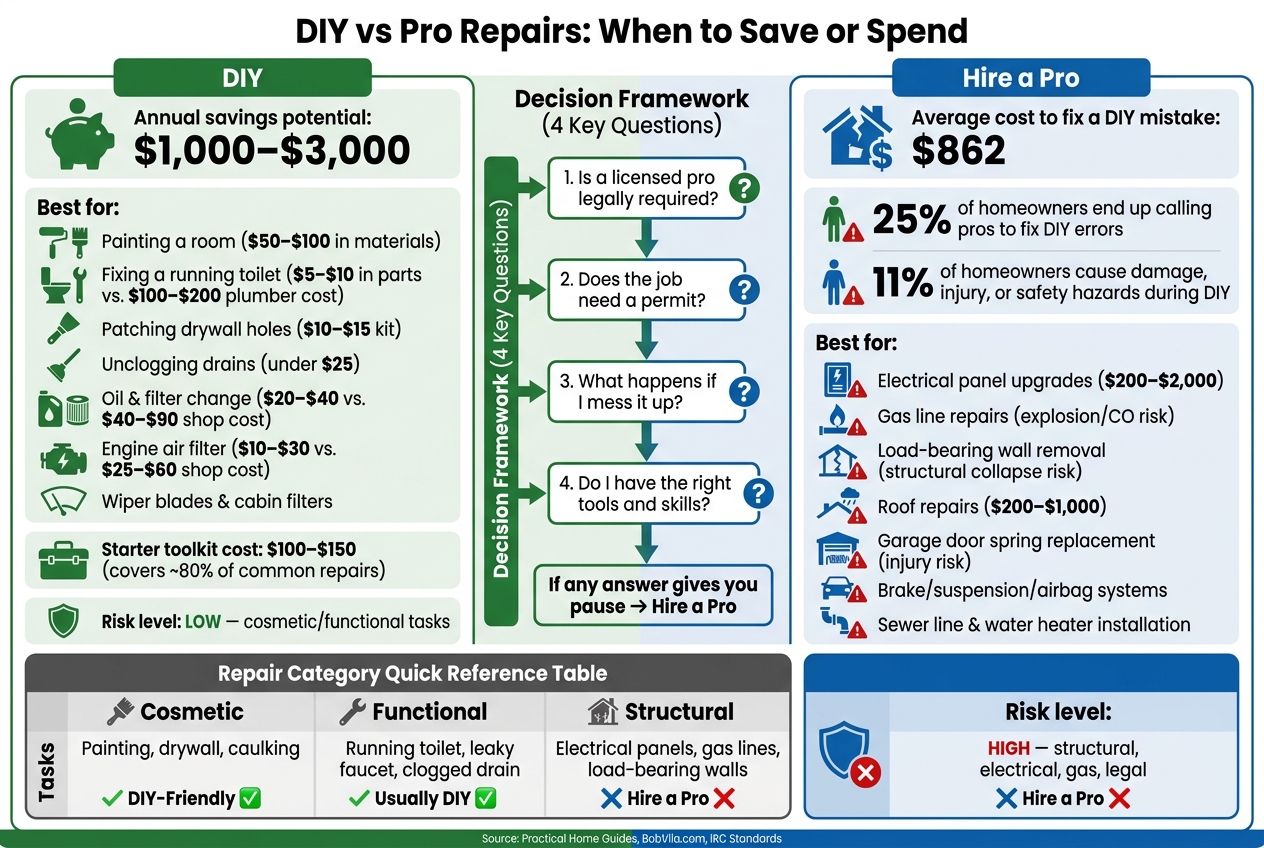
When deciding between DIY and hiring a professional for repairs, the key is understanding your skills, the risks, and the potential costs. DIY can save you $1,000–$3,000 annually on simple tasks like patching drywall or replacing a faucet. However, mistakes in complex repairs, such as electrical work or gas lines, can cost an extra $862 on average and pose safety risks.
Key Takeaways:
- DIY-Friendly Repairs: Painting a room, fixing a running toilet, or unclogging drains. These are low-risk and cost-effective.
- Hire a Pro For: Electrical panels, gas lines, structural changes, or advanced auto repairs. Mistakes here are costly and dangerous.
- Hidden Costs: DIY often requires tools, time, and may void insurance if not done correctly.
- Decision Framework: Ask yourself – Do I need a permit? What’s the risk if I mess up? Do I have the right tools and skills?
Balancing savings with safety is crucial. Start small, track your savings, and leave high-risk tasks to professionals.
DIY vs Pro Repairs: Cost Savings, Risks & Decision Guide
DIY or Hire a Pro? Don’t Make These Mistakes
sbb-itb-0a60575
Key Factors: DIY or Hire a Pro?
Building on the financial considerations discussed earlier, it’s essential to weigh these five core factors before deciding whether to tackle a project yourself or bring in a professional.
Assessing Risk and Safety
Think about this: What’s the worst that could happen if you mess up? A sloppy paint job might just look bad, but mistakes with wiring can be downright dangerous. In fact, amateur electrical work is a leading cause of residential electrical fires in the U.S.. Plus, 11% of homeowners admit to causing actual damage, injuries, or safety hazards during a DIY attempt.
Some projects come with higher risks than others. For example, working on a roof above a single story can be hazardous without proper safety gear. Homes built before 1978 may contain lead paint or asbestos, which need specialized handling. And let’s not forget gas lines or load-bearing walls – errors here can result in life-threatening situations or major structural damage. Beyond the risks, it’s also important to think about the hidden costs of DIY projects.
Comparing Costs and Hidden Expenses
It’s tempting to compare a contractor’s quote with the cost of materials and assume you’ll save money by doing it yourself. But that’s not the whole picture. DIY projects often come with hidden expenses, like the cost of specialty tools you might only use once, multiple trips to the hardware store, and the time you’ll spend on the project.
There’s also the issue of warranties and insurance. Professional work is often covered by warranties, and licensed contractors are typically insured if something goes wrong. On the other hand, DIY repairs usually don’t come with these protections. In some cases, unpermitted DIY work can even lead to denied insurance claims if an issue arises later. Another key factor to consider is whether your skills are up to the task.
Evaluating Your Skills and Tools
Being realistic about your abilities is critical. There’s a big difference between observing how something is done and actually meeting code standards. For home repairs, it’s not just about completing the task – it’s about meeting the standards set by the International Residential Code (IRC), which is used in some form by 49 U.S. states.
When it comes to auto repairs, diagnosing the actual problem is often more challenging than swapping out parts. Replacing a part based on symptoms alone, without identifying the root cause, is a common and costly mistake. If you’re unsure about your diagnostic skills, hiring a professional – who typically charges $110 to $170 per hour for diagnostics – might save you money in the long run.
Time Constraints and Repair Urgency
Sometimes, time isn’t on your side. A leaking pipe, a broken furnace in the middle of winter, or a car that won’t start when you need to get to work – these are situations where you can’t afford a learning curve. When urgency is a factor, a professional’s speed and reliability often outweigh the cost, especially if delaying the repair could lead to secondary damage, like water seeping behind walls.
Permits, Licenses, and Insurance Rules
Certain jobs – like working on gas lines, replacing main electrical panels, or making structural changes – are legally restricted to licensed professionals in most areas. Skipping required permits isn’t just a minor oversight; it can lead to failed inspections, complications when selling your home, or even voided homeowner’s insurance if something goes wrong. Always check with your local building department to understand what permits are needed and avoid costly setbacks.
Repairs You Can DIY: Safe and Affordable Tasks
When it comes to home and car repairs, tackling certain tasks yourself can save you a significant amount of money without compromising safety. The key is to focus on straightforward projects while leaving the complex or hazardous ones to the pros.
"The sweet spot for most homeowners is handling the safe, common repairs yourself while hiring professionals for the dangerous, complex, or permit-required work." – Beth Sullivan, Founder & Editor-in-Chief, Practical Home Guides
Home Repairs
Some home repairs are not only beginner-friendly but also cost-effective. For instance, replacing a worn flapper valve in a running toilet costs just $5–$10, compared to the $100–$200 you’d pay a plumber. Similarly, a leaky faucet often just needs a new O-ring or seat washer, which typically costs $5–$25 for parts.
You can patch small drywall holes (up to 6 inches) with a $10–$15 repair kit or unclog drains using tools that cost under $25. Painting a room is another great DIY project – materials usually run about $50–$100 per room, which is far less than hiring a professional.
Investing in a basic home toolkit is a smart move. Essentials like an adjustable wrench, screwdriver set, tape measure, stud finder, voltage tester, plunger, and caulk gun will cost around $100–$150. This initial investment often pays for itself after completing just one or two repairs.
Basic Car Maintenance
Car maintenance can also be a source of savings if you stick to simple tasks. To determine if a repair is DIY-friendly, ask yourself three questions: Can you clearly see the part? Can you complete the job with standard hand tools and no complex calibration? And, if something goes wrong, is the worst outcome just an inconvenience rather than a safety issue? If the answer to all three is "yes", you’re likely good to go.
Tasks like replacing wiper blades, cabin and engine air filters, or topping off fluids are perfect examples of safe DIY projects. Oil changes are also doable if you have the right equipment, such as a jack, jack stands, and a drain pan. Just remember – never work under a car supported only by a hydraulic jack.
Here’s a quick look at the potential savings:
| Maintenance Task | Typical DIY Cost | Typical Shop Cost | Estimated Savings |
|---|---|---|---|
| Oil & Filter Change | $20–$40 | $40–$90 | $20–$50 |
| Engine Air Filter | $10–$30 | $25–$60 | $15–$30 |
| Battery Replacement | $50–$150 | $80–$200 | $30–$50 |
| Wiper Blades | $50 (F-150) / $82 (Highlander) | Higher with labor | Varies |
Before changing your oil, check for local coupons – sometimes professional services are priced close to DIY supply costs.
Tracking and Using Your DIY Savings
DIY repairs can lead to annual savings of $1,000–$3,000. To make the most of this, keep a maintenance log where you record each repair, the date, parts cost, and the estimated cost of professional service. This not only tracks your savings but also creates a helpful record for home or vehicle maintenance.
Once you’ve accumulated a few months of savings, consider putting that money toward an emergency fund, paying off debt, or starting an investment account. Treating your DIY savings as genuine income – rather than letting them blend into everyday expenses – can turn these small wins into long-term financial benefits.
Repairs to Leave to the Pros
Some home and auto repairs are just too risky or complex to tackle on your own. While DIY fixes can save money, certain projects carry risks that could lead to serious injuries, costly damages, or even voided insurance claims. When safety and expertise are on the line, it’s best to call in a professional.
Structural and High-Risk Repairs
When it comes to your home’s structure, even small mistakes can have massive consequences. For example, removing a load-bearing wall without consulting a structural engineer or licensed contractor can compromise the integrity of your home and violate local building codes. Roof repairs are another area where professional help is essential, with costs typically ranging between $200 and $1,000 for expert services.
"Some projects can be costly or do more harm than good if attempted without the right professional expertise." – Mike Bidwell, CEO of Neighborly
Garage door spring replacements might look straightforward, but the springs are under extreme tension. A single error can result in severe injuries. Older homes, especially those built before 1978, often contain lead-based paint or asbestos insulation. Disturbing these materials without certified abatement professionals can release harmful toxins into your home. These examples highlight why some projects should always be left to trained experts.
Electrical, Gas, and Plumbing Systems
Electrical systems are another area where DIY attempts can lead to disaster. Faulty wiring is a leading cause of house fires in the U.S.. For tasks like upgrading wiring, installing new circuits, or working on your main electrical panel, hire a licensed electrician. Professional panel work typically costs between $200 and $2,000, depending on the complexity.
Gas line repairs are even riskier. Mistakes here can lead to explosions or carbon monoxide leaks, making it critical to rely on licensed professionals. Similarly, major plumbing jobs – like sewer line repairs or water heater installations – often require permits and inspections. If water damage is traced to unlicensed plumbing work, your insurance company may deny any claims.
"If you don’t obtain the proper permits or don’t have the fixture installed by a professional, the insurance company has grounds to deny your claim in the event of a house fire." – BobVila.com
These systems are not only complex but also tightly regulated, making professional expertise a must.
Advanced Auto Repairs
When it comes to your vehicle, safety should always come first. Certain repairs, like brake systems, suspension components, and airbag replacements, demand precision tools and technical knowledge that go beyond the capabilities of a typical home garage. For instance, improperly calibrated brakes can lead to accidents, while suspension issues can affect your car’s handling and tire wear.
| Repair Type | Why Professionals Are Needed | Risk if DIY’d |
|---|---|---|
| Brake system | Requires precision calibration | Brake failure, potential accidents |
| Suspension components | Needs alignment tools and expertise | Poor handling, increased tire wear |
| Airbag systems | Requires manufacturer-specific tools | Accidental deployment, injury |
| Electrical panel (home) | Must meet NEC standards | Fire hazards, insurance issues |
| Gas lines | Licensed work required by law | Explosion, carbon monoxide poisoning |
| Load-bearing walls | Requires structural engineer assessment | Structural collapse |
In auto repairs, the stakes are high – errors can endanger not just your safety but also the lives of others on the road. For these reasons, it’s better to rely on trained professionals for advanced vehicle repairs.
A Simple Framework for Deciding: Save or Spend?
Figuring out whether to tackle a repair yourself or hire a professional doesn’t have to be complicated. With a straightforward approach, you can make confident decisions every time.
Sorting Repairs by Type
Here’s a quick way to categorize repairs and decide if they’re DIY-friendly:
| Category | Examples | DIY-Friendly? |
|---|---|---|
| Cosmetic | Painting, patching drywall, caulking | Yes – low risk, easily fixable |
| Functional | Running toilet, leaky faucet, clogged drain | Usually – basic tools, big savings |
| Structural | Electrical panels, gas lines, load-bearing walls | No – call a licensed professional |
The main difference between these categories? The stakes. A sloppy paint job might be annoying, but a wiring mistake could lead to serious hazards. As Beth Sullivan, Founder & Editor-in-Chief of Practical Home Guides, explains:
"The most expensive DIY mistake is starting a project you can’t finish, then having to hire a professional to fix your work and complete the job."
Before diving into any repair, ask yourself four key questions: Is a licensed pro legally required? Does the job need a permit? What happens if I mess it up? Do I have the right tools? If any answer gives you pause, it’s probably safer to bring in an expert. This method ensures you save money without compromising safety or compliance.
Setting Your Own DIY Rules
Creating a personal set of DIY rules can help you make smarter choices, especially in high-pressure situations. Write down three lists: what you’ll always DIY, what you’ll always hire out, and what requires getting quotes before making a decision.
For example:
- Always DIY: Fixing a running toilet ($5–$10 in parts vs. $100–$200 for a plumber), patching small drywall holes, or painting a room ($50–$100 DIY vs. $500–$1,000 professionally).
- Never DIY: Anything involving the main electrical panel, gas lines, or load-bearing walls. These are non-negotiable.
Having these rules in place can prevent costly mistakes. Even if you’re legally allowed to handle a repair yourself, it must comply with International Residential Code (IRC) standards. Unpermitted or non-compliant work could void your homeowner’s insurance or cause problems when selling your home. These considerations highlight the balance between risk, cost, and legal obligations.
Once your rules are set, focus on gradually improving your DIY skills.
Building Your DIY Skills Over Time
Start small and work your way up. Simple projects like replacing a toilet flapper ($5–$10) are perfect for beginners – they’re quick, low-risk, and can save you $100–$200. From there, you can try tasks like fixing a leaky faucet, unclogging drains, or swapping out a light fixture.
Investing in a basic toolkit ($100–$150) is another smart move. It covers about 80% of common repairs and pays for itself the first time you skip calling a plumber.
One tip for tackling new projects: follow the "two-video rule." Watch at least two different YouTube tutorials on the repair before starting to catch potential pitfalls. Each successful project builds your confidence and skill set, helping you save more over time.
Conclusion: Balancing Savings and Safety
The choice between tackling a project yourself or hiring a professional often boils down to weighing cost savings against potential risks. Every repair decision boils down to one question: What could go wrong, and how much will it cost to fix? Low-risk tasks, like painting or patching drywall, usually have straightforward consequences – an imperfect finish that’s easy and inexpensive to correct. But when it comes to more complex systems like electrical work, plumbing, or gas lines, the risks are far less obvious and can lead to significant damage or expenses down the line.
For homeowners confident in managing basic repairs, the rewards can be substantial, with annual savings ranging from $1,000 to $3,000. However, these savings only materialize when you stay within your skillset. Statistics show that 25% of homeowners end up calling in professionals to fix DIY mistakes, with these corrections costing an average of $862 in additional fees. And it’s not just about the money – there are legal and insurance implications to consider.
Wells Insurance highlights a critical risk:
"If faulty DIY wiring sparks a fire, your insurer might deny the claim because it wasn’t done by a licensed electrician."
Non-compliant repairs can also complicate property sales, lower your home’s value, or require expensive remediation efforts.
To navigate these challenges, it’s essential to adopt a thoughtful strategy. Take on low-risk projects yourself to save money, but leave high-risk repairs to licensed professionals. This approach not only protects your home and finances but also ensures compliance with legal and insurance requirements. Don’t forget to keep detailed records of invoices and permits – they can be invaluable for filing insurance claims or preserving your home’s resale value.
FAQs
How do I know if a repair needs a permit?
When a repair involves modifications to structural, electrical, plumbing, or mechanical systems, a permit is usually required. These updates often need approval and inspections to ensure they comply with local building codes. Always consult your local building department to understand the exact requirements before beginning any work.
What DIY work can void my homeowner’s insurance?
DIY electrical projects or unapproved modifications can put your homeowner’s insurance at risk. If the work doesn’t comply with local building codes or results in damage – like a fire or injury – your insurance might not cover the repairs. Most insurance policies require that all work meets code standards, and unpermitted or faulty work could lead to denied claims.
Which DIY repairs add the most resale value?
Making simple, do-it-yourself repairs can be a great way to increase your home’s resale value. These projects often focus on improving the home’s look, functionality, or energy efficiency without the need for permits or risking safety. For instance, giving walls a fresh coat of paint, swapping out outdated fixtures, or handling small plumbing fixes can make a noticeable difference.
However, it’s wise to steer clear of major repairs, like electrical or structural work. These tasks are best left to professionals to avoid safety hazards or potential legal issues. Instead, stick to manageable, budget-friendly projects that are done properly and enhance the overall appeal of your home.
Related Blog Posts
- 7 Ways to Pay Off Credit Card Debt Faster
- Budget Not Working? 5 Common Mistakes to Fix Now
- Needs vs Wants: Budgeting for Major Purchases
- Why Budgets Fail: Common Mistakes Explained

Karla Moss is a CPA and former startup Controller who spent 15 years managing finance at the executive level — including inside a company that grew to unicorn status. She founded Karla & Co. to bring real-world financial clarity to everyday money decisions. She’s based in Phoenix, AZ and writes from personal experience as much as professional expertise.