
If your child is under 18, I’d freeze their credit at all three bureaus now. Child identity fraud hit about 915,000 kids in one year, and 67% of those cases involved someone the family knew.
Here’s the short version:
- I can place a child credit freeze for free
- I need to contact Equifax, Experian, and TransUnion separately
- I usually need:
- My photo ID
- Proof of address
- My child’s birth certificate
- My child’s Social Security card
- Proof I can act for my child
- If no credit file exists, the bureau can create a protected file just to hold the freeze
- A freeze helps block new credit accounts
- It does not stop tax fraud, medical ID misuse, or fraud on accounts that already exist
A few timing points matter too. After a bureau gets the request, it must place the freeze within 3 business days and send confirmation within 5 business days. I’d keep every letter, PIN, or reference number in a safe place.
Bottom line: if I want to cut the risk of someone using my child’s SSN to open credit, this is one of the first steps I’d take.
| Bureau | How to request it | Main note |
|---|---|---|
| Equifax | Mail form + documents | Uses a minor freeze form |
| Experian | Mail form + documents, or upload documents online | May ask for up to 2 years of prior addresses |
| TransUnion | Mail a written letter + documents | No standard minor freeze form |
The rest of the article walks through who can file, what documents to send, where to send them, and what to do after the freeze is in place.
How To Freeze Your Child’s Credit For Free
sbb-itb-0a60575
Before You Start: Eligibility and Required Documents
Now that you know who can file, it’s time to gather the exact paperwork each bureau wants.
When you can freeze a child’s credit
First, make sure you know who can submit the request. If your child is under 16, a parent or legal guardian can usually ask for the freeze. If your child is 16 or 17, they can usually handle it on their own.
If a bureau doesn’t already have a credit file for your child, it will set up a protected credit file so the freeze can be added. That file exists only to hold the freeze. It can’t be used to open accounts.
Documents you need for yourself, your child, and your authority
You’ll need three types of proof: your identity, your child’s identity, and proof that you can act for your child.
Use this checklist before you mail anything.
| Document Category | Parent or Guardian | Child |
|---|---|---|
| Photo ID | Government-issued ID (driver’s license or passport) | – |
| Identity | Social Security card | Social Security card (copy) |
| Proof of Address | Recent utility bill, bank statement, or insurance statement | – |
| Birth Record | – | Birth certificate (copy) |
| Proof you can act for the child | Birth certificate or court order | – |
A birth certificate shows parentage. A court order shows guardianship.
"A security freeze… is the strongest defense against certain types of identity theft." – California Department of Justice
Send photocopies only, and keep your originals. It’s smart to use certified mail with delivery confirmation when you send your packet.
Information to gather before you submit
Before you seal the envelope, gather these details for both you and your child:
- Full legal names
- Social Security numbers
- Dates of birth
- Current addresses
Experian also asks for up to two years of previous addresses for the parent or guardian, so have that ready too.
Put together one packet for each bureau. If you’re freezing credit for more than one child, each child needs a separate full set of documents. If something is missing or hard to read, the bureau will mail you and ask for more information.
Once the packets are ready, send each one to the bureaus separately.
How to Freeze Your Child’s Credit With All Three Bureaus
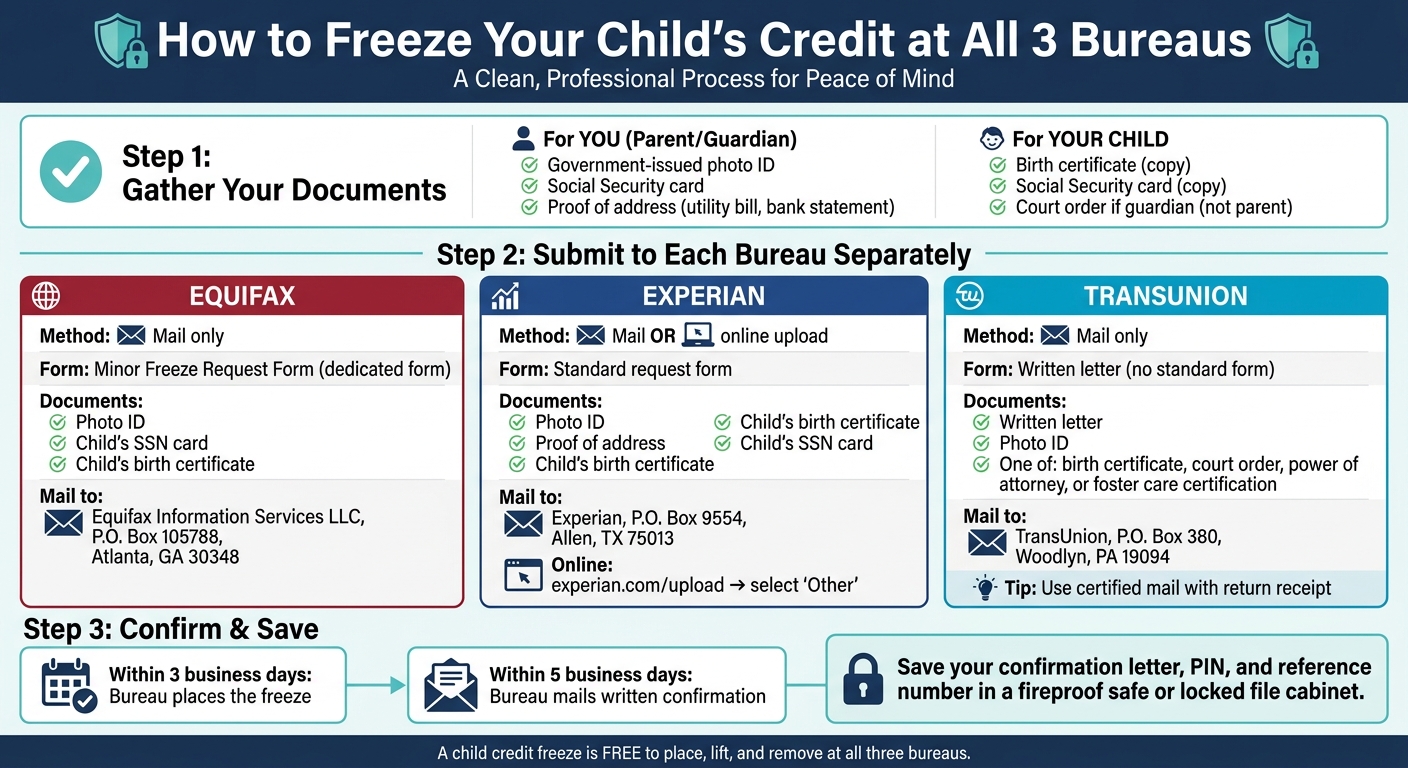
How to Freeze Your Child’s Credit: Step-by-Step Guide
Once your paperwork is ready, send a separate packet to each bureau. You need to place the freeze with Equifax, Experian, and TransUnion one by one.
After a bureau gets your request, it must place the freeze within three business days and mail written confirmation within five business days.
The bureau-by-bureau steps below help you send a complete packet the first time.
Equifax: Fill out the minor freeze form and mail your documents
Equifax uses a dedicated Minor Freeze Request Form for child credit freezes. Include copies of your government-issued ID, your child’s Social Security card, and your child’s birth certificate. A birth certificate that shows you’re the parent can also serve as proof that you can act for your child.
Mail the full packet to Equifax Information Services LLC, P.O. Box 105788, Atlanta, GA 30348.
Experian: Complete the form and send your packet by mail

Experian asks for a government-issued ID and proof of address from the parent, along with the child’s birth certificate and Social Security card.
If you’re mailing it the standard way, send it to Experian, P.O. Box 9554, Allen, TX 75013. For overnight delivery, use 701 Experian Parkway, Allen, TX 75013.
Experian also has a digital upload option at experian.com/upload. To use it, submit scanned documents and choose "Other" as the request reason.
TransUnion: Send a letter with ID and proof you can act for the child
TransUnion doesn’t use a pre-printed form for this step. Instead, write a letter requesting a child credit freeze and include it with your documents. That’s the main difference here: you send a written letter instead of filling out a bureau form.
For proof that you can act for the child, include one of these:
- Birth certificate
- Court order
- Power of attorney
- Foster care certification
Send the packet to TransUnion, P.O. Box 380, Woodlyn, PA 19094. It’s smart to use certified mail with return receipt.
After You Submit: Confirm, Manage, and Monitor the Freeze
Once each bureau puts the freeze in place, save every confirmation detail and keep everything locked down.
How to confirm the freeze is active
Each bureau must place the freeze within three business days and mail written confirmation within five business days after the freeze is placed. That letter will often include a reference number, PIN, or password you’ll need later if you want to remove the freeze.
Put the confirmation letter and PIN somewhere safe and permanent, like a fireproof safe or a locked file cabinet. This isn’t the kind of paperwork you want to misplace and scramble to find two years from now.
How to lift or temporarily thaw the freeze
The freeze stays in place until someone removes it. At 16 or 17, your child may be allowed to ask for removal. At 18, they can usually handle it on their own.
When your child needs access to credit for something like a student loan, first credit card, apartment, or utility account, you’ll need to contact Equifax, Experian, and TransUnion separately. And here’s the catch: a child’s Protected Consumer Freeze often can’t be temporarily thawed. In many cases, you may have to remove it completely and then place it again later.
What to do if you find signs of fraud
A freeze helps block new credit activity, but it doesn’t fix fraud that may have started earlier. So keep an eye out for signs that your child’s information is already being used. Common red flags include pre-approved credit offers, collection calls, or IRS notices sent to your child.
| Warning Sign | What It May Mean |
|---|---|
| Pre-approved credit offers | A credit file exists in the child’s name |
| IRS notice about unpaid taxes | Someone used the child’s SSN for employment or tax filings |
| Collection calls for unknown bills | Unauthorized accounts have gone into default |
| Denied student loan or apartment application | Fraudulent accounts have likely resulted in a negative credit history |
If you see any of these signs, file a report at IdentityTheft.gov, contact the company that opened the account, and ask for written confirmation that the account is fraudulent. You should also request an IRS Identity Protection PIN for your child.
Conclusion: Key Steps to Protect Your Child’s Credit
A child credit freeze is free to place, lift, and remove at Equifax, Experian, and TransUnion. Once you’ve sent all three requests, your next job is simple: keep the confirmations and watch for any signs of fraud.
This process involves a lot of paperwork. It’s smart to get it all in order now so the freeze goes through on the first try. Keep copies of your ID, your child’s birth certificate, Social Security card, and proof of authority ready for each bureau request. Mail a separate request to each bureau, and never send original documents.
After that, it mostly comes down to recordkeeping. Save each bureau’s confirmation and PIN in a secure file or a safe. That way, if your child needs credit access later, you won’t be digging through drawers trying to find old paperwork.
The freeze stays in place until you remove it, which means your child’s credit file remains protected until there’s a legitimate need to use it.
FAQs
Should I freeze my child’s credit before there’s a problem?
Yes. Freezing your child’s credit is a smart step to help stop identity theft and unauthorized accounts.
Most minors don’t have a credit report yet. So when you request a freeze, the credit bureaus can create a file if needed and place the freeze right away. Agencies like the FTC and CFPB recommend doing this early, before your child starts building credit.
What if my child doesn’t have a credit file yet?
That situation is common, and you can still ask for a freeze. If your child doesn’t already have a credit file, the credit bureaus must create one and place a security freeze on it right away.
To finish the request, you’ll need documents that prove:
- your identity
- your child’s identity
- your status as a parent or legal guardian
How do I remove the freeze when my child needs credit?
To remove or temporarily lift your child’s credit freeze, you need to contact Experian, TransUnion, and Equifax one by one. There’s no single form or shared process, so you’ll handle each credit bureau on its own.
In most cases, you’ll also need the PIN or password that was set up when the freeze was placed. That detail matters. Without it, the process can slow down.
A parent or legal guardian usually has to make the request in writing and include documents that prove both identity and the relationship to the child. Once your child turns 16, they can usually ask for the unfreeze on their own.
Related Blog Posts
- Credit Score Estimator to Boost Your Rating
- 10 Factors to Consider When Choosing a Guardian
- How to Cancel Paid Credit Monitoring Services
- 5 Common Beneficiary Mistakes To Avoid

Karla Moss is a CPA and former startup Controller who spent 15 years managing finance at the executive level — including inside a company that grew to unicorn status. She founded Karla & Co. to bring real-world financial clarity to everyday money decisions. She’s based in Phoenix, AZ and writes from personal experience as much as professional expertise.