
Head of Household can lower your 2026 tax bill, but only if you pass all 3 IRS tests. The big ones are simple: you must be unmarried or treated as unmarried on December 31, 2026, you must pay more than 50% of home costs, and you must have a qualifying person.
Here’s the short version:
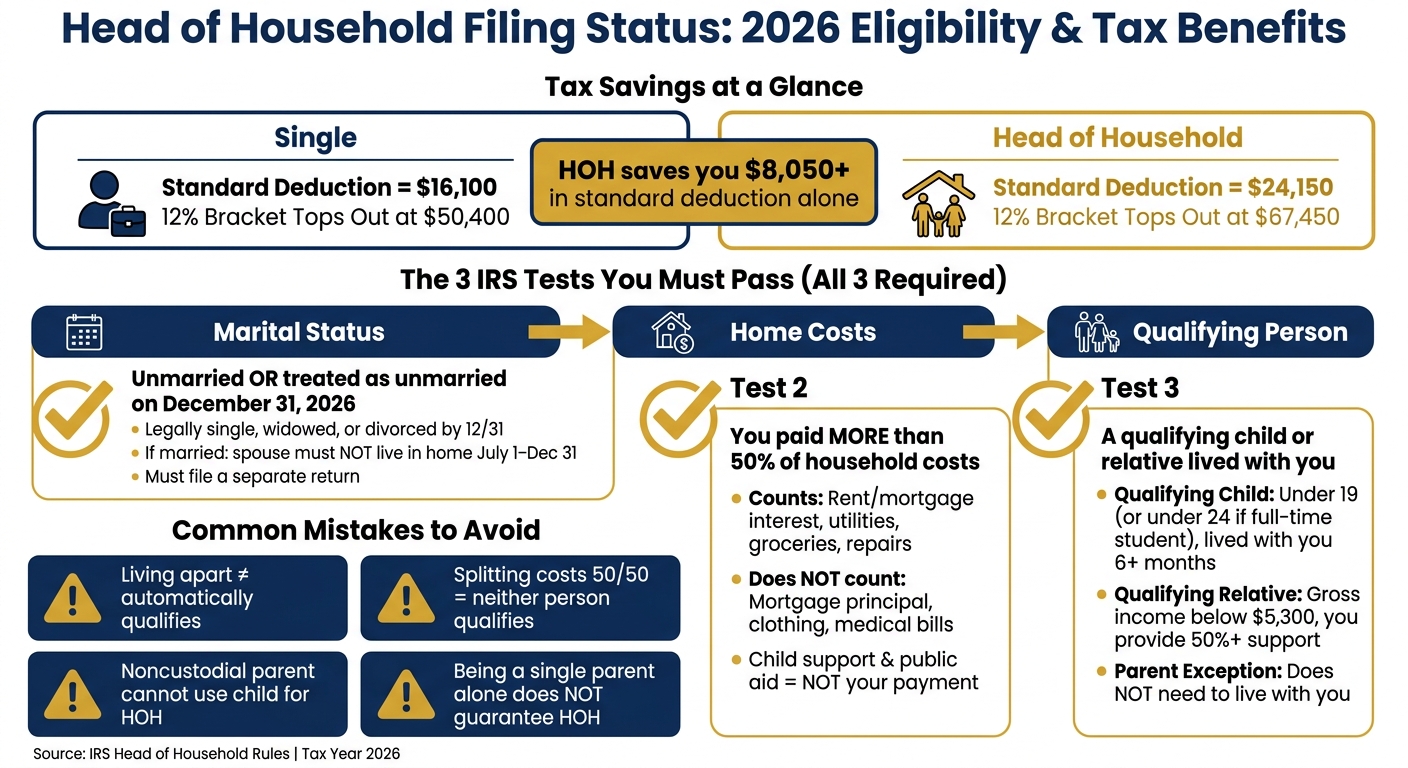
- Standard deduction: $24,150 for HOH vs. $16,100 for Single
- Marital test: Your status on 12/31/2026 controls
- Cost test: You must pay more than half of household costs
- Qualifying person test: Usually a child who lived with you more than half the year, or in some cases a dependent parent
- Common mistake: Being a single parent does not mean you qualify by default
A few rules trip people up fast:
- If you’re still legally married, living apart by itself is not enough
- If your spouse lived in your home any time from July 1 through December 31, the “treated as unmarried” rule usually fails
- If you split home costs 50/50, neither person qualifies
- Child support, public aid, and roommate money may count toward home costs, but not as your own payment
- A noncustodial parent can’t use the child for HOH just because they claim the child as a dependent
| Test | What I need to check |
|---|---|
| Marital status | Was I unmarried, or treated as unmarried, on December 31, 2026? |
| Home costs | Did I pay more than 50% of keeping up the home? |
| Qualifying person | Did my child, or another allowed relative, meet the IRS rules? |
If I’m close on any one of these, I should slow down before filing. HOH is worth more than $8,000 in extra standard deduction compared with Single, but filing under the wrong status can lead to IRS notices, added tax, interest, and penalties.
Head of Household vs. Single Filing Status: 2026 Tax Benefits & Eligibility
Head of Household vs Single EXPLAINED BY A CPA
sbb-itb-0a60575
Step 1: Check Your Marital Status as of December 31
The IRS looks at your marital status on December 31 to decide if you can file as Head of Household. That’s the starting point.
You can’t claim Head of Household unless you were unmarried at the end of the year, or the IRS treats you as unmarried.
What It Means to Be Unmarried at Year-End
You’re considered unmarried if you were single, widowed and not remarried, or divorced with a final decree of divorce or separate maintenance by December 31.
That last part matters. If your divorce decree is still nonfinal, the IRS still sees you as married. And simply living apart doesn’t change that. If your marriage has not ended under state law, you’re still married for tax purposes.
When a Married Person Can Be Treated as Unmarried
There’s one big exception. A married person may still be treated as unmarried for Head of Household if all four of these rules are met:
"Even if you were legally married at the end of the tax year, the IRS will consider you to be unmarried for purposes of the Head of Household filing status if you meet certain qualifications." – Kelly Wallace, CPA
| Condition | What’s Required |
|---|---|
| Return type | You must file a separate return – not Married Filing Jointly |
| Household costs | You paid more than half the cost of keeping up your home for the year |
| Spouse residency | Your spouse did not live in your home from July 1 through Dec. 31 |
| Qualifying person | A qualifying child, stepchild, or foster child lived in your home for more than half the year |
The spouse residency rule is strict. Your spouse cannot live in your home at any time from July 1 through December 31. Even one day back in the home breaks the test.
There’s also a limit on who counts as the qualifying person here. This rule works only if that person is your child, stepchild, or foster child. It does not work with a qualifying parent.
There’s one more case to know. If your spouse was a nonresident alien at any point during the year, the IRS treats you as unmarried for HOH if you have another qualifying person and paid more than half the cost of keeping up the home.
If you meet this test, move to Step 2 and check whether you paid more than half the home’s costs.
Step 2: Confirm You Paid More Than Half the Home’s Costs
The IRS says you must have paid more than half the total cost of keeping up your home for the year. So first, sort out home costs from personal spending. That part matters.
Which Costs Count and Which Do Not
For the HOH test, only costs tied to keeping up the home count.
| Counts as cost of keeping up the home | Does not count |
|---|---|
| Rent or mortgage interest | Mortgage principal |
| Property taxes and home insurance | Life insurance or health insurance |
| Utilities (gas, electric, water, trash) | Transportation and car insurance |
| Groceries eaten in the home | Restaurant meals and clothing |
| Repairs and maintenance | Education, medical bills, and vacations |
If you own your home outright, you can’t count fair rental value. Only actual out-of-pocket costs count.
How to Handle Shared Bills, Child Support, and Government Benefits
Add up all qualifying household costs, no matter where the money came from. Then look at how much you paid. To pass the test, your share must cover more than half of the total.
A few common trouble spots:
- Child support, public assistance, and roommate payments count toward the household total, but not as your own payments.
- If you split costs 50/50, neither person qualifies.
- Keep receipts, bills, and other records that show who paid what.
Once your share clears that test, the next step is to see whether the person living in your home qualifies.
Step 3: Confirm You Have a Qualifying Person
The last check is simple on paper, but this is where many people trip up: you need one person who meets the IRS test for Head of Household. The IRS puts that person into one of two groups: a qualifying child or a qualifying relative.
Qualifying Child Rules for Head of Household
For Head of Household, a qualifying child has to pass four IRS tests: relationship, age, residency, and support.
The relationship test covers your son, daughter, stepchild, foster child, sibling, half-sibling, step-sibling, or a descendant of any of them, like a grandchild, niece, or nephew.
The age test works like this:
- The child must be under 19 at the end of the year
- Or under 24 if they were a full-time student for at least five months of the year
- There is no age limit if the child is permanently and totally disabled
The residency test means the child must live with you for more than half the year. But life happens. Time away for school, medical treatment, or military service usually still counts as living with you, as long as the child is expected to come back.
There’s also the support test. The child cannot have paid more than half of their own support.
One point matters a lot for divorced or separated parents. If you are the custodial parent, meaning the child spent more nights with you, you may still file as Head of Household even if you signed Form 8332 and gave the other parent the dependency claim. The noncustodial parent cannot use that same child to file as Head of Household.
If no child fits these rules, the next place to look is a qualifying relative.
Qualifying Relative Rules and the Special Parent Exception
If you don’t have a qualifying child, some relatives can still help you qualify. For 2026, most qualifying relatives must have gross income below $5,300, and you must provide more than half of their support. In most cases, that person also must have lived with you for more than half the year.
The big exception is a parent.
A dependent mother or father does not have to live with you. You can still meet the Head of Household rule if you pay more than half the cost of keeping up the parent’s main home and you’re able to claim that parent as a dependent.
If you’re paying a parent’s nursing home bills, keep every invoice and proof of payment. That paper trail can help show that you covered more than 50% if the IRS asks.
Qualifying Child vs. Qualifying Relative: Key Differences
These two groups sound close, but the fine print matters.
| Category | Who may qualify | Must live with you more than half the year? | Key HOH rule |
|---|---|---|---|
| Qualifying Child | Son, daughter, stepchild, foster child, sibling, or descendants such as a grandchild, niece, or nephew | Yes, except for temporary absences | Must be under 19, or under 24 if a full-time student; no age limit if permanently disabled |
| Qualifying Relative (Other) | Grandparents, siblings, aunts, uncles, or in-laws | Yes | Gross income must be below $5,300 for 2026, and you must provide more than half of their support |
| Qualifying Relative (Parent) | Mother or father | No | Pay more than half the parent’s home costs and be able to claim the parent as a dependent |
One last line to keep in mind: boyfriends, girlfriends, and roommates usually do not count. For this rule, the IRS wants a listed family relationship.
Edge Cases, Tax Impact, and a Final Eligibility Checklist
Shared Custody, Multiple Adults in One Home, and Temporary Absences
These edge cases usually come down to the residency and support tests.
In plain English, the big issues are where the child lived and who paid the costs tied to the home and care. Only one parent can claim Head of Household for the same child. The custodial parent is the one the child lived with for the greater number of nights during the year. If the number of nights is exactly the same, the parent with the higher adjusted gross income (AGI) gets the tiebreaker.
If two adults live in the same home, both can qualify only if each keeps a separate household and each has a separate qualifying person. And if two people split household costs exactly 50/50, neither qualifies. The rule is more than half, not half.
Temporary absences can still count as time lived with you. That usually includes time away for school, military service, medical care, business, vacation, or juvenile detention, as long as the person is expected to return. If your case feels close, that’s a sign to slow down and check each rule before filing.
Why HOH Matters and a Final Eligibility Checklist
If you meet the tests, HOH can cut your tax bill. It matters because it gives you a larger standard deduction and stretches the lower tax brackets. For 2026, the 12% bracket goes up to $67,450 for HOH filers, compared with $50,400 for Single filers.
Before you file, use this quick checklist:
- Marital status: Were you unmarried on December 31, 2026? If you were still legally married, did you file a separate return, and did your spouse stay out of your home for the full period from July 1 through December 31?
- Household costs: Did you pay more than half the cost of keeping up the home? Child support does not count as your own payment.
- Qualifying person: Did a qualifying child live with you for more than half the year, or did you meet the parent exception by paying more than half of your parent’s home costs?
When you’re not sure, the IRS Interactive Tax Assistant can help you work through your own facts before you file.
FAQs
Can I file as Head of Household if I’m legally married?
Yes – you may be able to file as Head of Household if the IRS treats you as unmarried for tax purposes.
To qualify, you must meet all of these rules:
- File a separate tax return
- Have a spouse who did not live in your home during the last six months of the tax year
- Pay more than half the cost of keeping up your home
- Have a qualifying child or dependent who lived with you for more than half the year
What if my child lived with me only part of the year?
To qualify for Head of Household, your child usually needs to live with you for more than half the year – that means over 183 days.
There’s some wiggle room for temporary absences. Time away for school, vacation, illness, military service, or a hospital stay usually still counts as long as the child is expected to return.
If your child lived with you for less than half the year, you generally don’t meet the residency rule unless the exception for divorced or separated parents applies.
Which household expenses count toward the 50% test?
For Head of Household, you must personally pay more than half of the total yearly cost of keeping up your home.
That means the money has to come from you, and it has to cover over 50% of the costs that keep the home livable and running. This includes expenses like:
- Rent
- Mortgage interest
- Property taxes
- Insurance
- Utilities
- Repairs
- Food eaten at home
- In-home domestic help
Some costs don’t count toward keeping up the home. These include personal expenses such as clothing, medical bills, education, life insurance, transportation, vacations, and the value of your own labor.
Related Blog Posts
- Roth IRA vs Traditional IRA: Which Is Right for You?
- What Credit Score Do You Need to Buy a House?
- 10 Common Tax Filing Mistakes To Avoid
- 5 Common Beneficiary Mistakes To Avoid

Karla Moss is a CPA and former startup Controller who spent 15 years managing finance at the executive level — including inside a company that grew to unicorn status. She founded Karla & Co. to bring real-world financial clarity to everyday money decisions. She’s based in Phoenix, AZ and writes from personal experience as much as professional expertise.