
Credit card debt can feel overwhelming, especially with high interest rates eating into your payments. But there are proven ways to tackle it faster and save money. Here’s a quick rundown of strategies to help you get ahead:
- Pay More Than the Minimum: Focus on high-interest cards first to lower your overall interest costs.
- Debt Avalanche Method: Prioritize debts with the highest interest rates to save the most money.
- Debt Snowball Method: Pay off smaller balances first for quick wins and motivation.
- Balance Transfer Cards: Move your debt to a 0% APR card to avoid interest for a set period.
- Personal Loans: Consolidate high-interest debt into a lower-rate loan for simpler payments.
- Cut Expenses & Boost Income: Free up cash by trimming spending and earning extra money.
- Use Windfalls: Apply bonuses, tax refunds, or unexpected income directly to your debt.
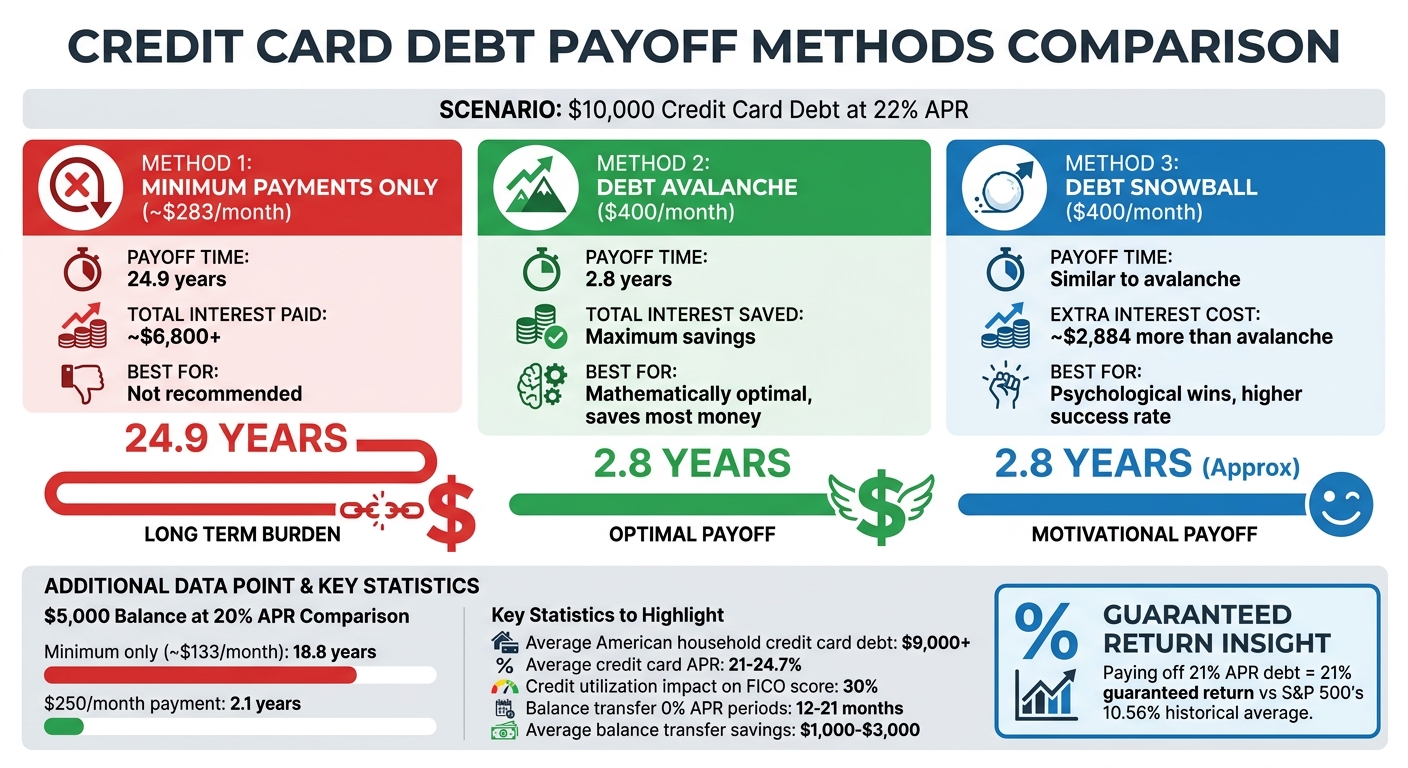
Credit Card Debt Payoff Methods Comparison: Avalanche vs Snowball vs Minimum Payments
1. Pay More Than the Minimum on High-Interest Cards
Effectiveness in Reducing Interest Payments
Paying more than the minimum on your credit cards can make a significant difference in reducing the overall interest you pay. Here’s why: when you chip away at the principal balance, you also lower the daily interest calculated on your debt. Over time, this can speed up the repayment process.
For example, let’s say you have a $2,000 balance at an 18% interest rate. If you stick to minimum payments, it could take over seven years to pay off, with around $1,700 going toward interest. Now imagine a $10,000 balance at a 22% APR – minimum payments could stretch repayment to nearly 25 years. But by increasing your monthly payment to $400, you could cut that timeline down to just 2.8 years.
Ease of Implementation for Individuals
This strategy doesn’t require financial expertise or special tools – it’s straightforward and easy to adopt. Start by identifying which of your credit cards has the highest APR; that’s the one to focus on first.
To free up extra cash, review your spending habits and look for areas to trim. Even redirecting $20–$100 per month can make a noticeable impact. Using a budgeting framework like the 50/30/20 rule can also help, where you allocate 50% of your income to necessities, 30% to discretionary spending, and 20% to savings and debt payments.
Another simple yet effective tip is to pay your bill as soon as possible. This reduces the compounding interest that builds daily. Making smaller payments multiple times a month can also help keep your balance – and interest charges – lower.
Potential for Accelerating Debt Repayment
Increasing your monthly payments can dramatically shorten the time it takes to eliminate debt. Whether you follow the Debt Avalanche method (focusing on the highest-interest debts first) or the Debt Snowball method (starting with the smallest balances), the results are clear. Let’s compare:
| Balance | APR | Monthly Payment | Estimated Payoff Time |
|---|---|---|---|
| $5,000 | 20% | Minimum only (~$133) | 18.8 years |
| $5,000 | 20% | $250 | 2.1 years |
| $10,000 | 22% | Minimum only (~$283) | 24.9 years |
| $10,000 | 22% | $400 | 2.8 years |
By focusing on your highest-APR card while making minimum payments on others, you can reduce borrowing costs and accelerate your path to being debt-free.
Long-Term Financial Impact
The benefits of paying more than the minimum go beyond saving on interest. By reducing your balance, you can improve your credit utilization ratio – the percentage of your available credit that you’re using. This ratio makes up about 30% of your FICO score, so lowering it can boost your credit score over time.
Additionally, as your debt decreases, your debt-to-income (DTI) ratio improves. Lenders often view a DTI ratio above 50% as a warning sign. A better DTI ratio not only strengthens your financial health but may also help you qualify for better loan terms in the future.
"If you make only the minimum payment, it could take years to pay off your credit card debt" – Consumer Finance Protection Bureau
Breaking free from the cycle of high-interest debt starts with prioritizing higher payments – especially on your most expensive cards.
sbb-itb-0a60575
2. Use the Debt Avalanche Method
Effectiveness in Reducing Interest Payments
The debt avalanche method is a powerful way to tackle debt by focusing on the balances with the highest interest rates first. Here’s how it works: list your debts by APR, make the minimum payments on all of them, and then put any extra cash toward the debt with the highest rate. This strategy minimizes the impact of compound interest on your costliest balances. For instance, consider a $5,000 credit card balance with a 24% APR. That balance racks up about $100 in monthly interest, and with a $120 minimum payment, only $20 actually goes toward the principal. On average, Americans carry about $6,500 in credit card debt at 24% APR, resulting in $1,560 in yearly interest costs. By attacking the highest-rate debt first, your extra payments work harder, often delivering better returns than traditional investments.
"The debt avalanche method eliminates your most expensive debts first, earning you returns on your money more quickly."
- Brianna McGurran, Freelance Journalist
Real-life results back this up. In one example, someone with $16,000 spread across three credit cards saved nearly $2,400 in interest by using the avalanche method instead of just paying the minimums. This approach sets you up for steady and effective debt elimination.
Ease of Implementation for Individuals
Starting with the avalanche method is simple. Begin by listing all your debts, including their balances, APRs, and minimum payments. Then, rank them by APR. Focus any extra funds on the debt with the highest rate while continuing to make minimum payments on the others. The challenge here is that if your highest-interest debt also has a large balance, it might take a while to pay it off. This requires patience and consistency. To stay motivated, consider using a debt payoff app to track your progress and see how much interest you’re saving.
Long-Term Financial Impact
Over time, the avalanche method not only helps you pay off debt faster but also reduces your total interest costs. For example, in a case involving $27,900 in total debt, the avalanche method saved $1,240 in interest compared to the snowball method and $6,800 compared to making only minimum payments. Beyond saving money, this strategy can improve your credit utilization ratio, which accounts for about 30% of your FICO score, by eliminating high-rate, high-balance debts first. Lowering your overall debt can also improve your debt-to-income ratio, potentially helping you qualify for better loan terms in the future.
"The avalanche method saves the most money in every scenario. There is no mathematical scenario where another ordering produces lower total cost."
- The Score Guide
3. Apply the Debt Snowball Method
How It Works and Why It’s Simple
The debt snowball method focuses on paying off your smallest debts first, regardless of their interest rates. Start by listing your debts from the smallest balance to the largest. Pay the minimum on all accounts, but direct any extra cash toward the smallest balance until it’s gone. Once the smallest debt is paid, take that payment and apply it to the next smallest balance. This approach is easy to manage with tools like spreadsheets or budgeting apps, giving you a sense of accomplishment early on. Those initial wins can fuel your motivation to tackle larger debts.
How It Speeds Up Debt Repayment
This method builds momentum quickly, helping you pay off debt faster than you might expect. For example, consider someone with $39,000 in debt. By adding an extra $250 per month, they could cut their repayment time down to 54 months instead of the 392 months it would take with minimum payments alone. Real-life success stories highlight its effectiveness: Taryn Williams paid off $16,000 by clearing five small loans in under two years, and George Kamel eliminated $40,000 of debt in just 18 months by focusing on his smallest balances. If you stick with it for at least a year, you’ll likely overcome the slower start and gain real momentum.
"The psychological advantage is real. Seeing a zero balance on even one account creates momentum that keeps you going."
- Adem Selita, The Debt Relief Company
The Bigger Picture: Financial Discipline
While the snowball method delivers quick wins, its real value lies in fostering better financial habits. It encourages discipline and smarter budgeting, aligning with the broader goal of taking control of your finances. That said, this approach might cost more in interest – about $2,884 extra on $39,000 of debt compared to the avalanche method. However, it often leads to higher success rates for paying off debt entirely. To make the most of this method, avoid using credit cards during the process, as new debt could undo your progress.
"Personal finance is 80% behavior and only 20% head knowledge."
- George Kamel, Personal Finance Expert, Ramsey Solutions
4. Transfer Balances to 0% Intro APR Cards
Effectiveness in Reducing Interest Payments
Balance transfer cards offer a promotional 0% APR for a period of 12 to 21 months. During this time, every payment you make directly reduces your principal balance, as there’s no interest to split your payment between principal and interest. Given that the average credit card interest rate is over 21% to 22% APR, this can lead to significant savings. For instance, transferring a $6,000 balance from a card with 22% APR to one with a 0% APR for 15 months could save you around $864 in interest, even after factoring in a 3% transfer fee. On average, those who use this method effectively save between $1,000 and $3,000 in interest charges.
"Balance transfer credit cards offer an introductory APR on transferred debt balances – usually 0% APR for several months after account opening. When you transfer a balance to these cards, you can use the intro period to pay down your balance without accruing additional interest."
- Kendall Little, Senior Writer, Credit Cards, Yahoo Finance
Ease of Implementation for Individuals
This method is most effective for individuals with good-to-excellent credit scores, typically 670 or higher. Most balance transfer cards charge a one-time fee of 3%–5% of the transferred amount. For example, transferring a $10,000 balance would cost between $300 and $500 in fees. Before applying, use "soft pull" prequalification tools to check if you qualify without impacting your credit score. Keep in mind, however, that banks generally don’t allow transfers between their own cards – you’ll need to move the balance to a card from a different issuer. Once approved, the transfer process usually takes 5 to 14 business days.
Potential for Accelerating Debt Repayment
To make the most of this strategy, divide your total balance (including fees) by the number of months in the promotional period to calculate how much you need to pay each month. For example, if you transfer $9,000 to a card with an 18-month 0% APR period, you’d need to pay $500 per month to clear the balance before the offer ends. Setting up automatic payments can help you stay on track and avoid late fees, which can trigger a penalty APR – often as high as 29.99% – and cancel the 0% rate. It’s also wise to avoid making new purchases on either card during this time, as this could increase your debt load.
Long-Term Financial Impact
While balance transfers can be a powerful tool, they require disciplined repayment to be effective. Consider this: if you only pay the minimum on a $10,000 balance at 21% APR, it could take about 29 years to pay off and cost nearly $17,000 in interest. A balance transfer offers a chance to eliminate debt faster, but only if you commit to paying it off during the promotional period. Once the 0% APR period ends, any remaining balance will typically revert to an interest rate between 18% and 28%. The biggest risk is falling back into old habits – if you start using the old card again, you could end up with twice the debt.
"A balance transfer is not a magic fix. It is a strategic financial tool that works powerfully when paired with discipline, a clear payment schedule, and a commitment to behavioral change."
- Marine Lafitte, Lead financial commentator, Millions Pro
This approach can be highly effective when paired with a solid repayment plan and mindful spending habits.
5. Consolidate Debt with a Personal Loan
Effectiveness in Reducing Interest Payments
Personal loans can offer much lower interest rates compared to credit cards – about 11.40% for a 24-month term versus an average of 21% on credit cards. This means more of your payment goes toward reducing the principal balance, rather than being swallowed up by interest.
For example, consolidating credit card debt into a personal loan can result in substantial savings. NerdWallet analyzed a case in December 2025, where a borrower with $10,000 in credit card debt at 23% APR, spread across four cards, was making minimum payments of $75 per card. It would take 4.5 years to pay off the debt, with $6,200 in interest paid. By switching to a personal loan at 15% APR, the borrower could save over $2,800 in interest and pay off the debt six months sooner.
"If you get a personal loan, more of your payment goes toward the principal balance rather than interest, helping you pay off your debt faster and with less total interest paid."
- Ryan Peterson, Personal Finance Writer, MoneyLion
Ease of Implementation
Getting a personal loan is relatively simple if your credit score is strong. Borrowers with scores above 670 are likely to qualify, while those above 740 can access the best rates. Start by comparing rates from lenders that use soft credit checks, as this won’t impact your credit score.
However, be aware of origination fees, which typically range from 1% to 6% of the loan amount. For a $10,000 loan, this translates to $100 to $600 upfront. Some lenders even streamline the process by paying your creditors directly. This straightforward approach aligns well with other debt repayment strategies, offering a clear and predictable path to becoming debt-free.
Accelerating Debt Repayment
Consolidation simplifies debt management by turning multiple balances into a single, fixed repayment plan. Personal loans come with consistent monthly payments and a set payoff date, typically between 2 and 7 years. This structure eliminates the uncertainty of credit card minimum payments, which can drag on for years.
Take this example: A borrower with $6,000 in credit card debt at 20% APR might spend over four years paying it off, with $2,830 in interest. Switching to a three-year personal loan at 10% APR, with a $193 monthly payment, reduces interest to $969, saving over $1,800 and shaving a year off the repayment timeline.
To save the most, choose the shortest repayment term you can afford. Setting up autopay can help you stay consistent, and some lenders even offer a small rate discount for doing so.
Long-Term Financial Impact
Consolidating debt with a personal loan not only simplifies repayment but also reinforces disciplined financial habits. Keep your paid-off credit cards open to maintain a low credit utilization ratio, but avoid racking up new debt. While applying for a loan may cause a slight dip in your credit score due to a hard inquiry, this is often outweighed by the benefits of improved utilization rates and consistent, on-time payments.
Additionally, paying off debt faster can improve your debt-to-income ratio, making it easier to qualify for future loans, such as a mortgage, when the time comes.
6. Cut Expenses and Increase Income for Extra Payments
Effectiveness in Reducing Interest Payments
Trimming your expenses and boosting your income can make a big difference when tackling credit card debt. Why? Every extra dollar you put toward your balance reduces the principal, which means less interest piling up over time. With average credit card interest rates hitting 24.7% in mid-2024, even small additional payments can save you a lot in the long run. Given that the average American household carries over $9,000 in credit card debt, cutting unnecessary spending and finding ways to earn extra cash can help you escape the cycle of minimum payments that barely make a dent in your balance.
Ease of Implementation
Start by reviewing your bank statements for recurring charges you may have forgotten about, like unused gym memberships or extra streaming services. Did you know that nearly 99% of U.S. households subscribe to at least one streaming platform as of early 2024? These subscriptions, along with internet and phone services, can add up to over $400 a month. Call your providers to negotiate better rates or explore cheaper alternatives. You could also save on insurance by increasing your deductible from $500 to $1,000, which might cut premiums by 25%.
When it comes to everyday spending, meal planning and sticking to a shopping list can help avoid impulse buys. Online grocery shopping could also reduce the temptation to grab unnecessary items. For even more savings, consider making your own household products instead of buying them.
On the income side, the gig economy offers flexible ways to earn extra money. Whether it’s driving for Uber or Lyft, walking dogs, or freelancing based on your skills, these side gigs can provide additional cash without requiring a long-term commitment.
"Many people are reluctant to cut expenses, as they simply believe it’s too hard."
- Anna Barker, LogicalDollar
Potential for Accelerating Debt Repayment
Take inspiration from Lauren Bowling, who paid off $8,100 in credit card debt in just three months by slashing her expenses and making aggressive payments. This combination of saving and earning more not only speeds up debt repayment but also increases your monthly cash flow over time.
One budgeting strategy to try is the 50/30/20 rule: dedicate 50% of your income to needs, 30% to wants, and 20% to debt repayment and savings. If you struggle with overspending, consider using cash for daily purchases. Studies show that over 50% of people are more likely to make impulse buys when using credit cards compared to cash. Switching to cash could help you avoid adding new debt while focusing on paying down what you already owe.
Long-Term Financial Impact
The habits you develop while cutting expenses and increasing income can benefit you well beyond paying off debt. Since credit utilization makes up 30% of your FICO score, reducing your balances quickly can improve your credit standing. Once you’re debt-free, redirecting your extra cash toward an emergency fund – aiming for $500–$1,000 – can help you avoid falling back into debt when unexpected expenses arise.
For many, housing costs are a major hurdle. Over half of renters spend more than 30% of their income on rent, making it even harder to tackle debt. By building sustainable habits now – like negotiating bills, reducing energy costs (heating and cooling alone account for about 50% of residential electricity bills), and maintaining side gigs – you prepare yourself for long-term financial goals. These efforts not only help you get out of debt faster but also lay the groundwork for saving, investing, and building wealth down the road.
ACCOUNTANT EXPLAINS: The FASTEST Way To Pay Off Debt This Year
7. Use Windfalls and Savings for Lump Sum Payments
Applying unexpected financial gains, like windfalls, directly to your debt is a smart way to speed up repayment and cut down on hefty interest charges.
Effectiveness in Reducing Interest Payments
When you receive extra money – think tax refunds, bonuses, inheritances, or legal settlements – using it to shrink your debt can save you a significant amount in interest. For instance, paying off debt with a 21% APR is like earning a guaranteed 21% return on that money, which far outpaces the S&P 500’s historical average return of about 10.56% (or 6.69% after inflation). To put it in perspective, applying a lump sum to a $20,000 balance with a 21% APR could save you nearly $4,200 in interest annually.
Ease of Implementation
The beauty of this approach is its simplicity – you don’t have to alter your daily spending habits. Since windfalls are extra, they can go straight toward tackling your debt. You can also create additional funds by selling things you no longer use or taking on side gigs. If you’re not ready to make an immediate payment, you can park the money temporarily in an FDIC-insured high-yield savings account while you finalize your repayment strategy. This method works hand-in-hand with other efforts to eliminate high-interest debt.
Potential for Accelerating Debt Repayment
Windfalls can also give you bargaining power. Creditors might be open to settling for less than the full balance, especially for older debts. To keep yourself motivated, consider setting aside 5% to 10% of the windfall for a small personal reward [8, 49].
Long-Term Financial Impact
Using lump sums to pay down debt doesn’t just reduce interest – it also improves your credit utilization ratio. This ratio, which compares your outstanding debt to your total available credit, makes up about 30% of your FICO score. Financial experts suggest keeping your utilization below 30% for a healthier credit score. Before diving into debt repayment, ensure you’ve secured your 401(k) match and have at least $2,000 set aside for emergencies. Once your high-interest debt is gone, you can redirect those funds toward retirement savings, like maxing out your 401(k) or IRA contributions (with 2026 limits of $24,500 and $7,500, respectively), shifting your focus from paying interest to growing your wealth.
Conclusion
Getting rid of credit card debt faster takes a mix of smart strategies, like using 0% APR balance transfers, and focused repayment methods, such as the debt avalanche. Combining these approaches helps reduce interest costs while tackling the principal balance. On top of that, adopting better habits – like switching to cash for daily expenses, setting up an emergency fund of at least $500, and using unexpected income to pay down debt – creates a practical system for lasting progress.
The numbers tell the story. The average American household carries over $9,000 in credit card debt. With APRs around 21%, sticking to just minimum payments on a $10,000 balance could stretch repayment to nearly 25 years. But increasing your monthly payment to $400 slashes that timeline to just 2.8 years.
"The fastest way to eliminate credit card debt is sticking to a consistent strategy." – Rachel Christian, contributor at The Penny Hoarder
To get started, list your debts along with their balances, APRs, and minimum payments. Choose a repayment method that fits your situation, automate your payments, and put every extra dollar toward reducing your balances. Keep in mind, paying off debt is a marathon, not a sprint.
Once high-interest debt is gone, shift your focus to building an emergency fund and investing for the future. Karla & Co. offers tools and advice on budgeting, retirement planning, and credit management, all backed by CPA Karla Moss. By following these steps, you’ll not only save on interest but also take charge of your finances. Every extra payment brings you closer to financial freedom, and the strategies outlined here offer a clear path to achieving it.
FAQs
Should I use the avalanche or snowball method?
Choosing between the avalanche and snowball methods comes down to what drives you and your financial priorities. The avalanche method targets high-interest debts first, helping you save more on interest in the long run. On the other hand, the snowball method focuses on clearing smaller balances first, giving you quick wins to keep your momentum going.
If cutting down on interest costs is your main goal, the avalanche method is the way to go. But if you need those early victories to stay motivated, the snowball method might work better for you. The key is to pick the approach that best matches your financial goals and keeps you on track.
Will a balance transfer or a personal loan save me more?
A 0% introductory APR balance transfer can help you cut costs in the short term by eliminating interest charges during the promotional period. On the other hand, a personal loan might be a smarter choice for long-term savings, offering a fixed interest rate and predictable monthly payments.
The right choice really depends on factors like your credit score, the amount of debt you’re dealing with, and your comfort with fees or ongoing interest. Take a moment to think about your financial goals and priorities – this will help you figure out which option works best for your situation.
How much should I pay each month to be debt-free by a certain date?
To figure out how much you need to pay each month to clear your debt by a specific date, try using a debt payoff calculator. Just enter your total debt amount, interest rate, and the date you want to be debt-free. The calculator will show you the monthly payment needed to hit your goal. These tools are a helpful way to keep your payments aligned with your timeline, making it easier to stay focused on eliminating your debt.
Related Blog Posts
- Budget Calculator for Smarter Spending
- Debt Payoff Calculator to Break Free
- Credit Score Estimator to Boost Your Rating
- Emergency Fund Goal Calculator for Peace

Karla Moss is a CPA and former startup Controller who spent 15 years managing finance at the executive level — including inside a company that grew to unicorn status. She founded Karla & Co. to bring real-world financial clarity to everyday money decisions. She’s based in Phoenix, AZ and writes from personal experience as much as professional expertise.