
Use your emergency fund only when a bill is unexpected, needed, and can’t wait. If even one of those is missing, I’d keep that money in the account and pay another way.
Here’s the short version:
- I use an emergency fund for things like job loss, ER bills, urgent dental care, major car repairs, and home fixes that affect safety or livability
- I do not use it for vacations, holiday gifts, routine car upkeep, planned home projects, or daily overspending
- A common target is 3 to 6 months of core living costs
- After using the fund, I rebuild it with automatic transfers and short-term budget cuts
- Before pulling money out, I pause for 24 hours if I can, check insurance, ask about 0% payment plans, and use HSA/FSA funds first for medical bills
A simple gut check helps: If waiting could lead to losing housing, losing income, more damage, or harm to my health, it likely counts.
| Situation | Use Emergency Fund? | Why |
|---|---|---|
| ER visit | Yes | Sudden and can’t wait |
| Burst pipe | Yes | Can cause more damage fast |
| Job loss | Yes | Covers core bills while income is down |
| Oil change | No | Predictable cost |
| Holiday shopping | No | Planned spending |
| Appliance upgrade | No | Not urgent if the old one still works |
I think of this fund as a shield for financial shocks, not a backup checking account. If the expense is sudden, needed, and urgent, I use it. If not, I plan for it somewhere else.
Emergency Funds – Everything You Need To Know In 2026
sbb-itb-0a60575
How to decide if an expense qualifies
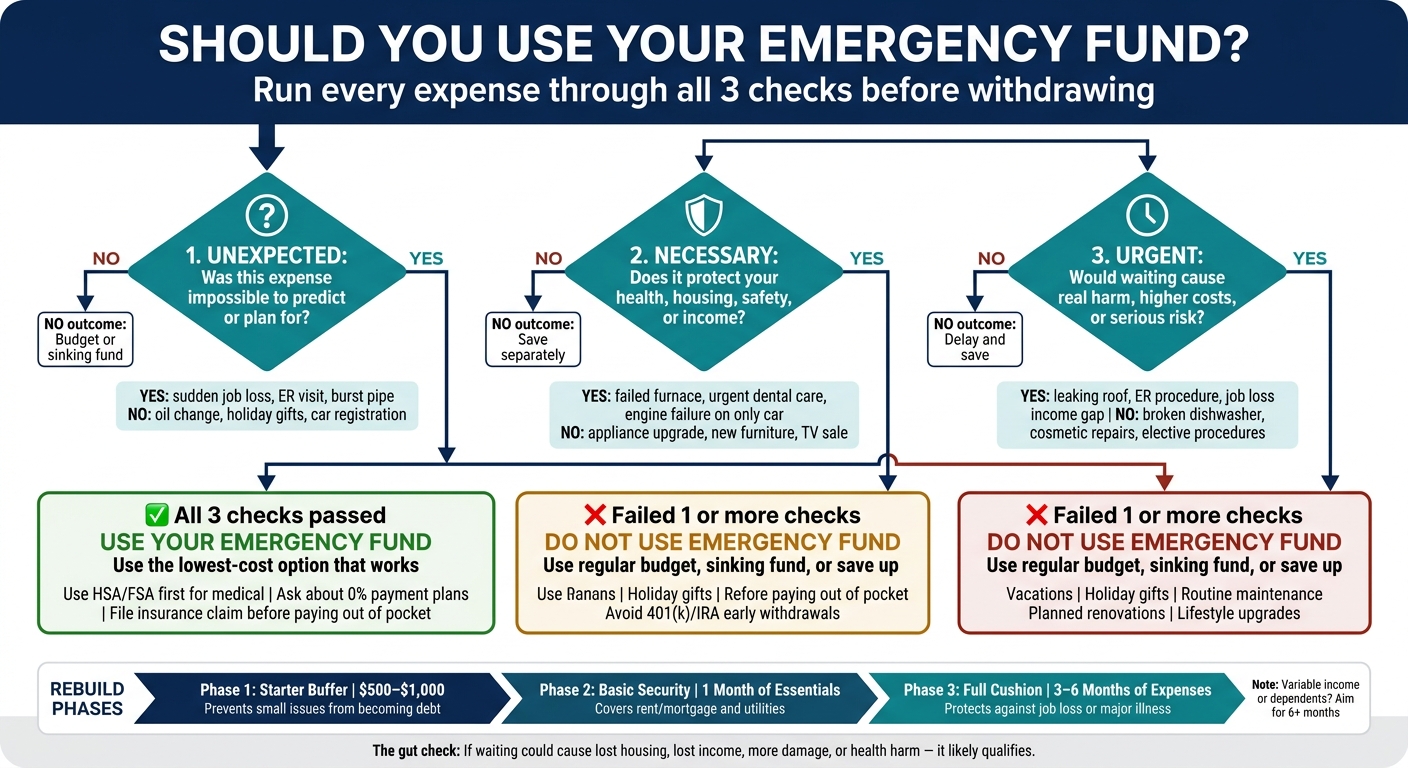
Emergency Fund Decision Framework: The 3-Part Test
Before you use your emergency fund, put the expense through a simple three-part test. It needs to be unexpected, necessary, and urgent – all three, not just one or two.
The unexpected, necessary, and urgent test
An expense counts only if it meets all three checks.
- Unexpected means it wasn’t planned, expected, or part of your normal routine.
- Necessary means it protects your health, housing, safety, or income.
- Urgent means waiting would lead to higher costs, more risk, or actual harm.
A broken furnace in winter fits all three. A new couch doesn’t.
Here’s a good rule of thumb: if skipping the expense could lead to eviction, repossession, or lost income, the fund is there for that. If it’s more of an annoyance than a threat, it should come out of your regular budget.
It’s also smart to build in a 24-hour pause before you take money out. Give yourself a day to make sure the expense is necessary or to see if there’s a lower-cost fix.
If the expense passes this test, the next section covers the most common cases where using the fund makes sense.
Emergency vs. non-emergency spending
| Criteria | Qualifies for Emergency Fund | Does Not Qualify |
|---|---|---|
| Timing | Unexpected – impossible to predict (e.g., hours cut unexpectedly) | Planned or predictable (e.g., holiday gifts, car registration) |
| Importance | Necessary – affects health, safety, or housing (e.g., burst pipe) | A want – affects comfort or style (e.g., upgrading a working appliance) |
| Timeline | Urgent – cannot be delayed without serious harm (e.g., ER visit) | Delayable – can wait until you save up (e.g., new furniture) |
| Impact | Essential – protects your ability to work or live (e.g., engine failure on your only car). If it protects your health, home, transportation to work, or income and it cannot wait, it qualifies. | Non-essential – a "nice-to-have" (e.g., a sale on a new TV) |
Use this test first, then compare the expense with the real-world cases that follow.
Situations where using your emergency fund makes sense
If an expense is unexpected, necessary, and urgent, that’s when your emergency fund should step in. Those three checks help cut through the noise and make the call a lot easier.
Here are the cases that most clearly fit.
Medical bills, urgent home repairs, and safety-related costs
An unexpected ER visit, an urgent dental procedure, or a prescription you can’t delay without putting your health at risk are clear reasons to use your emergency fund. If the provider offers a 0% interest payment plan, it’s smart to ask about that first. Doing so may help you keep more cash on hand.
Home repairs follow the same rule when they affect safety or whether your home is livable. A burst pipe, a leaking roof, or a furnace that quits during a cold snap all count. Replacing a needed appliance can fit too if basic living conditions are affected.
If the expense protects your health, your home, your ride to work, or your income – and it can’t wait – use the fund.
Before you pull money out, document the damage and check your insurance deductible. Then use the fund for the deductible and the most urgent repairs so the problem doesn’t get worse.
Car repairs and job loss that affect income
A major car repair counts when the car is your only way to handle key family transportation or caregiving needs. If the full repair costs $1,200, but $600 is enough to make the car safe to drive, cover the urgent $600 first and save for the rest.
Job loss is the other big one. When income stops out of nowhere, the fund acts as a bridge for housing, utilities, groceries, and transportation. A common benchmark is 3 to 6 months of essential living expenses. The point isn’t to keep your full lifestyle going. It’s to keep the most important bills paid while you work to replace your income.
Use this quick guide to sort common expenses.
Emergency savings or regular budget: a comparison by scenario
| Scenario | Best Funding Source | Why |
|---|---|---|
| ER visit or urgent medical procedure | Emergency fund | Unexpected, health-critical, and can’t wait |
| 0% interest payment plan for a medical bill | Payment plan, if available | Can preserve cash if the plan is truly low-cost |
| Burst pipe or failed furnace in winter | Emergency fund | Urgent home safety issue; waiting can cause more damage |
| Routine HVAC tune-up | Regular budget | Planned maintenance, not an emergency |
| Major car repair | Emergency fund | Necessary for safety and maintaining income |
| Oil change or new tires | Regular budget | Predictable wear-and-tear that belongs in a monthly budget |
| Sudden job loss | Emergency fund | Covers essential living expenses while income is replaced |
| Appliance upgrade | Sinking fund or savings | If the current one works, this is a want and should be saved for separately |
Expenses that should not come from your emergency fund
Use your emergency fund for true shocks only. If spending is predictable or optional, pulling from that account leaves you exposed when something bad hits at the wrong time. A simple rule helps: if the expense is not unexpected, necessary, and urgent, it does not belong in emergency savings.
Planned purchases, lifestyle spending, and routine costs
Vacations, holiday gifts, routine car maintenance, and scheduled HVAC service are not emergencies. They’re normal budget items. The same goes for dining out, entertainment, concert tickets, and phone upgrades.
If your household keeps running short on cash for groceries or utilities, that points to a budget problem, not a string of emergencies. It may feel urgent in the moment, but the fix is better cash-flow planning, not dipping into your safety net again and again.
Use sinking funds for expected expenses
A sinking fund works better for costs that show up on a regular basis but not every single month. Think car registration, pet care, home upkeep, or holiday shopping. You know those bills are coming. You may not know the exact day, but they’re not out of the blue.
When a routine expense becomes an emergency: a comparison table
A routine expense crosses into emergency territory only when it is unexpected, necessary, and urgent. This quick check makes the line a lot clearer.
| Use Emergency Fund Only If… | Plan and Save Instead |
|---|---|
| Car: Repair is required for safety or to get to work, like failed brakes or a dead alternator | Car: Oil changes, tire rotations, registration fees, or cosmetic upgrades |
| Home: Urgent repair is needed to prevent damage or maintain habitability, like a burst pipe or failed furnace | Home: Planned renovations, furniture replacement, or non-urgent repairs like a broken dishwasher |
| Medical: Emergency room visit, urgent procedure, or life-saving prescription | Medical: Elective procedures, cosmetic surgery, or routine check-ups |
| Family: Last-minute travel for a critically ill relative or funeral | Family: Annual vacations, holiday gifts, or back-to-school supplies |
| Essential appliance: Refrigerator breaks and can’t be lived without | Want: Replacing a functional appliance just for style or a newer model |
Here’s the gut check: if waiting would cause real harm, it may count as an emergency. A broken refrigerator can lead to spoiled food. A broken dishwasher usually can wait. If the expense can wait, cover it from your budget or a sinking fund. If it does qualify, the next move is to use the fund in the lowest-cost way and build it back fast.
How to use the money and rebuild the fund after a crisis
If an expense fits the rules, using your emergency fund is the right move. No guilt. That’s what the fund is for.
That said, try to pull out as little as you can. Once an expense qualifies, go with the lowest-cost option that still works so more cash stays in the account.
Spend from the fund in the lowest-cost way possible
Start with HSA or FSA money if the bill is for medical or dental care. That lets you cover the cost without draining your emergency savings first.
Next, ask about a 0% payment plan or other low-cost terms. A lot of people skip this step, but it’s often one of the easiest ways to ease the hit.
If the problem involves home or auto damage, file an insurance claim before paying out of pocket. When the repair bill is higher than your deductible, insurance may pay the rest.
One more thing: avoid tapping a 401(k) or IRA. Early withdrawals can come with penalties and taxes. In a crunch, that can turn one bad bill into a more expensive mess.
Rebuild with automatic transfers and temporary budget cuts
Once the crisis is over, start refilling the fund right away. The easiest path is to automate it. Set up transfers from each paycheck into your emergency savings, then send any tax refund, work bonus, or cash gift straight to the fund until you’re back where you want to be.
For a little while, trim spending that can wait. Dining out and entertainment are common places to cut first. It may feel annoying for a few months, but it can help you rebuild faster.
You can rebuild in stages:
| Rebuilding Phase | Target Goal | Purpose |
|---|---|---|
| Phase 1: Starter Buffer | $500–$1,000 | Prevents small issues from becoming new debt |
| Phase 2: Basic Security | 1 Month of Essentials | Covers one full cycle of rent/mortgage and utilities |
| Phase 3: Full Cushion | 3–6 Months of Expenses | Protects against long-term job loss or major illness |
Households with variable income or dependents should aim for 6+ months.
Conclusion: the simplest rule to remember
Use one filter: unexpected, necessary, and urgent. If an expense clears all three, use the fund. If it doesn’t, plan and save for it separately. Then refill the fund as soon as the crisis ends.
FAQs
What counts as urgent?
An expense is urgent when it needs attention now and putting it off would make the damage, cost, or fallout worse.
A real financial emergency is unexpected, necessary for your health, safety, housing, or income, and urgent. If the expense can wait or you could plan for it in your budget, it’s probably not an emergency.
Should I use credit before my emergency fund?
Generally, no. Use your emergency fund before you turn to credit.
That’s what the fund is for: unexpected, necessary, urgent expenses that need to be covered without piling on debt.
Using cash you’ve already set aside can help protect your long-term financial stability. Credit may still come into play in some cases, but it usually makes sense to look at your situation first and use your emergency fund if the expense fits. If it doesn’t, then other resources or credit may be worth a look.
How fast should I rebuild my fund?
Aim to rebuild your emergency fund as soon as things settle down. There’s no set deadline, but it helps to pick a target date so you can put money back in at a pace you can stick with.
If you want to build it back faster, a few simple moves can help:
- Set up automatic transfers on a regular schedule
- Put bonuses or tax refunds straight into the fund
- Cut back on nonessential spending for a while
A steady approach tends to be easier to keep up over time than trying to do too much all at once.
Related Blog Posts
- Emergency Fund Goal Calculator for Peace
- How to Rebuild an Empty Emergency Fund
- How to Budget for Big-Ticket Items
- 7 Budgeting Mistakes and How to Fix Them

Karla Moss is a CPA and former startup Controller who spent 15 years managing finance at the executive level — including inside a company that grew to unicorn status. She founded Karla & Co. to bring real-world financial clarity to everyday money decisions. She’s based in Phoenix, AZ and writes from personal experience as much as professional expertise.