
Most people can cut life insurance costs with a few simple moves: compare quotes, buy only the coverage they need, choose term instead of whole life in many cases, improve health, quit tobacco, trim riders, and use annual billing or discounts.
In the U.S., many buyers overestimate term life prices, and insurer pricing can vary a lot for the same person. That means you may be able to save hundreds of dollars per year without cutting the protection your family needs.
Here’s the full list at a glance:
- Shop around because rates can differ a lot by insurer
- Match coverage and term to your needs so you do not overbuy
- Choose term life if you want lower costs for a set period
- Improve your health before applying or ask for a new review later
- Quit tobacco and cut high-risk habits to move into a lower rate class
- Review riders and drop extras that add cost without much use
- Use annual billing, bundling, and group discounts when they lower the total price
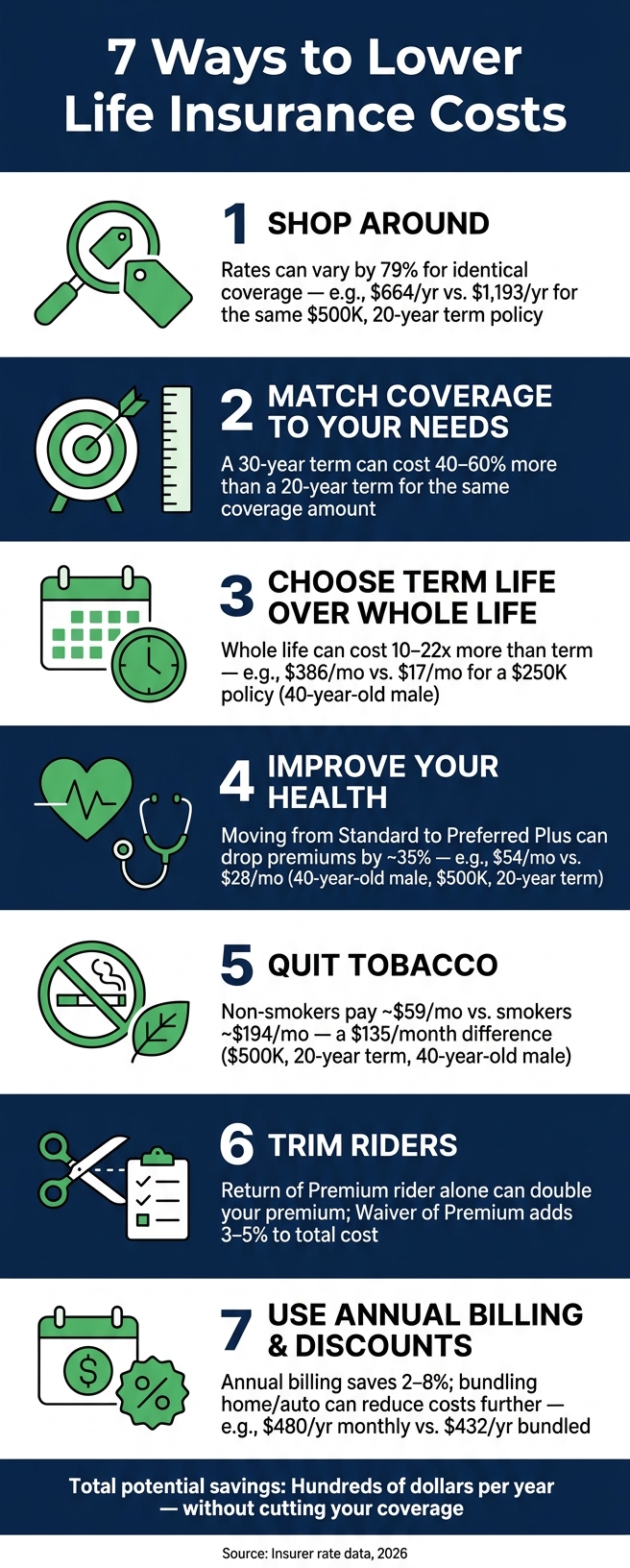
7 Ways to Lower Life Insurance Costs: Key Savings at a Glance
How to Get The Best Life Insurance At The Lowest Cost By Using a Broker To Shop Quotes
sbb-itb-0a60575
Quick Comparison
| Way to save | How it lowers cost | Main thing to watch |
|---|---|---|
| Compare quotes | Different insurers may price the same applicant very differently | Match the same coverage and term when comparing |
| Adjust coverage amount | Lower death benefit usually means lower premium | Do not cut coverage too far |
| Shorten term length | Fewer years of coverage often costs less | Make sure the term still covers major debts |
| Pick term life | Term is often far cheaper than whole life | Coverage ends after the term unless renewed or converted |
| Improve health | Better underwriting class can lower rates | A new exam can also show new health issues |
| Quit tobacco | Non-smoker rates are often much lower | Many insurers want 12 to 24 tobacco-free months |
| Trim riders / use discounts | Fewer add-ons and better billing setup can reduce total cost | Check whether you are giving up features you may want later |
If I were trying to lower my premium, I’d start with the three biggest levers first: quotes, policy type, and coverage size. Then I’d look at health, smoking status, riders, and billing setup.
What Drives Life Insurance Costs in the U.S.
Life insurers set prices based on risk. Put simply, your premium reflects how likely the company thinks it is to pay a claim while your policy is active. If you look riskier on paper, you’ll usually pay more.
Some of these pricing factors are fixed. Others are things you can improve.
Coverage Amount and Term Length
The larger the death benefit, the higher the premium. For example, a 40-year-old non-smoking woman pays about $28/month for a $250,000 policy, but about $86/month for $1,000,000 in coverage.
Term length affects cost in the same way. A longer policy means the insurer is on the hook for more years, so the price goes up. A 30-year term can cost 185% more than a 10-year term for the same person and the same coverage amount.
Term Life vs. Permanent Life Insurance
Term life is much cheaper than permanent life insurance. That’s because term coverage lasts for a set period and pays only if you die during that term.
Whole life works differently. It stays in force for your entire life and builds cash value over time. That extra feature comes with a much higher price tag. In many cases, whole life can cost 10 to 22 times more than term life for the same death benefit.
The gap can be dramatic. For a 40-year-old male, a $250,000 whole life policy costs about $386/month, while a $250,000 20-year term policy costs about $17/month.
Health, Age, and Underwriting Class
When you apply, the insurer looks at your medical history, and it may ask you to take a health exam. Then it places you into an underwriting class. That class has a direct effect on what you pay.
| Health Class | Monthly Premium |
|---|---|
| Preferred Plus | $28.03 |
| Preferred | $34.64 |
| Standard Plus | $45.89 |
| Standard | $54.08 |
Source: – 40-year-old male, $500,000, 20-year term
Age also matters – a lot. Premiums go up by about 5% to 8% for each year you wait to apply. That’s why buying earlier often means a lower locked-in rate.
Smoking Status and High-Risk Habits
Tobacco use is one of the biggest cost drivers you can control. A 40-year-old male non-smoker pays about $59/month for a $500,000 20-year term policy. A smoker of the same age pays about $194/month. That’s a difference of $135 per month.
Other habits can push rates up too. Activities like skydiving, private aviation, and motorsports may lead to surcharges or a worse risk class. If you stop those activities, or avoid them before applying, you may qualify for a lower rate.
Riders and Insurer Pricing Differences
Optional riders add to your premium. For instance, a waiver of premium rider usually adds about 3% to 5% to the total cost.
The insurer itself also makes a big difference. Two companies can look at the exact same applicant and offer very different prices. In some cases, rates vary by 50% or more between carriers.
These are the main factors behind what you pay, and the next seven tips focus on the ones you can influence.
1. Shop Around and Compare Multiple Quotes
Shopping around is the fastest way to cut your life insurance rate. Insurers don’t price the same applicant the same way, so it’s smart to compare quotes from at least three companies for the same death benefit, same term length, and same underwriting class.
The gap in price can be huge. In 2026, annual rates for a $500,000, 20-year term policy ranged from $664 at Corebridge Financial to $1,193 at Farmers Life – a 79% difference for the same coverage. That’s more than $500 per year in possible savings without cutting your death benefit.
Here’s a look at how far prices can vary for identical coverage:
| Company | Average Monthly Rate | Average Annual Rate |
|---|---|---|
| Corebridge Financial | $55.33 | $664 |
| Transamerica | $55.42 | $665 |
| Pacific Life | $55.92 | $671 |
| New York Life | $60.33 | $724 |
| Penn Mutual | $60.50 | $726 |
| John Hancock | $65.42 | $785 |
Based on a 20-year, $500,000 term policy
Price matters, but it shouldn’t be the only thing you look at. A lower premium can come with fewer features. So when you compare quotes, line up the details side by side. Make sure the term length, death benefit, and underwriting class all match.
One easy way to do this is to work with an independent broker. They can pull quotes from several insurers at once, which saves time. From there, compare three to five carriers with strong financial ratings, check the policy details, and pick the one that gives you the best fit at the lowest price.
2. Match Your Coverage Amount and Term Length to Your Needs
Pick a death benefit and term length that fit your life now, not some inflated “just in case” number. The goal is simple: don’t pay for coverage you likely won’t need. Start with the amount your family would need if you were gone, then choose a term that lines up with when your biggest bills should be behind you.
One common way to estimate coverage is the DIME method: add up your debt, income replacement, mortgage balance, and education costs. If you want a faster rule of thumb, many people use 10 to 12 times their annual income.
Term length matters too. Go with the shortest term that still covers your biggest obligations. For example, if your mortgage will be paid off in 20 years and your kids will likely be through college by then, a 20-year term may make more sense than a 30-year term. That matters because a 30-year term can cost 40% to 60% more than a 20-year term for the same coverage.
Another option is policy laddering. That means buying separate policies with different term lengths so your coverage drops over time as your needs shrink. It’s a simple way to keep more coverage when you need it most, then let both coverage and premiums fall later.
If the premium still feels too high after adjusting your amount and term, the next lever is policy type.
3. Choose Term Life Over Permanent Coverage When It Makes Sense
If lowering your coverage amount still doesn’t bring the premium down enough, the next thing to look at is the type of policy. For people who want income protection during their working years while they pay off a mortgage, loans, or other debt, term life is usually the lowest-cost choice.
The price gap can be huge. A healthy 35-year-old can get $500,000 of 20-year term coverage for about $27 to $40 per month, while the same amount of whole life insurance can cost $350 to $600 per month. That gap can leave you with a few hundred dollars more each month for retirement savings, an emergency fund, or faster debt payoff.
Here’s the simple tradeoff: term life lasts for a set number of years, while permanent coverage lasts your entire life but costs much more.
Before you buy, check whether the policy includes a conversion rider. That feature can let you move to permanent coverage later without taking a new medical exam. If the premium still feels too high after that, the next place to look is optional add-ons.
4. Improve Your Health Before You Apply or Requalify
Small health changes can cut your premium in a big way. The gap between underwriting classes is no joke: a 35-year-old woman in Preferred Plus pays about $23/month for $500,000 of 20-year term life coverage, while the same woman rated Standard pays about $42/month.
The biggest pricing shifts usually come down to a handful of measurable numbers: BMI, blood pressure, cholesterol, and A1C levels for people managing diabetes. Insurers rely on height-and-weight charts, so being only a few pounds above a cutoff can push you from Preferred to Standard. And that can bump your premium by 25% or more.
That’s why even a short health push can pay off. A 3- to 6-month plan to lose weight, lower blood pressure, and improve cholesterol may help you land in a better class before you apply. It’s a bit like shaving a few points off your credit score risk before applying for a loan – the numbers can change what you pay.
If your health has gotten better since you first bought coverage, ask about a rate review. Many insurers will look at your case again after 12 to 24 months of steady improvement, and the re-exam is usually paid for by the insurer.
One catch: a new exam can also turn up new health issues. So before you move ahead, compare the cost of reconsideration with the cost of applying for a new policy.
5. Quit Tobacco and Reduce High-Risk Habits
Tobacco is one of the few premium factors you can still change after you apply.
The price gap can be huge. For a 40-year-old woman buying a $500,000, 20-year term policy, smokers may pay about $143 to $170 per month, while non-smokers may pay about $46 to $55. That’s a big swing for the same coverage.
If you quit, your premium may drop by 30% to 50%. But there’s a catch: most insurers want to see 12 tobacco-free months before they move you into a non-smoker class. Some carriers, including Transamerica and Protective, want 24 months before they offer preferred non-tobacco rate classes. And here’s the part many people miss: when you hit that mark, ask for a rate review. The lower price usually does not show up on its own.
Insurers also look at tobacco use more broadly than many buyers expect. It’s not just cigarettes. Vaping, e-cigarettes, chew, nicotine gum, patches, and nicotine pouches are often treated the same way. Even occasional use can count. In many cases, one cigarette a week leads to the same smoker label as a pack-a-day habit.
The same idea shows up with other high-risk habits. Hobbies like skydiving, car racing, or private aviation can lead to flat extra charges added per $1,000 of coverage. A DUI or another poor driving record can push your rate up too. If you’ve stopped the activity, it’s worth asking for a rate review to see if that extra charge can be removed.
6. Review and Trim Riders and Optional Policy Features
If your coverage amount and policy type are already in good shape, look at the extras next. Riders are optional add-ons, and they push your premium up. Even a small rider can bump your monthly bill. Cutting one can lower your cost, but it may also limit choices you want later.
The Return of Premium (ROP) rider is often the most expensive add-on. It gives your premiums back if you outlive the term. Sounds nice on paper. But it can double the cost of a standard term policy.
A few other riders are worth a close look:
- Accidental Death Benefit: This often overlaps with coverage that may already be part of the policy.
- Waiver of Premium: This can overlap with disability coverage you already get through your employer.
One extra you may want to keep is the conversion option. Just make sure you know the deadline, because that window does not stay open forever.
It helps to review your riders every 2 to 3 years. Old add-ons can quietly keep your policy more expensive than it needs to be. Once you trim riders, the next thing to check is how you pay and which discounts you use.
7. Use Discounts, Payment Options, and Policy Bundling
After trimming riders, the next easy way to save comes down to how you pay and which discounts you can claim.
Paying annually is one of the simplest wins. Many insurers tack on billing fees or payment-plan charges when you pay monthly, quarterly, or twice a year. Those small admin costs can add 2% to 5% to your premium over the course of a year. Switching to one annual payment can cut 2% to 8% off your total premium. Some carriers also give a small break for automatic payments or drop certain admin fees altogether.
If annual billing doesn’t move the needle enough, look at bundling and group discounts next. Bundling is worth a quick check. If you already carry home or auto insurance, ask whether putting your life policy with the same company would trigger a multi-policy discount.
That said, there’s a catch: bundling can limit your freedom later. If you switch your auto insurer down the road, you might lose the discount tied to your life policy. So before you sign off on a bundle, compare the full bundled price with a standalone life quote. Sometimes a lower base rate from a life insurer beats the bundle discount anyway.
A few other price cuts are easy to miss:
- Group and professional affiliations can help, including the military, teachers, seniors, or certain employer-sponsored groups.
- Some insurers price coverage in tiers, so it’s worth asking whether a higher face amount lowers the rate per $1,000 of coverage.
What makes these savings appealing is that they usually change billing, not coverage. Annual billing, automatic payments, bundling, and group discounts are billing changes rather than underwriting changes, so they usually do not require a new medical review.
Comparison Tables to Use Throughout the Article
Use these quick comparison tables to spot the biggest cost gaps fast.
Shopping around (Tip 1): One quote can miss a large price gap.
| Insurer | Monthly Premium | 20-Year Cost Difference vs. Lowest |
|---|---|---|
| Lowest | $55 | Baseline |
| Mid-range A | $61 | +$1,440 |
| Mid-range B | $74 | +$4,560 |
| Highest | $83 | +$6,720 |
That’s the kind of spread that sneaks up on people. A price gap that looks small each month can turn into thousands of dollars over 20 years.
Sizing your coverage (Tip 2): Larger policies can cost less per $1,000.
| Coverage Amount | Approx. Monthly Premium | Cost per $1,000 of Benefit |
|---|---|---|
| $250,000 | ~$25–$30 | $0.10–$0.12 |
| $500,000 | ~$40–$49 | $0.08–$0.10 |
| $1,000,000 | ~$69–$86 | $0.07–$0.09 |
This is one of those pricing quirks that catches people off guard. The total premium goes up, but the cost per $1,000 of coverage often drops.
Term vs. permanent (Tip 3): For a 35-year-old buying $500,000 of coverage.
| Policy Type | Monthly Premium | 20-Year Total Cost | Cash Value? |
|---|---|---|---|
| 20-Year Term | $28–$40 | $6,720–$9,600 | No |
| Whole Life | $350–$500 | $84,000–$120,000 | Yes |
The trade-off is pretty clear here. Term keeps costs far lower, while whole life comes with cash value but a much bigger price tag.
Smoker status (Tip 5): For a 35-year-old buying a $500,000 20-year term policy, tobacco use can significantly increase premiums.
| Status | Monthly Premium | 20-Year Total Cost |
|---|---|---|
| Non-Smoker | ~$30 | $7,200 |
| Smoker | ~$115 | $27,600 |
| Difference | +$85/mo | +$20,400 |
That difference is hard to ignore. An extra $85 per month may not sound massive at first, but over 20 years it adds up to $20,400.
Payment options (Tip 7): Annual billing typically saves about 3% to 5% compared with monthly payments.
| Payment Method | Estimated Annual Cost | Notes |
|---|---|---|
| Monthly | $480 | Includes standard billing fees |
| Annual | $460 | Saves roughly 3–5% |
| Bundled (Home/Auto) | $432 | Multi-policy discount applied |
Payment setup can change the final cost more than people expect. Paying annually, or bundling with home or auto insurance, can trim the bill without changing the coverage itself.
When to Review and Update Your Coverage
After you lower your premium, don’t just set the policy aside and forget about it. Your life changes, and your coverage should keep up. A good rule is to review your policy every 2–3 years and any time a major life event happens. The right update can cut premiums without leaving you short on protection.
It also makes sense to review sooner after marriage, the birth of a child, buying a home, paying off debt, divorce, or a major health change.
Life Events That Can Change Your Coverage Needs
Some milestones are strong signals that it’s time to take another look at your policy.
| Life Event | What It Means for Your Coverage |
|---|---|
| Marriage or new child | Income replacement needs go up; consider adding coverage |
| Buying a home | Coverage needs may increase with new debt |
| Mortgage paid off | Debt-related need drops; reducing coverage may lower premiums |
| Divorce | Update beneficiaries and reassess face value and ownership |
| Children financially independent | Long-term protection need shrinks; a leaner policy may work |
| Lower-risk job change | Re-evaluate your rate class if your occupational risk has dropped |
| Approaching retirement | Review whether permanent coverage is still necessary or a leaner policy makes more sense |
When Reducing Coverage May Make Sense
If your financial obligations have gone down, trimming the death benefit is often one of the fastest ways to cut costs. For many policyholders, reducing the coverage amount is a simple request, and it can lower the monthly premium.
Think of it this way: if the mortgage is gone and the kids are on their own, you may not need the same level of coverage you needed ten years ago.
When a Policy Change May Require New Underwriting
Some policy updates are easy. Others mean starting part of the process again.
If you want to increase your death benefit, extend your term, or apply for a brand-new policy, the insurer will usually require new underwriting. That often includes a medical exam and a new review based on your current age and health.
If your health has improved, you may be able to ask for re-underwriting and move into a better risk class. And if you decide to replace a policy, keep the old coverage in place until the new policy is fully in force.
Conclusion
Lowering life insurance costs comes down to one simple idea: pay for the coverage you need, not extra coverage you won’t use.
That’s what these seven moves help you do. Compare quotes from different carriers, choose a death benefit and term length that fit your situation, work on your health where possible, and cut riders or features that no longer make sense.
A well-priced policy can help protect your family from income loss and debt. At the same time, it can leave more room in your budget for saving, planning, and building long-term financial stability.
As your finances, health, or family needs shift, review your policy and keep the coverage that still fits.
FAQs
How much life insurance do I really need?
Choose enough coverage to protect your family without paying for more than you need. A simple way to do that is to add up your debts, future costs like college, and the income you want the policy to replace. Then subtract what you already have in assets or current insurance.
A common rule of thumb is 10 to 12 times your annual income. From there, match your coverage amount and term length to your financial goals. For example, you might line the term up with your mortgage payoff date or the years until your children are financially independent.
Can I lower my premium after I already have a policy?
Yes, often you can.
You may be able to lower your premium by:
- Reducing your death benefit
- Removing riders you no longer need
- Switching from monthly to annual payments, which can save 3% to 8%
If your health has improved or you’ve quit smoking, you might also qualify for a lower rate. That said, your insurer may require new underwriting first.
It’s smart to review any changes with your insurer before you make a move.
When does whole life make more sense than term life?
Whole life tends to make more sense when your goals go beyond replacing income for a set number of years. It can fit high-net-worth families that may need cash for estate taxes, parents who want to fund a special needs trust, or business owners who need permanent coverage as part of succession planning.
It may also help if you’re worried your health could change later and you want insurability locked in. For most families, though, term life is still the lower-cost option.
Related Blog Posts
- Term Life vs Whole Life Insurance: Key Differences
- 8 Smart Ways to Lower Your Monthly Bills
- How to Spot Gaps in Insurance Policies
- Why Shopping Insurance Rates Saves Money

Karla Moss is a CPA and former startup Controller who spent 15 years managing finance at the executive level — including inside a company that grew to unicorn status. She founded Karla & Co. to bring real-world financial clarity to everyday money decisions. She’s based in Phoenix, AZ and writes from personal experience as much as professional expertise.