
When planning big purchases, it’s crucial to distinguish between needs and wants. Needs are expenses necessary for survival, health, or work, like housing, groceries, or a reliable car. Wants, on the other hand, are optional items that enhance comfort or enjoyment, such as luxury goods, vacations, or the latest gadgets. Misjudging this difference can lead to overspending and financial stress.
To make smarter decisions, consider the 50/30/20 rule:
- 50% for needs (housing, utilities, transportation, etc.)
- 30% for wants (entertainment, dining out, hobbies).
- 20% for savings or debt repayment (emergency funds, retirement, or big purchases).
For major expenses, temporarily adjust your budget by reducing wants and increasing savings (e.g., 50/20/30 split). Use tools like sinking funds to save consistently, and always factor in hidden costs like taxes or maintenance. Avoid emotional spending by waiting before making non-essential purchases and regularly review your financial priorities.
Separating needs from wants ensures you cover essentials, avoid unnecessary debt, and stay on track with your financial goals.
Needs vs. Wants: Understanding the Difference
What Are Needs and Wants for Major Purchases?
Understanding the difference between needs and wants is a key step in managing your budget effectively. Needs are expenses you simply can’t avoid – they’re essential for survival, health, safety, and maintaining your ability to work. These include things like housing, basic groceries, healthcare, utilities, and reliable transportation. They’re the building blocks of a stable and secure life.
Wants, by contrast, are optional expenses that improve your comfort, enjoyment, or social standing but aren’t necessary for your survival. Examples include luxury goods, premium streaming subscriptions, fine dining, or the latest tech gadgets. While these items can add convenience or happiness, they’re flexible expenses that can be trimmed or postponed without serious consequences.
What Are ‘Needs’?
Needs are the essentials that keep you safe, healthy, and able to work. This includes a roof over your head, whether it’s a modest rental or mortgage payment. Groceries that provide proper nutrition, health insurance, and a reliable car for commuting also fall into this category. These are often fixed or unavoidable costs, meaning they can’t be cut without risking your well-being or financial stability.
It’s also wise to factor in emergency savings and debt payments as part of your needs. These ensure you’re prepared for unexpected challenges and safeguard your long-term financial health.
What Are ‘Wants’?
Wants, on the other hand, are expenses that enhance your lifestyle but aren’t essential. A bigger house in a high-end neighborhood, luxury vacations, designer clothes, or the latest smartphone upgrade all qualify as wants. The key difference is flexibility – you can live without these things or delay purchasing them without jeopardizing your ability to function or meet your basic needs.
Sometimes, purchases blur the line between needs and wants. For instance, having a car to commute is a need, but choosing a flashy sports car instead of a practical sedan leans into the "want" category. Similarly, if average rent in your area is $1,500 and you’re paying $2,000 for a premium location, the extra $500 is a want.
Recognizing this distinction is a critical step as you prepare to budget for any major purchase.
Why the Difference Matters
Understanding the line between needs and wants helps you avoid lifestyle inflation, where luxuries start feeling like necessities as your income grows. By prioritizing needs, you ensure that essential expenses are always covered, which reduces financial stress and helps you avoid falling into debt. It also keeps emotional or impulsive spending in check, protecting your savings.
Before making a big purchase, ask yourself: "Would not having this negatively affect my health, safety, or ability to work?" or "Is this truly necessary?" If the answer is no, it’s likely a want. To curb impulsive spending, try waiting 48 hours to a week before buying non-essential items. This pause often clarifies whether the purchase is a fleeting desire or something you truly value.
This clear separation between needs and wants sets the stage for using budgeting tools like the 50/30/20 rule to manage your finances effectively.
Using the 50/30/20 Rule for Major Purchases
Once you’ve identified your essential needs and discretionary wants, the 50/30/20 rule can help you manage your income effectively. This budgeting method divides your after-tax income into three categories: 50% for needs, 30% for wants, and 20% for savings and debt repayment. First introduced in All Your Worth: The Ultimate Lifetime Money Plan, this approach remains a popular way to manage finances.
What Is the 50/30/20 Rule?
The rule breaks down like this: 50% of your income goes toward needs, such as housing, utilities, groceries, and transportation. 30% is for wants, which include dining out, entertainment, hobbies, and subscriptions – essentially the things that make life enjoyable. The final 20% is allocated to savings and debt repayment, covering emergency funds, retirement accounts, and saving for big-ticket items like a car or a home down payment.
According to the Bureau of Labor Statistics 2024 Consumer Expenditure Survey, the average American household spends about 75% of their pre-tax income, often leaving less than the recommended 20% for savings. This is where the 50/30/20 rule proves helpful – it forces you to balance current expenses with future financial goals.
"The 50/30/20 rule explicitly builds [wants] in because a budget that ignores quality of life doesn’t survive contact with reality." – Surplus Budget
With this foundation in mind, let’s explore how the rule can be adjusted to accommodate major purchases.
Adjusting the Rule for Major Purchases
While the 50/30/20 rule provides a solid structure for everyday budgeting, major purchases often require temporary adjustments. For example, if you’re saving for a car, a home renovation, or a down payment, you might need to shift priorities. In this case, the 20% savings bucket becomes the focus. To speed up your savings, consider flipping the percentages for "wants" and "savings", adopting a 50/20/30 split. This means cutting lifestyle spending to 20% and increasing savings to 30%.
For higher earners or those with specific financial goals, a 40/20/40 split might work better, reducing both needs and wants to allocate 40% toward savings. On the other hand, if you live in a high-cost area where housing takes up a significant portion of your income, a 60/20/20 adjustment may be necessary to account for higher essential expenses while still maintaining some level of savings.
If your major purchase involves financing – like a mortgage or car loan – it’s important to ensure the monthly payment fits within the 50% "needs" category. If adding this payment pushes your needs above 50%, you’ll need to reduce spending on wants or temporarily pause additional savings to maintain balance. Before taking on new debt, review your current fixed costs. You may be able to refinance existing loans or negotiate better insurance rates to free up room in your budget.
"The percentages aren’t sacred – the framework is. Having clear guardrails for needs, wants, and savings matters more than hitting exact numbers." – Surplus Budget
How to Budget for Major Purchases: Step-by-Step
Here’s a simple four-step process to help you plan and budget for major purchases.
Step 1: List All Potential Purchases
Start by making a list of all the big purchases you’re planning over the next 12–24 months. This could include everything from urgent replacements, like a broken fridge, to more aspirational goals, like a vacation or a home theater system. Write down the estimated total cost for each item, factoring in taxes, fees, and any ongoing expenses like maintenance or insurance. Once your list is ready, total up the costs and compare them to your monthly net income to identify any gaps.
Don’t forget to include hidden costs. For example, buying a home often comes with closing fees that can range from 2–5% of the purchase price. Taking the time to account for these extra costs now means fewer surprises later.
Once your estimates are complete, move on to sorting each item into "needs" and "wants."
Step 2: Categorize Each Purchase as a Need or Want
Now, evaluate your list using a simple "Needs vs. Wants" test. If an item is essential for your health, safety, or job, it’s a need. If it’s something that enhances your quality of life or provides enjoyment, it’s a want.
Be honest with yourself during this step. To avoid impulsive decisions, consider waiting 24 hours before categorizing discretionary purchases. Genuine needs tend to feel more urgent over time, while the excitement around wants often fades as trends change.
For items that fall into a gray area, split the cost into parts. For example, consider the base cost of a car as a need, but any luxury upgrades as a want. This helps you stay realistic about what’s necessary versus what’s just nice to have.
Step 3: Prioritize Needs Over Wants
Once you’ve categorized your purchases, rank your needs by urgency. Items that directly impact your health, safety, or ability to earn income should be at the top of your list. For example, replacing a broken water heater or fixing a car you rely on for work takes priority over upgrading to a newer model.
Savings and debt repayment should also be treated as non-negotiable needs. After covering your needs, any leftover funds can go toward wants. If your budget is tight, wants should either be delayed or cut entirely. This is where the 50/30/20 rule can help: it ensures you’re not jeopardizing your financial stability for short-term pleasures.
Once your priorities are clear, you can allocate your budget accordingly.
Step 4: Divide Your Budget by Category
Use your preferred budgeting method – like the 50/30/20 rule – to allocate funds. If you’re saving for a significant need, such as a home down payment, you might temporarily shift to a 50/20/30 split, reducing lifestyle spending to 20% and increasing savings to 30%.
To stay on track, automate transfers to a high-yield savings account earmarked for your purchase. Review your progress monthly. If your needs are consuming more than 50% of your income, look for ways to cut costs, such as carpooling, finding a roommate, or switching to a cheaper phone plan.
Needs vs Wants: Common Major Purchase Examples
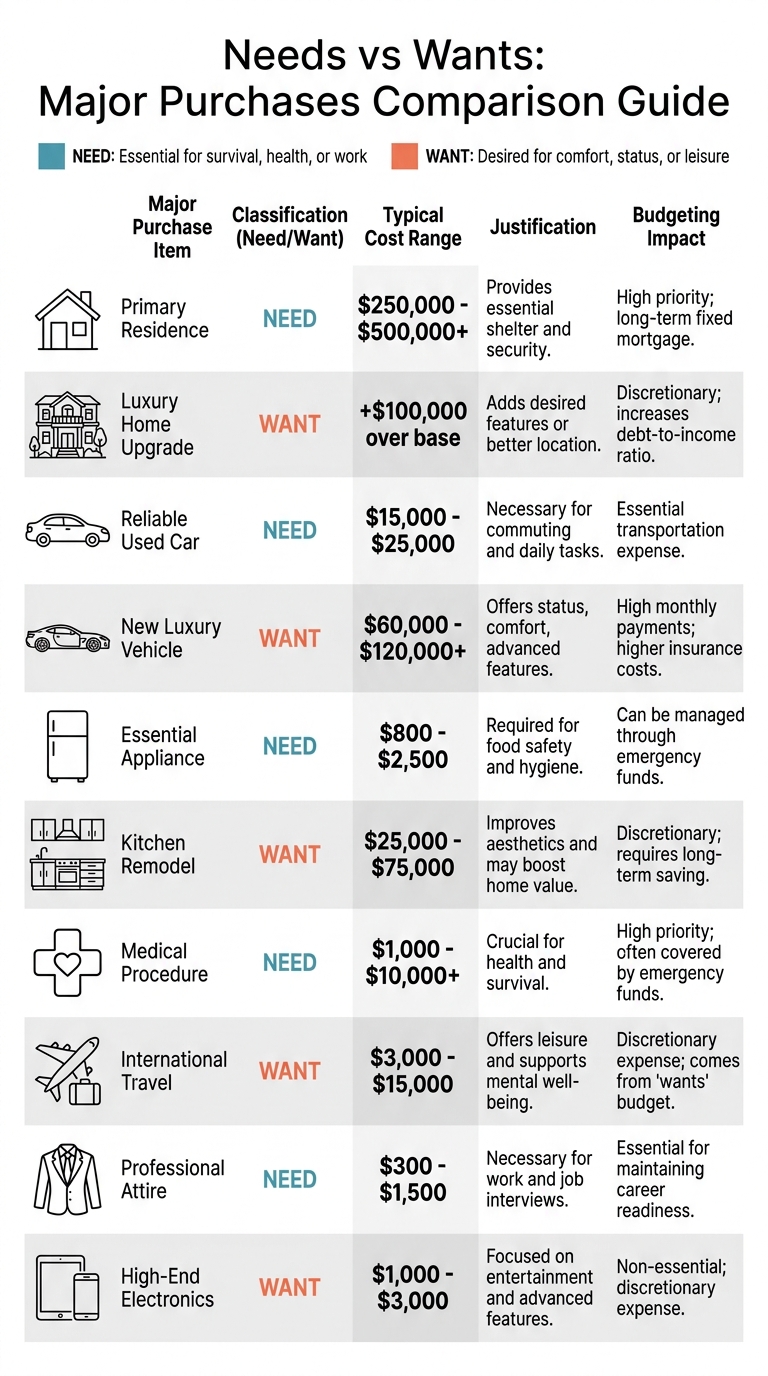
Needs vs Wants Major Purchases Comparison Guide
Looking at real-world examples can help clarify the difference between needs and wants. Even within the same expense category – like housing or transportation – the distinction often lies in the model you choose or the features you prioritize.
For instance, a dependable used car for daily commuting falls under a need. On the other hand, a brand-new luxury car with all the bells and whistles is a want. The table below highlights these differences.
Understanding whether a purchase is a need or a want can make budgeting decisions much clearer.
Comparison Table: Needs vs Wants
Here’s a breakdown of common major purchases, showing how they classify as needs or wants, their cost ranges, and their impact on budgeting:
| Major Purchase Item | Classification | Typical Cost Range | Justification | Budgeting Impact |
|---|---|---|---|---|
| Primary Residence | Need | $250,000 – $500,000+ | Provides essential shelter and security. | High priority; long-term fixed mortgage. |
| Luxury Home Upgrade | Want | +$100,000 over base | Adds desired features or a better location. | Discretionary; increases debt-to-income ratio. |
| Reliable Used Car | Need | $15,000 – $25,000 | Necessary for commuting and daily tasks. | Essential transportation expense. |
| New Luxury Vehicle | Want | $60,000 – $120,000+ | Offers status, comfort, and advanced features. | High monthly payments; higher insurance costs. |
| Essential Appliance | Need | $800 – $2,500 | Required for food safety and hygiene. | Can be managed through emergency funds. |
| Kitchen Remodel | Want | $25,000 – $75,000 | Improves aesthetics and may boost home value. | Discretionary; requires long-term saving. |
| Medical Procedure | Need | $1,000 – $10,000+ | Crucial for health and survival. | High priority; often covered by emergency funds. |
| International Travel | Want | $3,000 – $15,000 | Offers leisure and supports mental well-being. | Discretionary expense; comes from "wants" budget. |
| Professional Attire | Need | $300 – $1,500 | Necessary for work and job interviews. | Essential for maintaining career readiness. |
| High-End Electronics | Want | $1,000 – $3,000 | Focused on entertainment and advanced features. | Non-essential; discretionary expense. |
For example, a medical procedure that protects your health is a top priority, while a vacation – though beneficial for mental health – can be postponed if finances are tight. These distinctions are key to making thoughtful trade-offs when budgeting for major purchases.
This framework lays the groundwork for using targeted budgeting strategies to manage big expenses effectively.
Budgeting Strategies for Major Purchases
Once you’ve sorted your major purchases into "needs" and "wants", the next step is figuring out how to pay for them without throwing your finances off track. The approach you take will depend on whether the expense is essential or more of a luxury. These strategies help you go from identifying priorities to actually saving for them effectively.
Setting Up Sinking Funds for Needs
A sinking fund is a dedicated account where you save regularly for a planned expense. Think of it as your go-to strategy for predictable costs like a new roof, car insurance premiums, or eventually replacing your vehicle.
"Sinking funds are for planned expenses you can anticipate. Emergency funds are a safety net that should be used only in situations that are urgent, important and unexpected." – The Penny Hoarder
To make it work, divide the total cost by the number of months until the expense is due. For example, if you plan to replace a vehicle in eight years and estimate it will cost $20,000, you’d aim to save about $200 per month. Keep your sinking funds in a high-yield savings account (HYSA) with subaccounts labeled for each goal – like "2027 Vehicle Replacement" or "New Roof" – to avoid accidentally using the money for everyday expenses. Automating transfers can help you stay on track.
For goals that are several years away, you might also consider a Certificate of Deposit (CD) to lock in a higher interest rate, as long as you won’t need the money before the CD matures. If you’re unsure how much to save for less predictable needs like home or car maintenance, look at your past spending to set a realistic target. Always prioritize essential sinking funds – like those for taxes, medical bills, or urgent repairs – before allocating money toward discretionary goals like vacations.
Evaluating Opportunity Costs for Wants
Sinking funds are great for necessities, but when it comes to discretionary spending, it’s all about weighing opportunity costs. Every dollar spent on a "want" is a dollar that could have gone toward something else, like retirement savings, paying off debt, or building your emergency fund. Opportunity cost is about understanding this trade-off and deciding if the purchase is worth it.
"Choosing to prioritize needs over wants… accelerates your progress toward savings and debt-free living." – Michigan First Credit Union
Before making a large discretionary purchase, wait 24 hours to reconsider the need. Another helpful tool is the two-year utility test: ask yourself if the item will still bring value or joy two years down the road. If not, the opportunity cost might be too steep. You can also apply the "harm test": will skipping this purchase negatively impact your health, job, or quality of life? If the answer is no, it’s likely a luxury rather than a priority.
One thing to keep in mind: needs tend to grow more urgent over time, while the desire for a "want" often fades. This natural filter can help you focus on purchases that genuinely improve your life instead of those driven by fleeting excitement.
Temporarily Adjusting the 50/30/20 Rule
When saving for a major purchase, tweaking the 50/30/20 budgeting rule can help you hit your goal faster. Adjusting your spending categories temporarily allows you to save more aggressively without jeopardizing your overall financial health.
For example, if you’re saving for a home down payment (a need), you could reduce your "wants" spending from 30% to 20% and redirect that extra 10% into your sinking fund. On the other hand, if your income doesn’t allow for the full 20% savings rate while funding a big purchase, it’s okay to temporarily lower it to 10% or even 5%. The key is to return to your regular savings rate once the purchase is complete. Breaking large expenses into smaller monthly contributions using sinking funds also makes them more manageable.
It’s a good idea to review your budget every six to 12 months to ensure it reflects your changing goals and any upcoming major expenses. If you find that your current budget can’t accommodate contributions to a sinking fund, it’s a sign that you may not be able to afford the purchase later without resorting to debt. In that case, consider whether the expense is truly a need or if it can wait until your financial situation improves.
Common Budgeting Mistakes to Avoid
Even the best-laid budget can come undone if you’re not mindful of common missteps. Steering clear of these mistakes can help you make decisions with confidence and avoid unnecessary financial stress.
Emotional Spending
Shopping often triggers a dopamine rush, creating a fleeting sense of happiness that can lead to impulsive purchases. This is especially true when you’re feeling stressed, bored, or scrolling through social media. Psychological factors like present bias – where immediate gratification outweighs long-term benefits – and loss aversion – the fear of missing out on a deal – can make it even harder to resist.
"Overspending isn’t just about money management; it’s about psychology. Behind every impulse purchase and unplanned splurge are emotional triggers, habits, and beliefs that shape how we handle money."
- Hillary Seiler, Personal Finance Expert
To curb emotional spending, ask yourself questions like, "Why do I want this?", "How long will this make me happy?", and "What will this cost me in the future?" Keeping a financial journal to track not only your expenses but also your emotions at the time can help you identify patterns. This awareness can protect your savings and keep you focused on paying down debt or building financial stability.
Underestimating Total Costs
Big purchases often come with hidden costs – fees, maintenance, and taxes – that many overlook. As Katie Gatti Tassin puts it:
"When you buy a home, you’re also buying a 30-year headache. Shit breaks, and it costs money."
Taxes are another area where people often miscalculate. For instance, selling investments to fund a purchase could lead to capital gains taxes of around 15%. Likewise, interest earned in a high-yield savings account is taxed at your ordinary income rate. Before committing to a major expense, factor in all the associated costs – delivery fees, installation, insurance, annual upkeep, and taxes. Shopping around for better deals on recurring expenses like insurance can also free up money for other goals.
Skipping Emergency Savings
Using your savings for a big purchase can leave you vulnerable in the face of unexpected expenses. Your emergency fund is there to shield you from life’s curveballs, like sudden job loss, medical bills, or urgent home repairs. Without it, even a well-planned purchase could push you into debt.
Instead of dipping into this safety net, consider adjusting your timeline or scaling back your purchase. If saving 20% of your income feels overwhelming, start with 5% or 10% and increase it gradually as your financial situation improves. This approach ensures you’re prepared for the unexpected while staying on track with your larger financial goals. Avoiding these common mistakes can make a significant difference in maintaining your financial security and achieving your objectives.
Conclusion
Managing major purchases becomes simpler when you follow a structured approach. One of the most effective steps is separating needs from wants, which helps you prioritize essentials and make thoughtful financial decisions. This method ensures that your core expenses are covered while keeping you on track for long-term goals like buying a home or saving for retirement.
The 50/30/20 rule serves as a helpful guide: allocate 50% of your after-tax income to needs, 30% to wants, and 20% to savings or debt repayment. Consider treating savings and emergency funds as non-negotiable needs since they safeguard your financial future. If your local cost of living makes these percentages challenging, focus on cutting back on discretionary spending rather than compromising your financial safety net. Remember, your budget should evolve with your circumstances.
It’s a good idea to revisit your budget every six to 12 months, especially as your career, lifestyle, or priorities shift. What feels essential today might become less critical tomorrow. Regular reviews ensure your spending reflects your current goals. To make this process easier, try the "Needs vs. Wants Test" – ask yourself if a purchase is necessary for your health, work, or overall well-being. As Brian Walsh, CFP® and Head of Advice & Planning at SoFi, recommends:
"Consider using budgeting apps to help you keep track of your spending and savings. Your time is likely better spent planning and monitoring your budget than it is manually entering your purchases and transactions."
FAQs
How do I decide if a big purchase is a need or a want?
To figure it out, ask yourself if the item is crucial for your daily life – things like housing, food, or healthcare fall into this category. Needs are the essentials that support your well-being, while wants are more about improving your lifestyle but aren’t absolutely necessary. Ask yourself: Can you manage without it? If the answer is yes, it’s probably a want. Budgeting strategies, such as the 50/30/20 rule, can help you focus on covering your needs before indulging in wants.
What if my “needs” already take more than 50% of my income?
If more than half of your income goes toward necessities, it might indicate that your essential expenses are too high compared to what you earn. Take a close look at your budget and see where you can cut back. This could include negotiating lower rates on bills, seeking more affordable housing, or rethinking your transportation choices.
If trimming expenses isn’t an option, think about ways to bring in extra income, like taking on a side job. The goal is to focus on the essentials while managing your spending wisely to keep your finances steady.
How much should I save each month for a major purchase?
The 50/30/20 rule is a popular budgeting guideline that suggests dividing your income into three categories: 50% for needs, 30% for wants, and 20% for savings or debt repayment. This approach provides a straightforward way to manage your finances while prioritizing savings.
Let’s say your goal is to save $5,000 in a year, and you earn $4,000 per month. To achieve this, you’d need to set aside about $80 each month. By adjusting your spending within the 50/30/20 framework, you can make progress toward your savings goal while maintaining balance in other areas of your budget.
Related Blog Posts
- Budget Calculator for Smarter Spending
- Emergency Fund Goal Calculator for Peace
- 7 Ways to Pay Off Credit Card Debt Faster
- Budget Not Working? 5 Common Mistakes to Fix Now

Karla Moss is a CPA and former startup Controller who spent 15 years managing finance at the executive level — including inside a company that grew to unicorn status. She founded Karla & Co. to bring real-world financial clarity to everyday money decisions. She’s based in Phoenix, AZ and writes from personal experience as much as professional expertise.