
Managing money when your income varies can feel like a juggling act. Bills don’t wait, even if your paychecks are unpredictable. Here’s how to create a system that keeps your finances steady, no matter how much – or how little – you earn in a given month:
- Set a Baseline Income: Build your budget around the lowest amount you consistently earn. Use past income data or start with 60% of your projected average income.
- Prioritize Expenses: Sort your spending into three tiers – essentials (like rent and groceries), important but flexible (like subscriptions), and extras (like travel). Focus on essentials during lean months.
- Use the Three-Account System: Separate your money into three accounts – one for income deposits, one for monthly spending, and one for savings or a buffer.
- Build a Cash Reserve: Save enough to cover 6–12 months of essential expenses. This helps you avoid debt during low-income periods.
- Plan for Seasonal Patterns: Track income trends to prepare for predictable slow months. Save more during high-earning months.
This approach smooths out income swings, reduces financial stress, and helps you stay on top of your bills – even when your income isn’t steady.
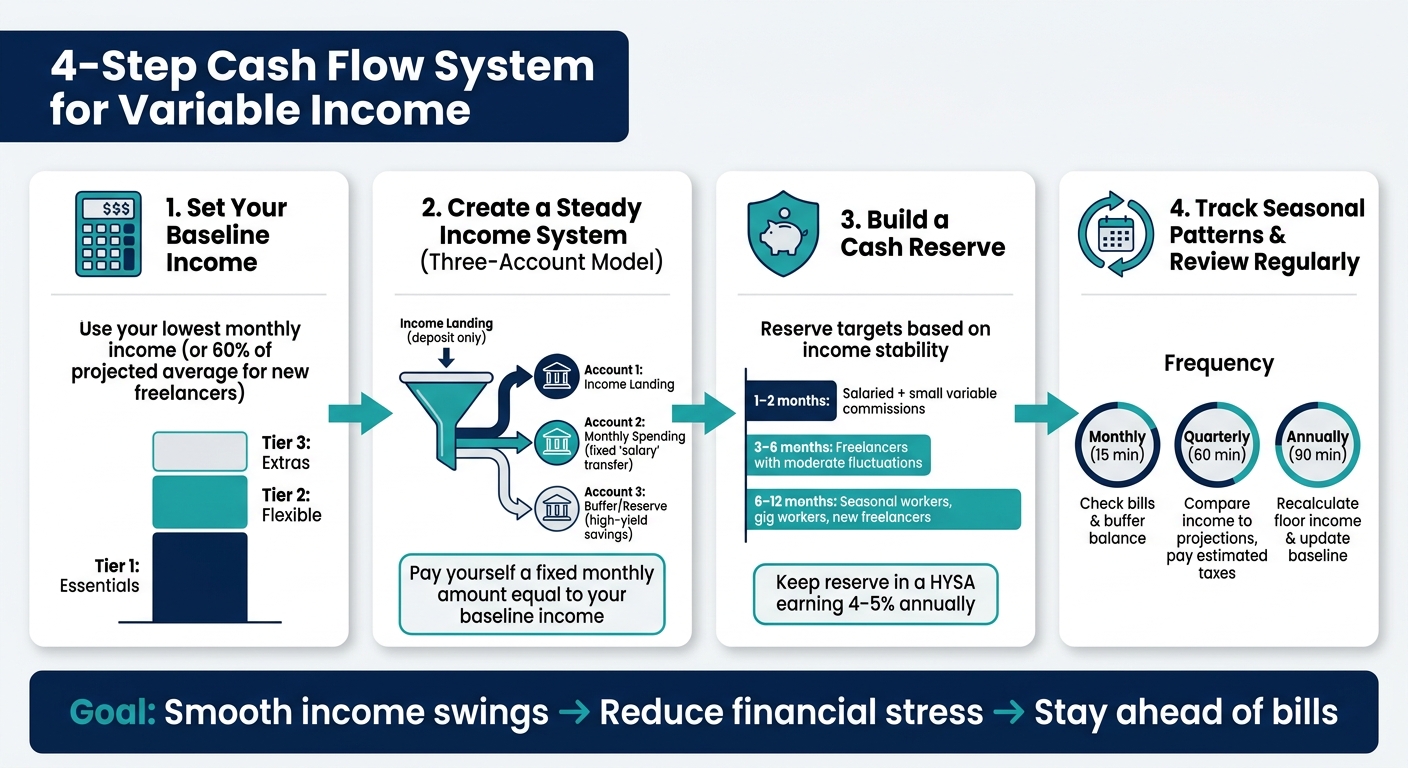
4-Step Cash Flow System for Variable Income
How Do We Budget On An Irregular Income?
sbb-itb-0a60575
Step 1: Set a Baseline for Income and Expenses
The first step to managing variable income is figuring out your baseline income – the minimum take-home pay you can consistently count on. This baseline is the cornerstone of your financial plan, helping you navigate income fluctuations and laying the groundwork for creating a steady income system and building a cash reserve.
How to Calculate Your Baseline Income
Start by reviewing your last 12 months of take-home pay. Use the lowest monthly amount as your income floor – this is the limit for your fixed expenses. As one financial expert explains:
"The income floor is the single most important number to calculate – it sets the maximum your fixed expenses are allowed to reach."
If you have more than two years of income data, you can refine this further with the percentile approach. Arrange your monthly income from lowest to highest and use the 20th or 25th percentile as your baseline. This method avoids overreacting to one-off bad months while staying realistic.
For those newer to freelancing or self-employment without much income history, start with 60% of your projected average income or rely on guaranteed retainers and signed contracts to set your baseline.
If you’re a 1099 worker, make it a habit to set aside 25–30% of every payment in a separate tax account. This will save you from any unpleasant surprises come tax season.
Sorting Expenses: Needs vs. Wants
Once your baseline income is set, figure out what it needs to cover. The "Four Walls" framework helps prioritize essentials: food (groceries, not dining out), utilities, housing, and transportation. These are the costs that remain constant, even during slower months.
Organize your expenses into three tiers:
- Tier 1: Non-negotiables like housing, basic groceries, insurance, and minimum debt payments. These must always be covered.
- Tier 2: Important but not essential items like subscriptions, dining out, and clothing. These are paused during lean months.
- Tier 3: Extras like travel, luxury purchases, or accelerated savings. These are funded only when you have surplus income.
This tiered system ensures that during slower months, cutting back on Tier 2 and Tier 3 isn’t a failure – it’s simply your plan working as designed.
Building a Simple Monthly Cash Flow Statement
With your income floor and expense priorities in place, the next step is to create a cash flow statement. This tool helps you manage the timing and amounts of your income and spending. Break your expenses into three categories:
| Expense Category | Examples | Priority |
|---|---|---|
| Fixed Costs | Rent, insurance, loan minimums | Always cover these first |
| Variable Necessities | Groceries, gas, utilities | Cover these next |
| Discretionary | Dining out, subscriptions, entertainment | Fund only with surplus income |
Map out when your income arrives and when your bills are due. A rolling 30-to-45-day forecast can help you anticipate potential cash flow issues, like overlapping bills or delays in income deposits. This way, you can stay ahead of any financial challenges and adjust as needed.
Step 2: Create a Steady Income System
Once you’ve established your baseline income and outlined your essential expenses, it’s time to create a reliable cash flow system. This approach separates income from spending, helping you smooth out financial ups and downs while making your money management simpler.
The Three-Account Model
The three-account model is a straightforward way to manage fluctuating income. Each account serves a specific purpose:
- Account 1 – Income Landing: Use this as the deposit-only account for all your earnings. Avoid spending directly from here.
- Account 2 – Monthly Spending: Transfer a fixed "salary" amount from Account 1 to this account. Use it for everyday expenses like bills, groceries, and other essentials.
- Account 3 – Buffer/Reserve: Keep this as a high-yield savings account. During high-income months, funnel the surplus here. During slower months, use it to cover any shortfalls.
This setup works because it creates a clear separation between earning, spending, and saving. As Fiat Is Fake explains:
"The fix is not a better spreadsheet. It is a buffer account that absorbs income variability so your spending account always sees the same amount."
Paying Yourself a Fixed Monthly Amount
To make this system work, set your monthly transfer to match your baseline income – the lowest monthly figure you calculated in Step 1. This ensures that even in lean months, your essential expenses are covered.
Take Maya, for instance, a freelance brand designer. She calculated her lowest monthly income at $3,100 and used that as her fixed transfer amount. Over nine months, she built a $9,300 buffer by allocating surplus income to taxes, retirement, debt, and discretionary spending.
Automate this transfer on the 1st of each month so your spending account consistently receives the same amount. Reevaluate and adjust the transfer every 90 days to account for any significant changes in your income.
Comparing Income-Smoothing Methods
Not all income-smoothing strategies work for everyone. Here’s a quick comparison of common methods:
| Method | Complexity | Stress Level | Best Fit For |
|---|---|---|---|
| Fixed Salary (Lowest Month) | Medium | Low | Ideal for freelancers who value predictability |
| Rolling Average | High | Medium | Suited for those with consistent growth; requires recalculating income trends over 6–12 months |
| Direct Spending | Low | High | Best for beginners but often leads to "feast or famine" cycles |
| Percentage Only | Low | Medium | Works well for gig workers with minimal overhead; adjusts automatically but lacks a spending floor |
For most freelancers and variable-income earners, the fixed salary method is the easiest and most dependable option.
As Finny Blog aptly puts it:
"A budget that requires every month to be average is not a budget, it is a hope."
Step 3: Build and Maintain a Cash Reserve
Once your income system is set up, the next step is to protect yourself from lean months by creating a solid cash reserve. For anyone with variable income, this reserve is a lifeline. Without it, slow months can lead to high-interest debt. Research indicates that income volatility, not income level, is the key factor in whether a household ends up with high-interest debt. By building a reserve, you can break this cycle and ensure your cash flow stays steady, even when earnings dip.
How Much to Save in Your Cash Reserve
For salaried employees, saving three to six months of expenses is often enough. But if your income fluctuates, aim higher – six to twelve months of essential expenses. This larger cushion can help you ride out longer periods of low income.
To figure out your target, start by averaging your three lowest-earning months. This gives you a baseline income floor. Then, subtract your essential expenses from that amount to calculate your monthly shortfall. Finally, multiply that shortfall by the number of months you want to cover.
| Reserve Target | Best For |
|---|---|
| 1–2 months | Those with a steady salary and small variable commissions |
| 3–6 months | Freelancers with moderate income fluctuations |
| 6–12 months | Workers with highly unpredictable income, like seasonal workers, new freelancers, or gig workers |
How to Fund and Use the Reserve
When you have a high-income month, prioritize funneling the extra money into your reserve before spending on non-essentials. Think of it as paying your future self. Once you’ve hit your reserve goal, any additional income can go toward investments or discretionary spending.
When it comes to using the reserve, set strict guidelines: only tap into it when your actual income for the month falls below your essential expenses. This ensures the reserve doesn’t slowly drain away on unnecessary purchases. Keep your reserve in a high-yield savings account (HYSA) – these accounts currently offer returns of around 4–5% annually. Storing it at a separate bank makes it accessible when you need it but less tempting to dip into impulsively.
"The buffer creates space between your income volatility and your investment decisions, so you’re never forced to choose between staying invested and covering next month’s bills." – Allison Copsey, Associate Wealth Advisor, Titan
Cash Reserve vs. Credit: A Comparison
When income drops, it’s tempting to rely on credit cards or lines of credit. But this approach often creates a bigger problem: the debt from one slow month becomes a fixed expense that makes surviving the next slow month even harder. Here’s a quick comparison to show why a cash reserve is a better option:
| Factor | Cash Reserve | Credit (Cards/Lines of Credit) |
|---|---|---|
| Interest Cost | None – earns 4–5% annually in a HYSA | High – typically 15–30% APR |
| Financial Stress | Low; offers peace of mind | High; adds debt obligations |
| Impact on Cash Flow | Smooths out future months | Reduces future cash flow due to repayments |
| Long-Term Stability | Builds wealth and financial security | Can lead to a cycle of debt |
| Accessibility | Immediate, if kept in a liquid account | Immediate, but limited by credit limit |
The only downside to a cash reserve? It takes time to build. That’s why it’s so crucial to start saving during high-income periods – before you feel the pinch.
Step 4: Account for Seasonal Patterns and Review Your Plan
Once you’ve built a steady income system and set aside a cash reserve, it’s time to fine-tune your budgeting approach to handle seasonal income fluctuations. Adjusting your plan to match these predictable cycles can make all the difference in managing variable income.
Spotting Seasonal Income Patterns
Start by analyzing 12–24 months of bank statements to identify trends in your income. Variable income often follows seasonal cycles, even if it seems unpredictable at first glance. Look for patterns, such as recurring periods of lower income – typically three or more consecutive months when earnings dip. Once you’ve identified these cycles, you can plan smarter: save more aggressively during high-income months and rely on your reserve during slower periods.
"Irregular doesn’t mean random. Most variable-income earners have patterns – seasonal slow months, quarterly payment cycles, summer dips, December surges." – mybankstatementanalysis.com
It’s also helpful to track where your income is coming from. For example, if a single client contributes heavily to your peak earnings, losing that client could significantly disrupt your seasonal income flow. Knowing this allows you to adjust your plan accordingly.
Reviewing and Updating the Plan
Avoid overreacting to a single unusual month. Instead, look at trends over three or more months before making changes to your baseline budget. This is why having a regular review schedule is so important – it helps you make informed adjustments rather than impulsive ones.
| Review | Duration | What to Do |
|---|---|---|
| Monthly | 15 minutes | Verify essential bills are paid and check your buffer balance |
| Quarterly | 60 minutes | Compare actual income to projections, pay estimated taxes, and review sinking funds |
| Annually | 90 minutes | Recalculate your floor income and update your baseline budget assumptions |
Stick to the principle of waiting for consistent patterns – three months or more – before adjusting your "salary" transfer or reserve target. Acting too quickly can lead to lifestyle creep, which might derail your financial goals. A structured review schedule ensures your plan stays realistic and aligned with your current financial situation.
Tools for Tracking Cash Flow
You don’t need anything fancy to keep track of your finances. A simple spreadsheet or a budgeting app like YNAB can work wonders. The key is consistency – choose a tool you’ll actually use. These tools should provide a clear view of your income, expenses, and buffer balance, all in one place. Regularly reviewing this information allows you to catch potential issues early and make adjustments before they affect your cash flow. By sticking to this system, you’ll stay ahead of seasonal changes and keep your finances under control.
Conclusion: Building Financial Stability on a Variable Income
Managing a variable income isn’t about achieving perfection – it’s about creating a system that can weather the ups and downs. The cash flow plan outlined here revolves around four key steps: identifying your baseline "survival number", paying yourself a steady monthly amount, maintaining a dedicated cash reserve, and routinely reviewing your plan. Together, these steps form a framework that helps you stay steady, even when your income fluctuates.
Once this system is in place, you can tie your daily cash flow to your long-term goals. One way to do this is by automating consistent contributions – aim for 10–15% of every deposit – into a retirement account like a SEP-IRA or Solo 401(k). This approach allows your contributions to grow naturally alongside your income.
Here’s a perspective to keep in mind:
"By building up an adequate amount of savings, you will create a situation where you can pay yourself the salary you need each month." – Holly Johnson, Author and Freelancer
Getting started is often the toughest hurdle. Financial planner Antowoine Winters captures this challenge well: "Creating a budget with a variable income can require big-picture thinking… if done correctly, it can really empower you to control your life." The first 90 days might feel challenging as you build your financial buffer, but that’s part of the process. Once the system begins to take shape, you’ll likely notice the anxiety easing as it starts working in your favor.
FAQs
What if my income is too new to estimate a baseline?
If your income is unpredictable or too new to estimate reliably, it’s smarter to focus on managing your expenses rather than trying to predict earnings. Begin by calculating your essential monthly costs – think housing, utilities, and insurance. For now, build your budget around the lowest income you anticipate earning. This conservative strategy helps you avoid overspending and keeps you from falling into debt during slower months.
How do I choose a “salary” amount to pay myself each month?
Start by figuring out the absolute essentials you need to cover each month. This includes things like housing, utilities, groceries, insurance, and minimum debt payments. Once you’ve tallied up these core expenses, deduct the necessary amounts for tax set-asides and contributions to an income-smoothing buffer – a fund to help even out any income ups and downs.
The remaining amount is what you should pay yourself as your monthly salary. Sticking to a consistent paycheck not only keeps your personal spending in check but also helps you maintain financial stability, no matter how much your income might fluctuate.
When is it okay to use my cash reserve?
Your cash reserve, often called an income buffer, is there to bridge the gap between irregular income and fixed expenses. It ensures you can keep up with consistent bill payments, maintain your regular salary, or stick to planned investments during months when income dips. Unlike an emergency fund, which is set aside for unforeseen crises, this reserve is specifically designed to handle predictable income swings, helping you avoid impulsive financial decisions.
Related Blog Posts
- Budget Calculator for Smarter Spending
- Emergency Fund Goal Calculator for Peace
- Budget Not Working? 5 Common Mistakes to Fix Now
- Why Budgets Fail: Common Mistakes Explained

Karla Moss is a CPA and former startup Controller who spent 15 years managing finance at the executive level — including inside a company that grew to unicorn status. She founded Karla & Co. to bring real-world financial clarity to everyday money decisions. She’s based in Phoenix, AZ and writes from personal experience as much as professional expertise.