
Most insurance policies have hidden gaps that could leave you financially exposed. These gaps often stem from exclusions buried in the fine print, outdated limits, or policies that no longer fit your current lifestyle. For instance, over 60% of U.S. homes are underinsured by about 20%, which can lead to out-of-pocket expenses exceeding $150,000 during a loss.
Key Steps to Close Insurance Gaps:
- Organize Your Policies: Gather your documents, including the declarations page, exclusions, and endorsements.
- Review Coverage Limits: Ensure your dwelling coverage matches rebuild costs, liability aligns with your net worth, and personal property limits cover high-value items.
- Identify Exclusions: Watch for common exclusions like flood damage, sewer backups, and outdated building codes.
- Add Endorsements: Consider add-ons like flood insurance, water backup coverage, and replacement cost for personal property.
- Update After Life Changes: Marriage, a new child, or a home purchase should prompt immediate policy reviews.
Annual reviews are essential. Schedule a yearly check-up to ensure your coverage evolves with your life. Protect yourself from unexpected costs by staying proactive.
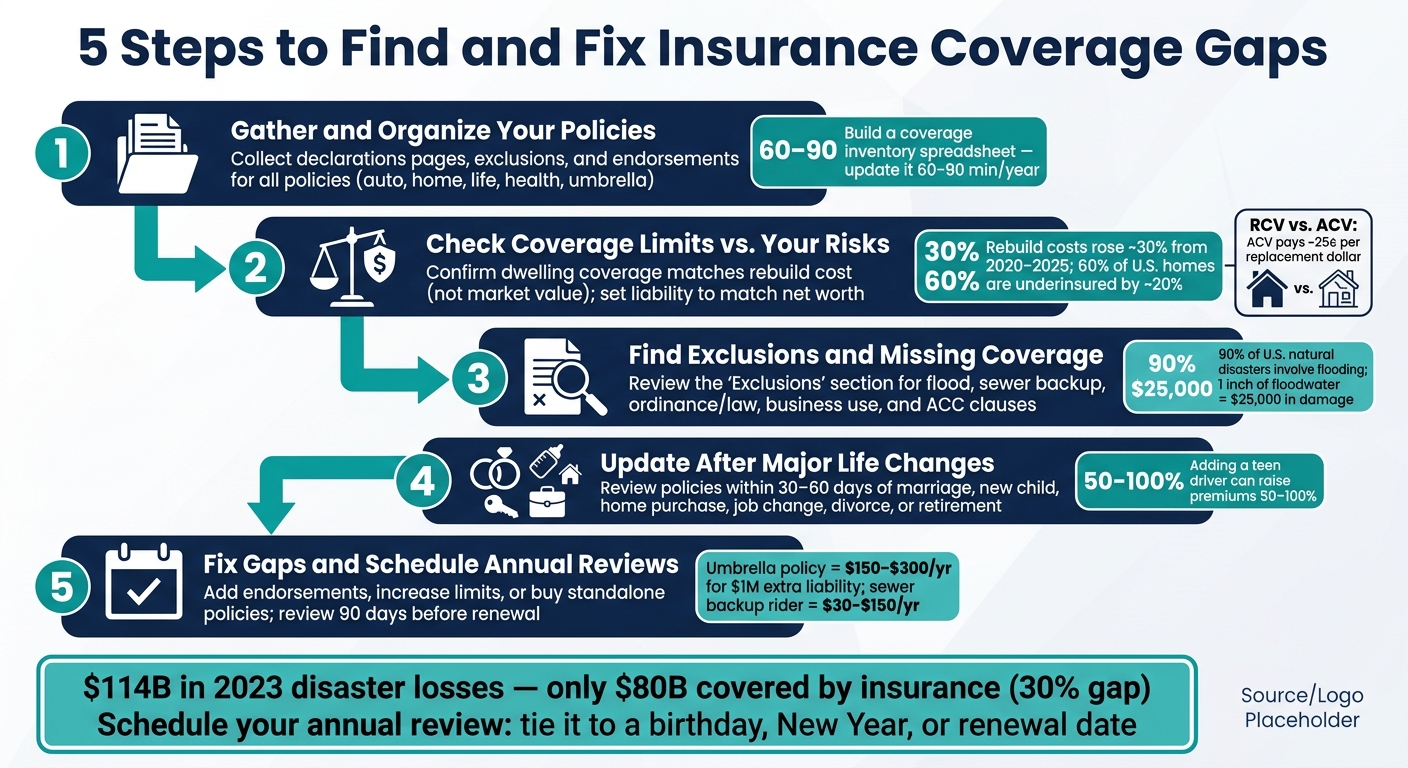
5 Steps to Find and Fix Insurance Coverage Gaps
Insurance Coverage Gaps That Could Cost You Thousands
Step 1: Gather and Organize Your Insurance Policies
Before identifying coverage gaps, you need a clear view of your current insurance. Start by collecting all your active policies – this might include auto, home or renters, life, health, umbrella, and any specialty coverages. These documents are often spread across emails, filing cabinets, and online benefits portals, so take the time to gather them all in one place.
Find Your Policy Documents
Begin by locating the declarations page (also called the "dec page") for each policy. This page is essentially a summary, outlining who and what is covered, coverage limits, deductibles, and the policy’s expiration date. As Zach Nadler, Founder of Nadler Insurance, explains:
"The dec page is where you stop assuming and start knowing what you actually bought."
If you’re missing a policy, try logging into your insurer’s online portal or call their customer service. By law, insurers are required to provide a free copy of your policy within 30 days of your request.
Once you have the declarations page, focus on two additional sections: Exclusions and Endorsements. Exclusions clarify what the policy does not cover, while endorsements are add-ons that modify or enhance your coverage. These endorsements are often attached to the end of the main document, so make sure to check thoroughly. Don’t forget to review your employer’s benefits portal for any group life, disability, or health coverage you might have overlooked.
Build a Coverage Inventory
After gathering your documents, create a simple spreadsheet to keep everything organized. Dedicate 60–90 minutes each year to update this inventory, ensuring it stays accurate.
| Inventory Category | Key Details to Record | Why It Matters |
|---|---|---|
| Policy Basics | Insurance Provider, Policy Number, Expiration Date | Ensures you know who to contact and prevents coverage lapses |
| Coverage Limits | Dwelling, Liability, etc. | Helps you determine if limits align with your current assets |
| Deductibles | Flat dollar amount or percentage (%) | Shows your out-of-pocket costs when filing a claim |
| Endorsements | Riders (e.g., sewer backup, jewelry) | Confirms that high-risk or high-value items are adequately covered |
| Beneficiaries | Primary and contingent names | Ensures death benefits go to the intended recipients |
Include a "Gap Notes" column in your spreadsheet to flag any missing coverage, such as water backup or replacement cost endorsements. This transforms your inventory into an actionable checklist for addressing potential weak spots in your policies. With everything organized, you’ll be ready to assess whether your coverage limits match your current risks in the next step.
Step 2: Check Whether Your Coverage Limits Match Your Risks
Now that you’ve got your coverage inventory sorted, it’s time to figure out if your policy limits are enough to cover your financial risks. Insurance is only helpful if it aligns with your actual needs – falling short could leave you with unexpected expenses that could cost tens of thousands.
Compare Your Limits to What You Own
Start with your dwelling coverage. Use your inventory to confirm that the coverage amount reflects what it would cost to rebuild your home today, not its market value. Why? Because rebuilding costs – driven by labor and material prices – can be much higher than market prices. Between 2020 and 2025, repair and rebuilding costs jumped nearly 30%.
Most homeowners policies include an 80% coinsurance rule. This means you need to insure your home for at least 80% of its full replacement cost. If you don’t, your insurer might reduce your claim payout. To stay on top of this, ask a local contractor or your insurance agent for an updated cost-per-square-foot estimate every couple of years.
Liability limits are another key area to review. A solid rule of thumb is to set your home and auto liability coverage at a level that matches your total net worth, including home equity, savings, and investments. For auto policies, liability limits are often shown as three numbers, like 100/300/100. This means $100,000 per person for bodily injury, $300,000 per accident, and $100,000 for property damage.
Don’t forget to check the sublimits on your personal property coverage. While your overall personal property limit might seem sufficient, standard policies often cap payouts for specific categories. For example, jewelry might be limited to $1,500 and electronics to $2,500. A detailed home inventory can help pinpoint where these caps fall short. If you have high-value items that exceed the limits, consider adding a scheduled property endorsement (or "floater") to cover their full appraised value.
"The cost of getting covered wrong isn’t measured in premiums – it’s measured in uncovered losses at the moment you can least afford them." – Joe Haddad, Covered Right
Replacement Cost vs. Actual Cash Value: What’s the Difference?
It’s not just about how much coverage you have – it’s also about how your policy values your belongings. Most policies offer two options: Replacement Cost Value (RCV) and Actual Cash Value (ACV). Here’s the difference:
- RCV pays to replace an item with a new equivalent at today’s prices.
- ACV pays the replacement cost minus depreciation for age and wear.
The gap between the two can be massive. As Brenda Wells from East Carolina University explains:
"ACV usually pays 25 cents-ish on the replacement cost dollar. So, if you lose everything you own, and it would cost you $100,000 to get all new things, your ACV policy will pay you around $25,000." – Brenda Wells, East Carolina University
| Feature | Replacement Cost (RCV) | Actual Cash Value (ACV) |
|---|---|---|
| How it works | Pays to replace the item new at today’s prices | Pays replacement cost minus depreciation |
| Payout example | A 5-year-old laptop (new cost: $1,500) → ~$1,200 | Same laptop → ~$200 after depreciation |
| Premium cost | Higher; may require an endorsement | Lower; standard default for many policies |
| Best for | Full financial recovery after a loss | Budget-conscious owners of older items |
In a standard HO-3 policy, the dwelling is usually covered at replacement cost, but personal property is often valued at ACV unless you add an endorsement. Upgrading to replacement cost for personal property typically costs only $50 to $100 a year, which can save you from a huge financial gap during a claim.
One thing to note: RCV claims are often paid in two parts. First, you’ll receive a check for the ACV amount. The remaining "recoverable depreciation" is paid once you provide proof that the item was replaced. Most policies require you to notify the insurer within 180 days of the loss, so don’t delay this process.
Next up, take a closer look at your policy exclusions to ensure you’re fully protected.
Step 3: Find Exclusions and Missing Coverage in Your Policies
Once you’ve confirmed your coverage limits in Step 2, the next step is just as important: pinpointing what your policies don’t cover. Exclusions often hide the gaps that could leave you vulnerable, and they’re easy to overlook.
Common Policy Exclusions to Be Aware Of
Grab your policy and head to the "Exclusions" or "What Is Not Covered" section. This is where you’ll find the most common reasons claims are denied.
- Flood and earthquake damage: Standard homeowners policies almost never cover these. Considering that about 90% of U.S. natural disasters involve flooding, this is a critical gap. Just one inch of floodwater can rack up $25,000 in damage. Earthquake coverage is also excluded unless you purchase a separate rider or policy.
- Sewer and drain backups: These aren’t considered "floods", but they’re still excluded from most policies. Damage from a single backup event in a finished basement can cost anywhere from $7,000 to $30,000.
- Ordinance or Law: If your home needs to be rebuilt to meet updated building codes (like modern wiring), standard policies won’t cover the additional 20–30% in costs. This is especially important for older homes.
- Business use exclusions: If you run a home-based business or participate in ridesharing services, personal policies often won’t cover related liabilities. You may need a rideshare or business-use endorsement.
- Anti-concurrent causation (ACC) clauses: These clauses can deny your entire claim if both a covered and excluded peril contribute to a loss. For instance, after Hurricane Helene, 53% of residential claims were denied due to ACC clauses.
Once you’ve identified the exclusions, it’s time to explore endorsements that can help close these gaps.
Endorsements That Can Help Fill Coverage Gaps
Endorsements (or riders) are add-ons that extend your coverage to include what standard policies leave out. Here are some key options to consider:
| Coverage Gap | Endorsement/Solution | Estimated Annual Cost |
|---|---|---|
| Flood damage | NFIP or private flood policy | $700–$2,500 |
| Sewer/drain backup | Water backup endorsement | $50–$150 |
| Earthquake | Standalone policy or rider | $800–$3,000+ |
| Ordinance or Law | Ordinance/Law endorsement | $25–$100 |
| Rideshare gap | Rideshare endorsement | $120–$480 |
| Service lines | Service line coverage | $25–$50 |
J. Robert Hunter, a former Texas Insurance Commissioner, offers a helpful perspective:
"The right question is not ‘How much does this endorsement cost?’ but ‘How much would I pay out-of-pocket if this excluded loss occurred?’"
Pay close attention to words like "however", "except," or "unless" in your policy. These often indicate partial exceptions to exclusions. For example, while general water damage might be excluded, a sudden and accidental pipe burst could still be covered.
If you’re unsure about what endorsements you already have, check your Declarations Page. This document lists all your active coverage options. If it’s not listed there, it’s not included.
sbb-itb-0a60575
Step 4: Update Your Coverage After Major Life Changes
Understanding exclusions and endorsements is only part of managing your insurance effectively. Just as important is ensuring your coverage aligns with your current life situation. Major life changes can leave you unintentionally underinsured if your policies don’t keep up.
Life Events That Should Trigger a Policy Review
Whenever a significant life event occurs, it’s a good idea to revisit your insurance policies within 30 to 60 days. These changes often expose gaps or vulnerabilities you may not have noticed before. Here’s a quick look at common life events and the areas you should review:
| Life Event | Policies to Review | Key Action |
|---|---|---|
| Marriage | Life, Auto, Health, Home | Combine auto policies (can save 15–25%); update beneficiaries |
| New Child | Life, Health, Disability | Add the newborn to your health plan within 30 days; increase life coverage to 10–12x your income |
| Home Purchase | Homeowners, Umbrella, Life | Set dwelling limits to match rebuild costs – not the purchase price – and consider flood coverage |
| Job Change | Health, Life, Disability | You have 60 days to elect COBRA or switch to a marketplace plan |
| Divorce | All policies | Separate joint auto/home policies; immediately remove your ex-spouse as a beneficiary |
| Retirement | Medicare, Long-term Care | Enroll in Medicare Part B at age 65; review long-term care insurance options |
One commonly overlooked event is adding a teen driver to your auto policy. This can increase your premiums by 50% to 100%, making it a good time to reassess your liability limits.
How to Adjust Your Policies After a Life Change
Once you’ve identified potential gaps, it’s time to make updates to ensure your policies reflect your current needs. Start with these steps:
- Update your legal name, marital status, mailing address, and household members on all policies.
- Revise beneficiary designations. Remember, life insurance, 401(k)s, and IRAs bypass your will – whoever is listed as the beneficiary will receive the funds.
- Make immediate updates to beneficiaries after a marriage or divorce.
For homeowners, it’s essential to adjust your dwelling coverage to match current rebuild costs – not the original purchase price. Construction costs have surged nearly 30% over the last five years, and over 50% of homeowners don’t have enough coverage to fully rebuild. If your net worth has grown or you’ve added features like a pool or trampoline, consider adding a $1 million umbrella policy, which typically costs between $200 and $300 annually.
Real-life stories highlight the importance of keeping your policies up to date. For instance, Sarah, a homeowner in Lexington, KY, purchased her home in 2017 for $285,000. By 2024, a review revealed her rebuild cost had risen to $410,000 due to post-COVID construction inflation. Shortly after updating her policy, a kitchen fire caused $95,000 in damages. Thanks to her updated coverage, she avoided $40,000–$50,000 in out-of-pocket expenses caused by a coinsurance penalty.
Step 5: Fix Coverage Gaps and Set Up Regular Reviews
How to Close the Gaps You Find
Now that you’ve identified gaps through your inventory and analysis in Steps 1–4, it’s time to address those gaps and ensure your coverage stays up to date.
Start by adjusting your current policies or adding new ones:
- Increase limits to match your actual risks. If your liability coverage doesn’t align with your net worth, you’re leaving yourself exposed. For example, a personal umbrella policy can provide an extra $1 million in liability protection for just $150–$300 per year. Similarly, ensure your dwelling limits reflect current rebuild costs, especially with home insurance rates rising 45.8% from 2020 through 2025.
- Add endorsements to address specific shortfalls. These are affordable add-ons for common gaps. A sewer backup rider might cost $30–$150 per year, while a replacement cost endorsement for personal property is usually around $50–$100 annually. If you’re a rideshare driver for platforms like Uber or Lyft, adding a rideshare endorsement for $10–$40 per month covers gaps that standard auto insurance won’t.
- Consider standalone policies for risks your current coverage excludes. Flood insurance is one of the most common examples. Policies through the National Flood Insurance Program (NFIP) or private insurers can be critical, especially when the average NFIP claim payout is approximately $52,000. Events like the Marshall Fire in Colorado (December 2021) highlight the dangers of being underinsured – 74% of nearly 5,000 policyholders were found to lack sufficient coverage, with over one-third carrying limits below 75% of their actual rebuild costs.
Here’s a quick breakdown of common gaps and their solutions:
| Coverage Gap | Common Fix | Estimated Annual Cost |
|---|---|---|
| Flood damage | Standalone NFIP or private policy | $700–$2,500 |
| Sewer/drain backup | Sewer backup endorsement | $30–$150 |
| Liability shortfall | Personal umbrella policy | $150–$300 per $1M |
| Undervalued personal property | Replacement cost endorsement | $50–$100 |
| Underground utility failure | Service line coverage | $25–$50 |
Once you’ve addressed these gaps, it’s essential to keep your coverage current through regular reviews.
Set a Schedule for Reviewing Your Policies
Closing coverage gaps is only part of the process – regular reviews ensure your policies continue to meet your needs as they change over time. A good rule of thumb is to perform a comprehensive review at least once a year, ideally 90 days before your primary policy renewal. This gives you plenty of time to compare quotes, make adjustments, and avoid last-minute decisions.
To make this habit stick, tie your review to a memorable date, like your birthday, New Year’s Day, or your home insurance renewal. Set a recurring calendar reminder and block out 60 to 90 minutes to go over everything. During this time, review the declarations page of each policy, verify that your limits align with current costs, and check your beneficiary designations. A simple spreadsheet tracking policy details – like numbers, carriers, renewal dates, and coverage limits – can help you stay organized.
In addition to annual reviews, certain life changes should prompt immediate updates. Major events like a home renovation, starting a side business, or making a significant purchase mean your coverage needs may shift. As InsuranceHub aptly puts it: "Insurance is a snapshot in time. It reflects your home, your income, your family, and your assets as they existed when you first bought the policy, not as they exist today."
Conclusion: Keep Your Coverage Current with Regular Reviews
An insurance policy is like a snapshot of your life at the time you bought it. But as your assets grow and your lifestyle changes, that snapshot can quickly lose relevance. Without regular updates, your policy might not reflect your current needs. The steps outlined here – reviewing policies, checking coverage limits, identifying exclusions, updating after major life events, and addressing gaps – offer a straightforward way to ensure your insurance keeps up with your life.
Many homeowners unknowingly find themselves underinsured. In 2023, for example, insurers covered only $80 billion of the $114 billion in natural disaster losses, leaving about 30% of losses uninsured. That gap often means paying out-of-pocket during emergencies, which can be financially devastating.
"Every year you skip a review, the distance between that snapshot [of your life when you bought the policy] and your current reality grows." – InsuranceHub
A yearly review of your policy – perhaps tied to a memorable date – can make a huge difference. This simple habit helps you avoid unexpected costs and ensures your financial security remains intact. By staying proactive, you protect yourself from unnecessary strain during life’s surprises. For more straightforward advice on insurance and personal finance, check out Karla & Co..
FAQs
How do I know if my home is underinsured?
To determine if your home is underinsured, make sure your policy covers the replacement cost – the amount it would take to rebuild your home at today’s prices – not just its market value. It’s also important to update your coverage limits regularly to account for rising construction costs, recent renovations, or new belongings you’ve added over time. Keep in mind that standard policies often don’t cover disasters like floods or earthquakes; you’ll need separate policies for those. Talk to your insurance agent to confirm that your dwelling limit is sufficient to cover rebuilding costs, and consider adding endorsements to protect against unexpected price increases.
What exclusions should I check for first?
When reviewing your insurance policy, start with the exclusions section. This part outlines scenarios where coverage doesn’t apply. For homeowners, common exclusions include floods, earthquakes, sewer backups, home-based businesses, and compliance with local ordinances. In auto policies, exclusions might cover business use, driving for hire (like ridesharing), or intentional acts. For health insurance, pay attention to out-of-network costs and pre-existing conditions. If anything seems unclear, reach out to your agent for clarification.
Do I need an umbrella policy?
An umbrella policy provides additional liability protection beyond the limits of your auto, homeowners, or renters insurance. This type of coverage is designed to safeguard your personal assets and future earnings in case of significant lawsuits or judgments. It’s particularly important for individuals with higher incomes, property owners, or those with potential risks such as owning a pool, having dogs, or having teen drivers in the household. To purchase an umbrella policy, you’ll need to meet certain minimum liability requirements on your existing insurance policies.
Related Blog Posts
- Term Life vs Whole Life Insurance: Key Differences
- DIY vs Pro Repairs: When to Save or Spend
- How to Rebuild an Empty Emergency Fund
- How to Budget for Big-Ticket Items

Karla Moss is a CPA and former startup Controller who spent 15 years managing finance at the executive level — including inside a company that grew to unicorn status. She founded Karla & Co. to bring real-world financial clarity to everyday money decisions. She’s based in Phoenix, AZ and writes from personal experience as much as professional expertise.