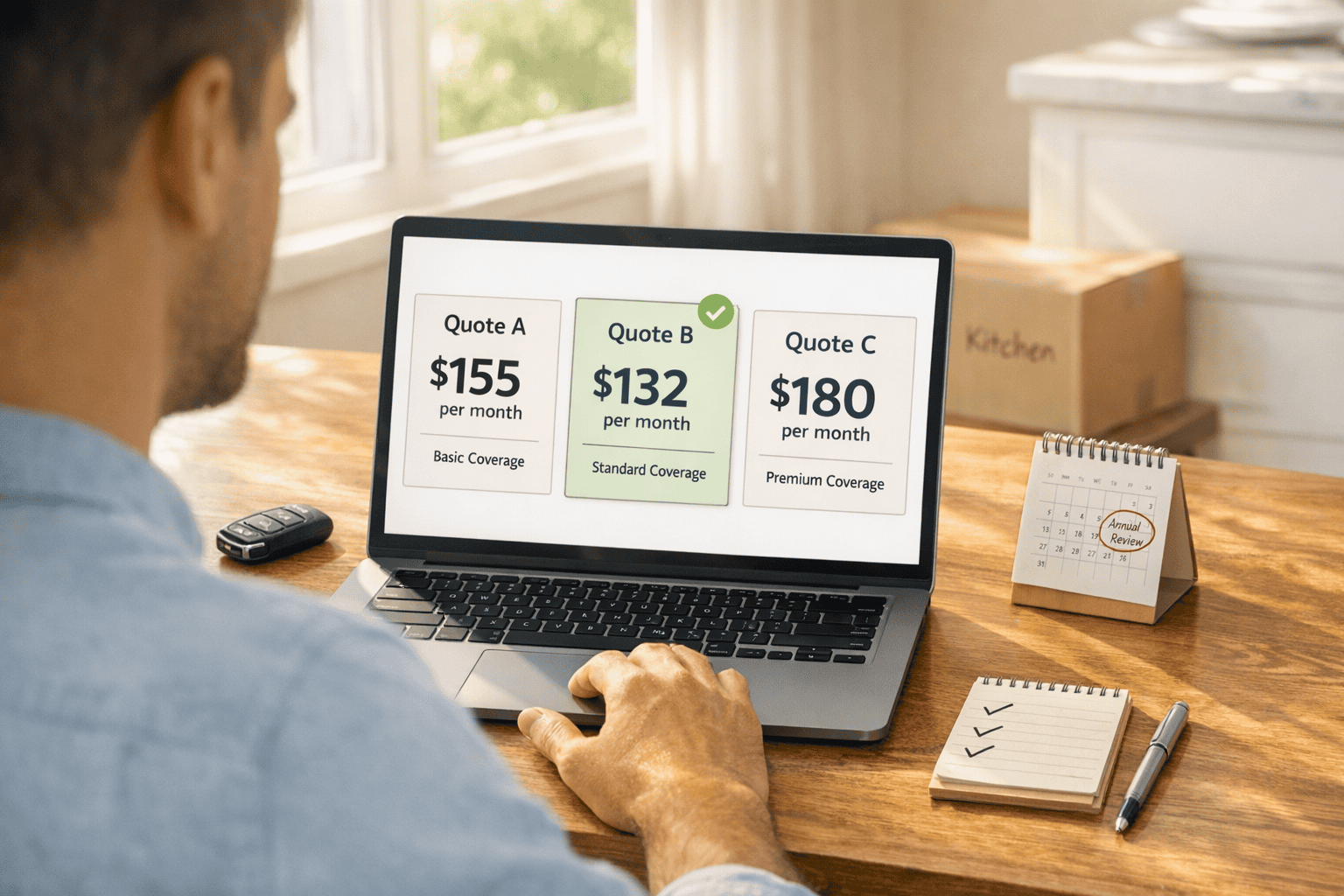
When it comes to auto insurance, sticking with the same provider might cost you more than you think. Insurers often offer their best rates to attract new customers, leaving loyal clients with rising premiums over time. In fact, drivers who shop around and switch insurance save a median of $461 per year, with 41% saving $500 or more. Yet, 65%-70% of people don’t compare rates annually, missing out on significant savings.
Key Takeaways:
- Loyalty can cost you: Insurers use algorithms to gradually increase premiums for long-term customers.
- Discounts vary widely: Switching providers may unlock savings like telematics discounts (up to 30%) or bundling offers.
- Rates differ by provider: Factors like driving record, credit score, and even your ZIP code can cause quotes to vary by hundreds – or even thousands – of dollars.
- Life changes matter: Moving, getting married, buying a new car, or improving your credit score can all impact your rates.
- Timing is key: Shop for quotes 21-29 days before your policy renewal for the best deals.
To save money, compare at least three quotes every year or after major life events. Always ensure your new policy is active before canceling the old one to avoid coverage gaps. Switching providers may seem like a hassle, but the potential savings make it worth the effort.
The Cost of Staying with One Provider
Why Loyalty Can Cost You More
It might feel like sticking with the same insurance provider is the easiest and safest option, but it could be quietly draining your wallet. Many insurers lure new customers with lower introductory rates, while long-term customers often face higher base premiums. On average, new policyholders save 15% to 20% compared to those who stay loyal to the same company.
This pricing strategy isn’t random. Insurers use price optimization algorithms to gradually increase rates, banking on the idea that loyal customers won’t shop around. If you rarely compare quotes, you’re essentially signaling to your insurer that you’re willing to accept higher premiums. As Insure.com explains:
"Price optimization is designed to optimize policy pricing for the insurer, not for the customer."
While loyalty discounts do exist – such as State Farm‘s 20%, American Family‘s 18%, and GEICO‘s 15% – they often don’t offset the higher premiums long-term customers are charged. The math simply doesn’t favor sticking around without regularly comparing quotes.
This makes it all the more important to explore potential savings and discounts that your current provider may not be offering.
Discounts You May Be Missing
By staying with one insurer, you could also be missing out on discounts that other providers might offer. Switching carriers can reveal savings opportunities that your current provider either doesn’t promote or doesn’t have.
Take telematics, for instance. This usage-based insurance program monitors your driving habits – like speed, braking, and mileage – and rewards safe driving with discounts of up to 30%. Interestingly, 63% of drivers are open to sharing their driving data if it means paying less for insurance. If your current insurer lacks a competitive telematics program, another provider might offer significant savings.
Other discounts often overlooked include bundling home and auto policies, paying your premium in full, opting for paperless billing, or qualifying for discounts through professional or alumni associations. These savings can add up quickly, and new providers are often more eager to apply them to win your business. If you haven’t reviewed your discount options recently, you might be leaving money on the table.
sbb-itb-0a60575
Why You Need To Shop Your Auto Insurance ASAP
Why Insurance Rates Differ Between Providers
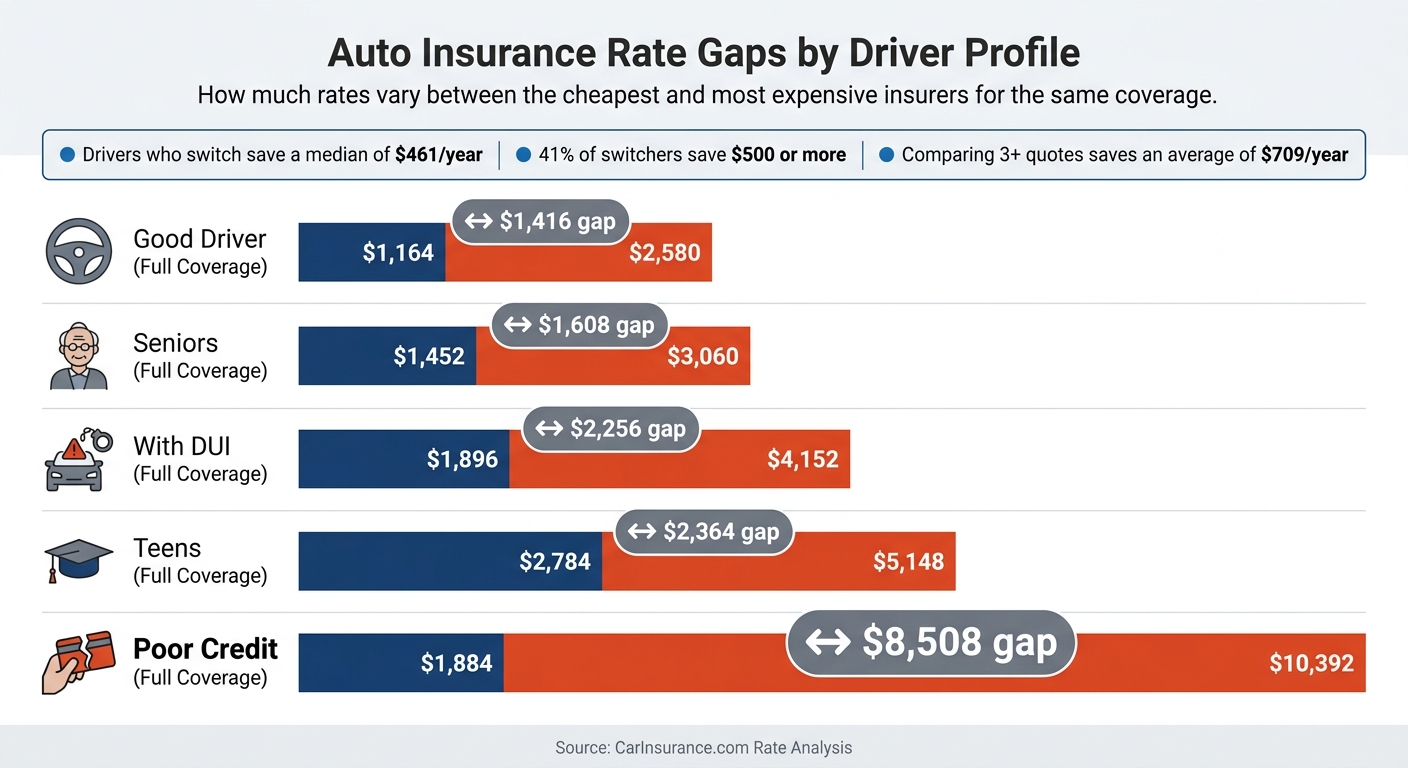
Auto Insurance Rate Gaps by Driver Profile: How Much You Could Save by Shopping Around
How Insurers Calculate Your Risk
Ever wonder why two drivers with nearly identical profiles can get insurance quotes that vary by hundreds of dollars? It all comes down to how insurers calculate risk. Each company uses its own proprietary algorithm to assess the likelihood of a claim, which means the same person might appear riskier – or safer – depending on the insurer.
Key factors like your driving record, claims history, credit score (where it’s permitted), ZIP code, and vehicle type all play a role. These elements reflect local traffic patterns, crime rates, and repair costs. Even the car you drive can make a big difference. For example, insuring a Toyota Prius costs an average of $2,774 per year for full coverage, while a BMW 330i averages $3,309 – a $535 difference based solely on the vehicle.
One of the most surprising factors? Credit score. Drivers with low credit can see massive price swings – up to 452% between the cheapest and most expensive policies for identical coverage. For instance, one insurer might quote $1,884, while another charges a staggering $10,392 for the same policy. However, if you live in California, Hawaii, or Massachusetts, you’re in luck – those states prohibit the use of credit scores in setting insurance rates.
"Car insurance is one of the few consumer products that tends to undermine loyalty." – Joshua Morrison, Owner, Morrison Insurance Service
Take a look at the table below to see how rates can vary based on driver profiles:
| Driver Profile | Lowest Avg. Rate | Highest Avg. Rate | Price Gap |
|---|---|---|---|
| Good Driver (Full Coverage) | $1,164 | $2,580 | $1,416 |
| Teens (Full Coverage) | $2,784 | $5,148 | $2,364 |
| Seniors (Full Coverage) | $1,452 | $3,060 | $1,608 |
| Poor Credit (Full Coverage) | $1,884 | $10,392 | $8,508 |
| With DUI (Full Coverage) | $1,896 | $4,152 | $2,256 |
Source: CarInsurance.com Rate Analysis
How Life Changes Affect Your Rates
Life doesn’t stand still, and neither do your insurance rates. Major life events can shift how insurers view your risk, often creating opportunities to find better deals.
Moving is one of the biggest factors. A new ZIP code can completely change your risk profile based on local accident rates, theft statistics, and repair costs. Similarly, getting married can work in your favor – married drivers tend to pay about 7% less than singles since they’re considered lower risk. However, adding a 16-year-old driver to your policy is a different story. That change can spike your annual premium to an average of $5,740.
Buying a new car is another moment to reassess your rates. Cars equipped with advanced safety features, like lane assist or automatic braking, might earn you discounts with some insurers, while others may not weigh those features as heavily. The same goes for improving your credit score. In most states, a credit boost can lead to lower premiums – but only if you shop around to take advantage of it.
These shifts highlight why comparing quotes regularly is so important. Life changes can dramatically alter your rates, and staying proactive ensures you’re not paying more than you should.
How to Compare Insurance Quotes the Right Way
What to Look at When Comparing Policies
It’s tempting to focus only on the monthly premium when comparing insurance quotes, but that approach can lead to surprises. A lower price might come with trade-offs like reduced coverage, higher deductibles, or a company that struggles with claims processing. Before diving in, pull up your current declarations page. This document outlines your liability limits, deductibles, and any add-ons, giving you a solid foundation to make an "apples-to-apples" comparison.
Here are the main elements to review in each quote:
- Liability limits: Experts recommend at least 100/300/100 coverage – $100,000 per person and $300,000 per accident for bodily injury, plus $100,000 for property damage. State minimums often fall short of protecting your assets in a serious accident.
- Deductibles: Opting for a higher deductible can trim your premium by 20% to 25%. Just make sure you can afford the out-of-pocket expense if you need to file a claim.
- Exclusions and perks: Look closely at who’s covered as a driver and whether extras like roadside assistance are included or available for an additional fee.
- Payment plan fees: Some insurers offer a 5% to 10% discount if you pay your premium in full. On the flip side, paying monthly may come with extra fees that drive up your total cost.
Don’t stop at the numbers – dig deeper into the insurer’s reputation. Check their financial strength (look for an AM Best rating of A or higher) and their complaint history with the National Association of Insurance Commissioners. A low premium might not be worth it if the company has a track record of disputed claims.
"Be wary of extremely low quoted premiums. If one quote comes in extremely low, ask clarifying questions to ensure you are comparing apples to apples." – Steve Ellis, Assistant Vice President and Claims Field Manager
For instance, in May 2026, Selena, a 30-year-old married teacher, needed to replace her $1,800 policy. She received three quotes: $2,100, $1,500 (which included roadside assistance), and $1,250. While the $1,250 quote was the cheapest, she ruled it out due to the provider’s poor claims reputation. Instead, she chose the $1,500 policy, and after applying a teacher discount, her rate dropped to $1,400. This gave her better coverage and a lower deductible – proof that the cheapest option isn’t always the best.
Once you’ve nailed down what to look for in a policy, it’s time to figure out when and how to shop for quotes.
When and How to Get Quotes
Timing is everything when it comes to shopping for insurance. The sweet spot is 21 to 29 days before your policy renewal. This window is early enough to snag "early shopper" discounts but close enough to your renewal date to avoid price shifts. Start your research 30 to 45 days ahead of renewal to avoid last-minute scrambling.
Aim to gather at least three quotes. Studies show that comparing quotes from three or more insurers can save drivers an average of $709 annually. Use online tools to get a quick overview, then consult an independent agent if your situation is more complex – like bundling home and auto policies or insuring multiple drivers. And don’t worry about your credit score; insurance quotes typically involve a "soft" credit pull, which won’t affect it.
Here are a few life events that might signal it’s time to shop around:
- Moving to a new ZIP code: Local crime rates and accident statistics can impact your premium.
- Getting married: Married drivers often see premiums drop by 6% to 15%.
- Improving your credit: A better credit score can unlock lower premium tiers.
- Buying a new car: Features like advanced safety systems and the car’s value influence your rate.
- Job change or remote work: Driving fewer miles could qualify you for low-mileage discounts.
- Turning 25: Rates tend to decrease as drivers exit the high-risk young driver category.
When you find a low quote, be sure to ask, "Will this new-customer discount expire at renewal?" Some insurers use introductory pricing that jumps after the first six months, so it’s crucial to confirm this upfront. Following these steps ensures you’re getting the best coverage at a competitive price while avoiding costly surprises.
How to Switch Providers Without Losing Coverage
Switching to a new insurance provider can save you money, but it’s crucial to do it without losing coverage. By following a few key steps, you can ensure a smooth transition and avoid any gaps in your protection.
Steps to Avoid a Coverage Gap
The golden rule: never cancel your old policy until your new one is active and you have written proof. Even a single day without coverage is illegal in most states and can lead to steep rate hikes – anywhere from 10% to 50% – for the next three to five years.
Here’s a real-life example: In March 2026, a policyholder named Marcus let his auto insurance lapse for just three days. The result? A $340 annual surcharge that added up to over $1,000 in extra premiums over the next three years. That’s an expensive lesson.
To avoid this, start by securing an insurance binder from your new provider. This document serves as temporary proof that your new coverage is active. Many insurers now offer this instantly through their mobile apps. Be sure to align the start date of your new policy with the end date of your old one – no gaps, no overlaps.
If you have a car loan or mortgage, notify your lender within three days of switching policies. Homeowners should also update the "mortgagee clause" on their new policy right away. Ignoring this step can result in force-placed insurance, which is significantly more expensive and only benefits your lender, not you.
"Only cancel your policy after written confirmation posts since system delays can flag uninsured status. For example, start dates must overlap." – Michelle Robbins, Licensed Insurance Agent
Once your new coverage is active and confirmed, you’re ready to cancel your old policy. Here’s how to do it correctly.
How to Handle Cancellations and Refunds
After confirming your new policy is active, cancel your old one in writing. Don’t just stop making payments – this can be reported as non-payment, which can harm both your insurance score and credit history.
If you’re canceling mid-term, you’re likely owed a refund for the unused portion of your premium. However, the amount depends on how your insurer handles cancellations:
- Pro-rata refund: You get back the full unused amount.
- Short-rate refund: The insurer keeps a small percentage (often around 10%) to cover early cancellation costs.
For example, if you cancel a six-month policy costing $600 after three months, you’d typically get $300 back under pro-rata terms, minus any fees. Some insurers charge no fee, while others may take a flat fee (e.g., $50) or up to 15% of the unused premium.
Even with fees, it’s often worth it. As MoneyGeek points out, "A $50 cancellation fee costs less than one month of overpaying at a higher rate". Refunds are usually processed within 5 to 14 business days, so follow up to ensure you receive a final statement showing a $0 balance.
Conclusion: Start Saving by Shopping Around
Insurance premiums can vary widely based on market trends, personal risk factors, and how willing you are to switch providers. Many insurers use price optimization algorithms to charge loyal customers the highest amount they think those customers will pay without leaving. In short, loyalty often comes at a cost.
This makes it clear why shopping around is so important. The numbers speak for themselves: drivers who switch carriers save a median of $461 per year, and 13% of them save $1,000 or more. For homeowners, the potential savings are even higher, with premiums dropping by 15% to 25% when switching. If you redirect these savings into a high-yield savings account, the benefits can multiply over time.
"The gap between the cheapest and most expensive carriers has grown large enough that switching insurers represents one of the most impactful personal finance decisions Americans can make." – Mark Fitzpatrick, Insurance Expert, MoneyGeek
Getting quotes is easier than you might think. A soft credit check won’t hurt your credit score, and switching mid-policy often comes with prorated refunds. Just make sure your new coverage is active before canceling your old policy to avoid any gaps.
To stay ahead of rising rates, compare quotes every one to two years – or after major life events like moving, getting married, or improving your credit score. This helps you take advantage of early-shopper discounts and ensures your coverage limits stay aligned with your needs.
"Rates change often, and a simple comparison prevents a family from carrying an outdated price into the next policy period." – Dennis Shirshikov, Adjunct Professor of Economics and Finance, City University of New York
FAQs
How often should I shop for car insurance?
Shopping for car insurance isn’t a one-and-done task. You should review your options at least once a year – ideally 30–45 days before your policy renewal. This gives you time to compare rates and check for any discounts you might qualify for.
It’s also smart to re-shop after major life changes, like moving to a new area, adding a driver to your policy, purchasing a new car, or updating your coverage needs. These factors can directly affect your premium, and comparing options can help ensure you’re not paying more than you need to.
Will getting quotes hurt my credit score?
No, getting quotes won’t harm your credit score. When you shop for insurance, providers might check your credit-based insurance score, but this is a soft inquiry. Soft inquiries don’t impact your credit score in any way. Comparing rates from multiple insurers is a great way to find the best deal for your budget without worrying about your credit history. It’s a smart move to save money in the long run.
What’s the safest way to switch without a lapse?
The best way to change providers without any gaps in coverage is to activate your new policy before canceling your current one. Make sure you have written confirmation of your new policy’s start date and verify that it’s active. Align the start date of your new policy with the end date of your existing one. Only cancel your current policy after confirming the new one is fully in place to avoid any coverage gaps or legal complications.
Related Blog Posts
- Term Life vs Whole Life Insurance: Key Differences
- 8 Smart Ways to Lower Your Monthly Bills
- DIY vs Pro Repairs: When to Save or Spend
- How to Spot Gaps in Insurance Policies

Karla Moss is a CPA and former startup Controller who spent 15 years managing finance at the executive level — including inside a company that grew to unicorn status. She founded Karla & Co. to bring real-world financial clarity to everyday money decisions. She’s based in Phoenix, AZ and writes from personal experience as much as professional expertise.