
When transferring a credit card balance, it’s easy to make errors that can cost you money and cancel out the benefits of a 0% APR offer. Here’s what you need to know to avoid common pitfalls and save on interest:
- Missed Deadlines: You typically have 60-90 days to transfer your balance and secure the 0% APR. Act quickly to avoid regular interest rates, which can range from 16.49% to 29.49%.
- Balance Transfer Fees: Most cards charge a fee of 3%-5% of the transfer amount. Calculate this cost to determine if the transfer is worth it.
- Using the Transfer Card for Purchases: New purchases may accrue interest immediately unless the card also offers 0% APR on purchases. Avoid using the card for daily expenses.
- No Repayment Plan: Without a clear plan, you risk carrying a balance into the regular APR period, which can exceed 28%. Divide your total balance by the promotional months to set a realistic monthly payment.
- Missed Payments: A single late payment can result in fees, a penalty APR, and loss of the 0% offer. Set up autopay to avoid this.
- Ignoring Credit Limits: Ensure the transfer amount, including fees, fits within your credit limit. Most issuers allow transfers up to 75% of your limit.
- Spending on Old Cards: Resist using the freed-up credit on your old cards. This can lead to more debt and derail your repayment efforts.
How 0% Balance Transfer Works (Don’t make this mistake)
Missing the Balance Transfer Deadline
Balance transfer cards typically give you a 60- to 90-day window from the time you open the account to qualify for that enticing 0% APR offer. If you miss this deadline, your transferred balance will be hit with the card’s regular interest rate, which can range anywhere from 16.49% to 29.49%, depending on the issuer.
Why Deadlines Matter
This promotional window isn’t flexible – it’s a firm deadline. To lock in the 0% rate, you need to not only initiate but also confirm the transfer within this period. Simply requesting the transfer won’t cut it.
"After the deadline passes, balances transferred may receive the higher, standard APR." – LaToya Irby, Personal Finance Writer, Experian
Timing is everything here. Transfers can take 3 to 14 days to process, and issuers like Discover won’t even start processing until your account has been open for 14 days. So, if you initiate a transfer on day 59 of a 60-day window, there’s a good chance it won’t post in time.
How to Stay on Track
Start the transfer process as soon as your account is approved – don’t wait for the physical card to arrive. To keep yourself on schedule, set digital reminders on your phone or calendar for the 30-day and 45-day marks after opening the account. This ensures you’ll have time to initiate and confirm the transfer.
Double-check account numbers before submitting to avoid errors that could delay the process. And don’t stop paying the minimum on your old card until you’ve received confirmation that the transfer is complete.
Ignoring the Balance Transfer Fee
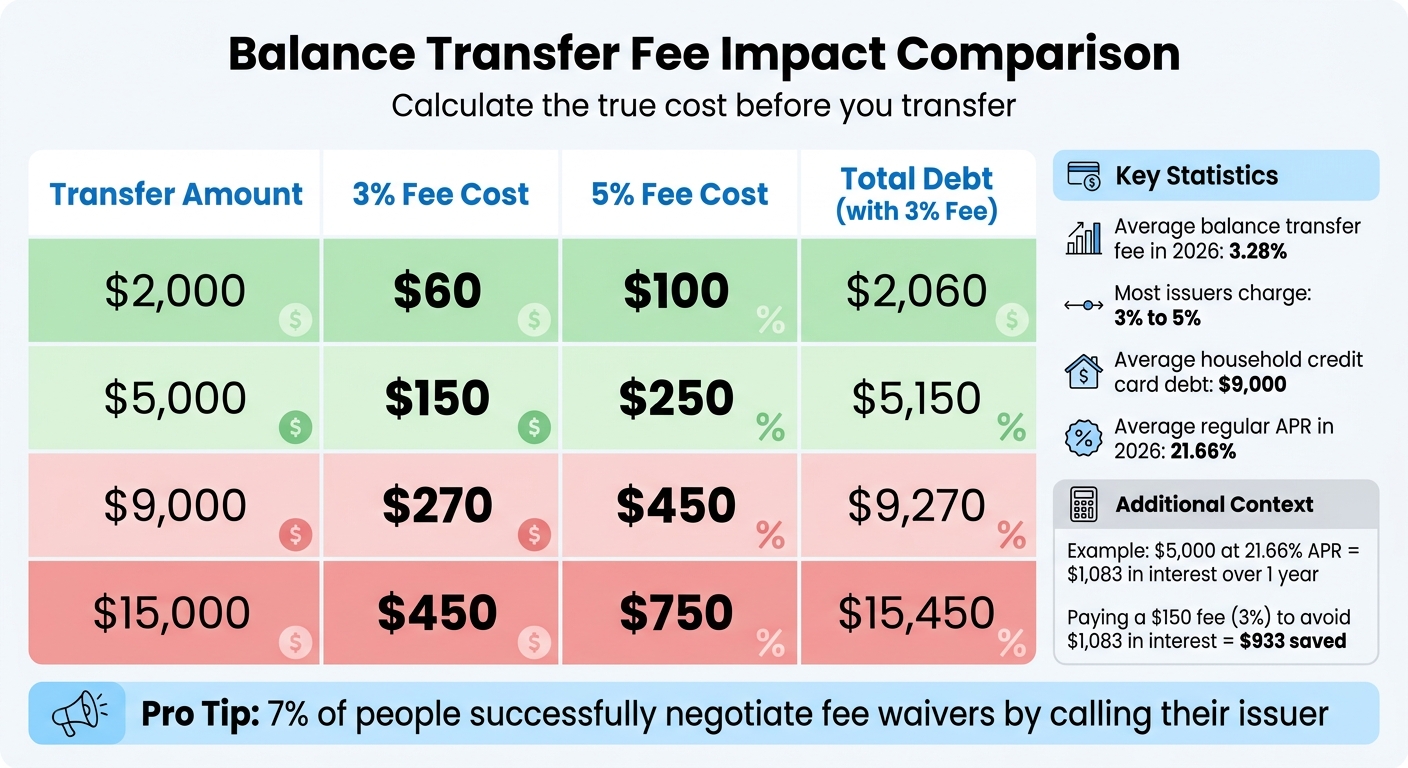
Balance Transfer Fee Impact Calculator: Cost Comparison by Transfer Amount
Once you’ve tackled deadlines, don’t forget to factor in the balance transfer fee. Most balance transfer cards tack on a one-time fee, and it’s added to your new balance right away. As of early 2026, the average fee is 3.28%, though most issuers fall between 3% and 5% of the transfer amount.
Calculating the Real Cost
Let’s break it down: transferring $5,000 at a 3% fee means you’re paying $150 upfront, which is added to your balance immediately. That brings your new total to $5,150. For the average household carrying $9,000 in credit card debt, a 3% fee would cost around $270.
"Balance transfer fees ensure that the issuers of balance transfer credit cards make money even if you repay your full balance before a 0% intro APR gives way to a high regular interest rate." – Adam McCann, WalletHub Financial Writer
Before you commit, weigh the fee against the interest you’d save during the 0% APR period. For example, if you’re paying 21.66% APR (the 2026 average for regular rates) on $5,000, you’d rack up about $1,083 in interest over a year. Paying a $150 fee to avoid that interest could be a smart move – if you can clear the balance before the promotional period ends.
Fee Impact Comparison Table
| Transfer Amount | 3% Fee Cost | 5% Fee Cost | Total Debt (with 3% Fee) |
|---|---|---|---|
| $2,000 | $60 | $100 | $2,060 |
| $5,000 | $150 | $250 | $5,150 |
| $9,000 | $270 | $450 | $9,270 |
| $15,000 | $450 | $750 | $15,450 |
One more tip: call your card issuer and ask for a fee waiver. About 7% of people succeed. A quick phone call could save you some cash, especially if your credit score is strong.
Making Purchases on the Transfer Card
A common misstep people make is transferring a balance to take advantage of a 0% APR offer, then using the same card for everyday purchases like groceries, gas, or online shopping. Unless your card explicitly includes a 0% introductory APR on both balance transfers and purchases, any new transactions will start accruing interest at the regular rate – often 18% or more – right away.
Typically, credit cards offer a grace period of about 21 days for new purchases, during which no interest is charged. However, this grace period disappears once you transfer a balance, meaning interest starts piling up on new purchases immediately.
"Making purchases after transferring a balance may increase your interest cost and the time it takes to pay off the balance." – LaToya Irby, Personal Finance Writer, Experian
Beyond the immediate interest charges, making purchases on a balance transfer card creates additional complications. Payment allocation rules make it tricky to manage repayment effectively. By law, payments above the minimum are applied to the balance with the highest interest rate first. This means your payments will target new purchases before touching the 0% balance transfer, delaying your progress on the transfer.
To avoid these issues, it’s a good idea to set your balance transfer card aside. Remove it from digital wallets and saved payment methods. Instead, use a different card or a debit card for daily expenses. This strategy helps you fully benefit from the 0% APR period and ensures your repayment plan stays on track.
Failing to Create a Repayment Plan
Not having a repayment plan in place can cost you – big time. The 0% APR period, which usually lasts between 12 and 21 months, is a limited window of opportunity. Once it ends, any unpaid balance will start accruing interest at the regular APR, which can range from 17.49% to over 28%.
"If your payments are too low, you may have a balance left when the regular APR kicks in." – LaToya Irby, Personal Finance Writer, Experian
To avoid this, calculate your monthly payment by factoring in the transfer fee (usually 3% to 5%) and dividing the total by the number of promotional months. This calculated amount is what you should aim to pay each month – not the minimum payment your bank suggests, but the amount you need to ensure your balance hits zero before the promotional period ends.
In September 2025, Joel O’Leary shared an example of someone with $30,000 in credit card debt. By using an 18-month 0% balance transfer card and sticking to a strict repayment plan, they managed to pay off the entire balance and save about $9,000 in interest charges.
Setting Realistic Monthly Goals
Once you’ve worked out your repayment strategy, it’s time to set clear monthly goals. This helps you avoid carrying any leftover balance into the regular APR period. For instance, if you transfer $6,000 and pay a 5% fee ($300), your total balance becomes $6,300. With an 18-month promotional period, you’d need to pay $350 per month to clear the debt before interest kicks in.
Here’s a quick breakdown of different scenarios:
| Total Debt to Transfer | Transfer Fee (5%) | Total Balance | Promo Period | Monthly Payment to Reach $0 |
|---|---|---|---|---|
| $2,000 | $100 | $2,100 | 12 Months | $175.00 |
| $5,000 | $250 | $5,250 | 15 Months | $350.00 |
| $6,000 | $300 | $6,300 | 18 Months | $350.00 |
| $10,000 | $500 | $10,500 | 21 Months | $500.00 |
Once you’ve calculated your monthly payment, set up automatic payments for that amount. This prevents missed payments, which could lead to late fees of up to $41 and might even cancel your 0% APR offer.
"A great way to do this is by taking your entire balance, and dividing it by the number of months in the 0% intro APR period. Then setting a monthly automatic payment for that amount." – Joel O’Leary, Full-Time Personal Finance Writer, Motley Fool Money
Benefits of Paying Off Early
If you can, paying off your balance ahead of schedule has multiple perks. By exceeding your monthly target, you can eliminate debt faster and reduce financial stress. It’s a smart idea to aim to finish at least one month before the end of the promotional period. This provides a buffer for any unexpected expenses or payment processing delays.
Paying early doesn’t just lighten your financial load – it can also boost your confidence as you see your debt shrink. Plus, once the balance is cleared, you can redirect that monthly payment toward other goals, like building an emergency fund or starting an investment plan.
Missing Payments
Missing just one payment can have serious consequences, especially if you’re relying on a 0% APR offer. A missed payment doesn’t just lead to late fees – it can also trigger a penalty APR, which could send your interest rate soaring to the maximum allowed under your card’s terms.
"At a minimum, a late payment means you’ll pay a late fee, which can be as high as $41. In addition, you could lose your temporary 0% APR rate and have the penalty APR imposed on your balance instead." – LaToya Irby, Personal Finance Writer, Experian
Beyond the immediate financial hit, missing a payment can harm your credit score. Since payment history accounts for 35% of your FICO Score, it’s the most important factor in determining your creditworthiness. While credit bureaus typically don’t report a payment as late until it’s at least 30 days overdue, your card issuer can impose late fees right away. Worse, a missed payment could result in losing your 0% promotional APR, replacing it with a penalty APR.
To steer clear of these costly mistakes, make sure to continue paying at least the minimum due on both accounts until your balance transfer is fully processed – this can take several weeks. Stopping payments too early might result in late fees on your original account, further complicating your situation.
Here’s how to stay on top of things:
- Set up autopay on both accounts to ensure payments are never missed.
- Monitor both accounts for one to two months after the transfer to confirm there are no lingering fees or residual interest.
- If you miss a payment by just a few days, call customer service immediately. Many issuers may grant a one-time courtesy waiver to preserve your 0% APR.
Taking these precautions can help you avoid unnecessary fees, protect your credit score, and maintain your promotional interest rate.
Overlooking Credit Limits and Eligibility
When planning a balance transfer, it’s not just about managing payments and fees – it’s equally important to ensure your credit profile aligns with the requirements for a smooth transfer. Overlooking credit limits or eligibility can derail your strategy before it even begins.
Before applying, confirm that you’re eligible and that the credit limit can comfortably cover your debt. Skipping this step might lead to a hard inquiry, which could drop your credit score by 5–10 points. Worse, you might end up with a credit limit too low to handle your transfer.
Most issuers limit balance transfers to about 75% of your approved credit line. For instance, if you’re granted a $10,000 limit, you might only be able to transfer $7,500. On top of that, the 3% to 5% balance transfer fee is added to your total, further reducing your available credit. For example, transferring $7,500 with a 5% fee would add $375 to your balance, cutting into what’s left of your credit line.
Pre-Qualifying for a Transfer
Several major issuers, such as Citi, American Express, and Chase, offer pre-qualification tools. These tools use a soft credit pull to check your eligibility without impacting your credit score.
"Prequalification gives your potential lender permission to run a soft credit check and determine your eligibility without affecting your credit score." – First Federal Bank
Pre-qualification simplifies the process and helps you avoid unnecessary hits to your credit score. To pre-qualify, you’ll typically need to provide your Social Security number, address, employment status, and annual income. If you don’t qualify, it’s best to wait at least six months before reapplying, giving your credit score time to recover.
Ensuring Adequate Credit Limit
Make sure your available credit can handle not just the balance but also the transfer fee. Add 5% to your total debt to account for the fee. For example, if you owe $8,000, you’ll need at least $8,400 in available credit. Most balance transfer cards require a credit score of 670 or higher, with the best offers typically reserved for scores above 700.
"Your total transfer amount, including fees, must be within your available credit limit." – LaToya Irby, Personal Finance Writer, Experian
If your approved limit falls short of your total debt, prioritize transferring the highest-interest balances first to maximize savings. Additionally, if your financial situation has improved – such as an increase in income or a reduction in debt – you can request a credit limit increase from your issuer.
Resuming Spending on Old Cards
Once you’ve set up a solid repayment plan, resist the temptation to start using the available credit on your old card again.
When you transfer a balance, the credit limit on your old card becomes available once more. While it might feel like a safety net, using that credit could derail your repayment efforts and lead to even more debt.
The biggest danger here? Adding new charges to the old account, which can deepen your financial challenges. As LaToya Irby, Personal Finance Writer at Experian, puts it:
"Another credit card balance means another payment to keep up with. It can strain your budget and make it harder to pay off your transfer balance".
Juggling multiple payments can make it nearly impossible to hit your repayment goals. Remember, the key to maximizing a 0% APR balance transfer is sticking to a plan that pays off your debt within the promotional period.
To stay on track, consider using a debit card for your daily expenses. This way, you’re only spending money you already have, keeping your focus squarely on paying down your transferred balance. You should still monitor your old card occasionally to ensure no unexpected charges pop up. While it’s important to stop using the card, avoid closing the account. Keeping it open helps preserve your credit history and keeps your overall credit utilization lower.
Conclusion
Balance transfers can help you save on interest, but they only work if you sidestep common pitfalls like missed deadlines, fees, and racking up new charges – whether on your transfer card or your old ones.
The key to success lies in adopting a disciplined repayment strategy. As Prince George’s Community Federal Credit Union explains:
"A credit card balance transfer doesn’t erase the old debt. Instead, it moves the debt to a different credit card".
Without a clear plan, you’re not eliminating debt – you’re just shifting it around.
Start by setting a realistic monthly payment goal based on your total balance and the promotional period. Automate your payments to avoid missing deadlines, as a single late payment could hit you with fees as high as $41 and might cancel your 0% APR. Also, resist the urge to use the newly freed-up credit on your old cards or to make fresh purchases on your transfer card.
When used wisely, balance transfers can save you thousands in interest and help you pay off your debt faster. But success depends on careful planning, self-discipline, and a commitment to breaking the spending habits that led to the debt in the first place. This approach not only clears your debt but also sets the stage for long-term financial health.
FAQs
Should I transfer all my balances or just the highest-APR one?
When using a 0% APR promotional offer, it’s smart to prioritize transferring the balance with the highest APR. This strategy helps you save the most on interest and tackle your most expensive debt first. If your transfer limit permits, you can include multiple balances, but only if you’ve mapped out a solid repayment plan. Make sure you can stay on top of payments and avoid any late fees. Always take the time to thoroughly review the terms before proceeding.
Can I cancel a balance transfer if it doesn’t post in time?
If your balance transfer hasn’t been processed yet, you can often cancel it – but this varies based on your card issuer’s rules. Failing to meet the transfer deadline might result in losing the promotional interest rate or incurring fees. To avoid complications, reach out to your card issuer promptly to explore your options.
Will a balance transfer hurt my credit score?
When you initiate a balance transfer, it might cause a slight dip in your credit score at first. This happens because of a hard inquiry on your credit report and a potential decrease in the average age of your accounts. However, over time, a balance transfer can actually work in your favor. By reducing your credit utilization ratio – a major factor in credit scoring – it can help boost your score in the long run.
Related Blog Posts
- Debt Payoff Calculator to Break Free
- 7 Ways to Pay Off Credit Card Debt Faster
- Budget Not Working? 5 Common Mistakes to Fix Now
- 8 Smart Ways to Lower Your Monthly Bills

Karla Moss is a CPA and former startup Controller who spent 15 years managing finance at the executive level — including inside a company that grew to unicorn status. She founded Karla & Co. to bring real-world financial clarity to everyday money decisions. She’s based in Phoenix, AZ and writes from personal experience as much as professional expertise.