
Struggling to cut monthly expenses? Here are eight practical ways to save money without sacrificing your lifestyle:
- Negotiate Bills: Call service providers (internet, phone, insurance) to request better rates. Savings: $200–$500/month.
- Cancel Unused Subscriptions: Review bank statements and cancel services you don’t use. Average savings: $50–$150/month.
- Reduce Utility Costs: Adjust thermostats, switch to LEDs, and unplug electronics. Potential savings: $500–$700/year.
- Shop Smarter for Groceries: Meal plan, buy store brands, and limit trips. Possible savings: $450–$655/month.
- Bundle Insurance: Combine auto and home policies for discounts up to 40%. Savings: $200–$800/year.
- Refinance Loans: Lower interest rates on credit cards, student loans, or mortgages. Savings: $50–$300/month.
- Cut Transportation Costs: Use public transit, carpool, or improve fuel efficiency. Savings: Up to $10,000/year.
- Use Budgeting Apps: Track spending and automate savings. Average savings: $200–$500/month.
Quick Tip: Start with simple steps like canceling subscriptions or negotiating bills, then move on to bigger changes like refinancing or cutting transportation costs. Even small adjustments can free up hundreds of dollars each month.
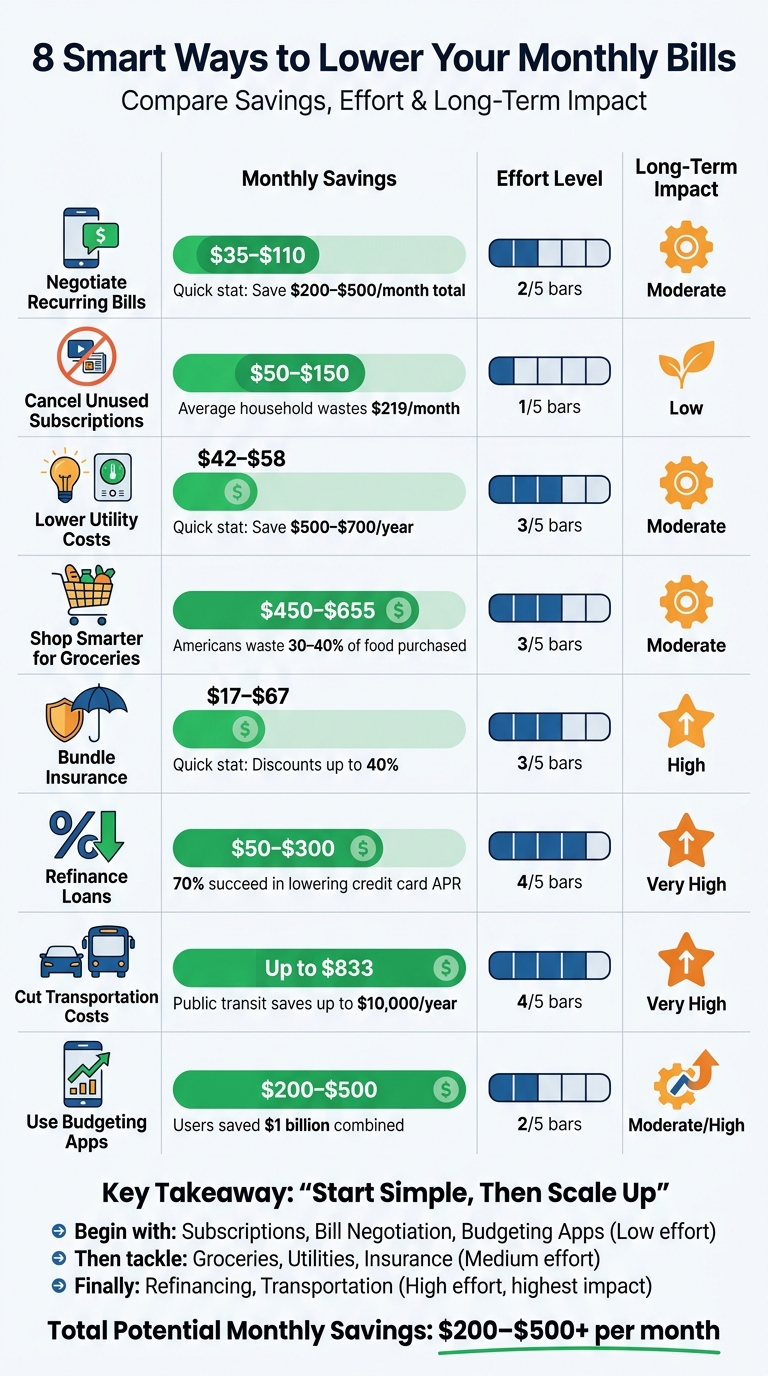
8 Ways to Lower Monthly Bills: Savings Comparison and Effort Guide
A Step-By-Step Guide to Lowering Your Monthly Bills
1. Negotiate Your Recurring Bills
Did you know the price on your bill isn’t always set in stone? Service providers often prefer to lower your monthly costs – sometimes by $10 to $40 – rather than risk losing you to a competitor. The trick is knowing which bills to target and how to approach the conversation.
Focus on services you’ve had for over a year, such as internet, cell phone, cable, auto insurance, or gym memberships. If you’re paying more than the rates advertised for new customers on your provider’s website, you’re likely overpaying. When you call, ask specifically for the retention or loyalty department. These agents usually have access to discounts that regular customer service representatives can’t offer.
When speaking to the agent, stay polite but assertive. A good starting point might be:
I’ve been a loyal customer for X years. I don’t want to switch providers, but I’m seeing better rates elsewhere. Can you help me with a better offer?
If the first representative doesn’t budge, don’t give up – call back and try speaking with someone else who might have more flexibility. Before ending the call, make sure to get written confirmation of any changes, including the new rate, when it starts, and how long it will last.
Potential Savings
Negotiating your bills can save your household anywhere from $200 to $500 per month. For example:
- Internet and cable bills can drop by $20 to $60 monthly.
- Cell phone plans might save you $15 to $50.
- Car insurance reductions could range from $30 to $100 per month.
- Credit card interest rate reductions are successful for over 70% of those who ask.
Even small wins add up. Cutting just $20 from your internet bill and $15 from your phone plan translates to an extra $420 in your pocket each year.
Ease of Implementation
Set aside 15–20 minutes for these calls, ideally mid-week mornings when hold times are shorter and agents are more accommodating. If you’re negotiating your internet bill, the FCC’s Broadband Labels can help you compare prices and speeds, giving you solid evidence if you’re being overcharged. To stay ahead, set a calendar reminder to renegotiate about 30 days before any promotional rates expire – these often last 12 to 24 months.
Taking the time to negotiate your recurring bills not only saves money but also builds confidence for tackling other expenses.
2. Cancel Unused Subscriptions
After tackling your bills, it’s time to focus on subscriptions – those sneaky little charges that quietly drain your bank account. Most people think they have just a handful of subscriptions, but the reality? They often have 12 to 15. Even small charges, like $5 or $15, can snowball fast. On average, American households waste around $219 a month on subscriptions they don’t use. That’s over $2,600 a year – money that could be put to much better use.
To get a handle on this, do a 90-day review of your bank and credit card statements, app store subscriptions, and email renewal notices. Once you’ve identified your subscriptions, sort them into three categories: essential, unnecessary, and seasonal. Use the 30-day rule as a guide – if you haven’t used a service in the past month, it’s time to cancel. If you’re hesitant to let go completely, consider switching to lower-cost options like ad-supported tiers or smaller storage plans. These small adjustments can save an extra $10 to $20 per month without cutting off access entirely.
Potential Savings
Eliminating just two $15 subscriptions could save you $360 a year. A detailed review often uncovers monthly savings between $50 and $150, and some households reclaim as much as $200 to $500 per month. Here’s how those savings can grow over time:
| Monthly Savings | Annual Savings | 5-Year Total |
|---|---|---|
| $20 | $240 | $1,200 |
| $30 | $360 | $1,800 |
| $50 | $600 | $3,000 |
Ease of Implementation
Canceling subscriptions is surprisingly simple and one of the easiest ways to cut costs. Most cancellations require just a few clicks. If the in-app process feels clunky, try using a desktop browser and head to the "Account" or "Billing" section. If you’ve already been charged for the current month, cancel right after the billing cycle starts to get the most out of what you’ve paid for. To avoid falling back into the subscription trap, adopt a "one-in, one-out" rule: cancel an old subscription whenever you sign up for a new one.
Long-Term Financial Impact
Once you’ve freed up that extra cash, put it to work. Set up automatic transfers to your savings or investment accounts. For example, saving $30 a month adds up to $1,800 in five years, even before factoring in potential investment growth. As Dave Flegal, Founder of Flegal Financial Planning, wisely says:
You can’t fix something if you don’t know it’s broken… Gaining awareness can help you identify the areas you need to cut down.
3. Lower Utility Costs with Simple Habits
Cutting down utility bills doesn’t have to mean major sacrifices. On average, U.S. households spend about $2,060 per year on electricity alone. The key is targeting the biggest energy users in your home. For instance, heating and cooling consume roughly 50% of household energy. Adjusting your thermostat settings can make a noticeable difference.
Start by tweaking your thermostat. Lowering it by 7°F–10°F for eight hours daily – like when you’re at work or asleep – can save up to 10% annually on heating and cooling costs. When you’re home, aim for 68°F in winter and 78°F in summer. If you’d rather not adjust it manually, a programmable or smart thermostat (starting at about $60) can handle the job for you.
Your water heater is another energy hog. Reducing its temperature from the standard 140°F to 120°F can save energy while also preventing accidental burns.
Laundry is another area where small changes go a long way. Since heating water accounts for 90% of your washing machine’s energy use, switching to the cold water cycle can save you $60 to $100 annually. And don’t forget your lightbulbs – replacing old incandescent bulbs with LEDs, which use 75% less energy, can save about $225 per year. LEDs are affordable, costing between $2 and $5 each, and they last up to 25 times longer than traditional bulbs.
Lastly, unplug devices like TVs, gaming consoles, and phone chargers when not in use. These "vampire" electronics still draw power even when turned off, adding an extra $100 to $200 to your yearly bill.
Potential Savings
Even small changes can lead to big savings. For example, combining LED bulbs, cold water laundry, and unplugging electronics can save between $385 and $525 annually. Add thermostat adjustments and water heater tweaks, and your savings could grow to $500 to $700 per year. Here’s a breakdown of potential savings:
| Habit/Upgrade | Estimated Annual Savings | Upfront Cost |
|---|---|---|
| Switch to LED Bulbs | $225+ | $20–$50 |
| Unplug Vampire Electronics | $100–$200 | $0 |
| Wash Clothes in Cold Water | $60–$100 | $0 |
| Lower Water Heater to 120°F | $50–$150 | $0 |
| Adjust Thermostat (7–10°F) | Up to 10% of heating/cooling | $0 (or ~$60+ for smart model) |
Ease of Implementation
These adjustments are quick and straightforward. Lowering your water heater temperature, washing clothes in cold water, and adjusting your thermostat are free and immediate. Swapping out lightbulbs or using a smart power strip takes just a bit of effort and a small upfront investment. As the Department of Energy explains:
"You can save as much as 10% on your heating and cooling costs by adjusting your thermostat by 7 to 10 degrees for 8 hours per day."
Long-Term Financial Impact
These simple habits lead to consistent savings. With annual savings of around $500, you could save $2,500 in just five years. Plus, many upgrades – like LEDs and smart thermostats – pay for themselves within months through reduced energy costs. Sticking to these habits not only lowers your bills but also strengthens your monthly budget over time.
4. Shop Smarter for Groceries
Adjusting your grocery shopping habits can have a real impact on your monthly budget. Did you know that the average American household wastes 30–40% of the food they purchase? That’s about $1,500 to $2,000 a year down the drain. Poor meal planning, impulse purchases, and food waste are the main culprits behind these unnecessary costs.
One way to cut back is by planning meals around weekly sales. Check store ads for discounts on proteins and produce. Pair this with switching to store-brand staples, which can save you $50–$100 per month. Store brands are often 20–40% cheaper than name brands and may even come from the same production facilities. For instance, a store-brand can of tomatoes might cost $1.29 compared to $2.49 for the name-brand equivalent.
Another tip? Limit your grocery trips to once a week. Every extra trip can tack on an average of $32 in impulse buys. If impulse shopping is a challenge, grocery pickup services can help you spend 15–20% less. Beth Sullivan, the founder of Practical Home Guides, sums it up well:
"A $0.50 banana at home can prevent $30 in impulse purchases at the store."
Before heading to the store, take inventory of your fridge, freezer, and pantry to avoid buying duplicates or letting food go to waste. Use the "First In, First Out" (FIFO) method – placing older items in front to ensure they’re used first. You can even dedicate one night a week to a "leftover buffet", turning unused food into a full meal and saving money in the process.
Potential Savings
Tweaking your grocery habits can lead to substantial savings. For example, in April 2025, Gina Zakaria slashed her family of four’s grocery bill in Los Angeles from $800–$1,000 a month to just $400. She did this by meal planning every Sunday, using what she already had, and repurposing leftovers. Similarly, Beth Sullivan reduced her family’s grocery budget from $900 to $430 a month by focusing on a few key strategies: meal planning around sales (saving $150–$200), switching to store brands (saving $60–$80), buying proteins in bulk (saving $40–$60), using cashback apps (saving $40–$60), and cutting food waste (saving $50–$75). These methods can save a typical household $450 to $655 per month.
Ease of Implementation
The good news? These changes are easy to implement. Switching to store brands and using grocery pickup services are quick adjustments that can produce immediate results. Creating a meal plan and shopping list takes just 15–30 minutes a week. Timing your shopping can also make a difference – Wednesday is ideal since many stores overlap new and old sales. For even better deals, shop early in the morning or late at night when perishables nearing expiration are marked down.
Long-Term Financial Impact
The benefits of smarter grocery shopping extend far beyond the immediate savings. Families that consistently meal plan tend to spend 20–30% less on food while cutting their waste in half. Saving $400 a month and investing it with an 8–10% return could grow to over $75,000 in ten years. Even reducing food waste by 50% can save the average household $750–$1,000 annually. These habits not only trim your monthly expenses but also free up funds for building an emergency savings account or tackling debt.
5. Bundle and Optimize Insurance
Once you’ve tackled daily expenses, it’s time to look at your insurance costs for additional savings. One effective way to lower these expenses is by bundling your insurance policies. Combining home and auto insurance, for instance, can unlock multi-policy discounts. These discounts typically range from 4% to 25%, but some providers, like American Family, offer discounts as high as 40%. Phil Minnes, Owner of American Family Insurance, shares his perspective on how these discounts have evolved:
"When I started 15 years ago, bundle discounts were 10% to 15%. Now, they’re sometimes 30% or 40%."
The savings can be substantial. For example, State Farm customers can save up to $1,429 annually by bundling, while Liberty Mutual reports that new customers who switch and bundle save an average of $950. Beyond the financial benefits, bundling simplifies life by consolidating policies into one bill, offering single app access, and streamlining claims handling. Some insurers even provide "common loss deductibles", which means if a single event – like a storm – damages both your home and car, you may only need to pay one deductible.
Potential Savings
Discounts vary by provider. American Family offers up to 40%, Amica up to 30%, and State Farm around 25%. On the lower end, Progressive and USAA offer average discounts of 5% and 10%, respectively. Overall, bundling home and auto insurance can save you anywhere from $200 to $800 annually. However, always crunch the numbers – bundling isn’t always the cheapest option. Compare the total cost of bundled policies with separate policies from different insurers to ensure you’re getting the best deal.
Ease of Implementation
Bundling your insurance is surprisingly easy. Start by gathering quotes from 3–5 insurers for both bundled and separate policies. This will help you identify the most cost-effective option. To avoid cancellation fees – usually about 10% of the remaining premium – time your switch to coincide with the renewal of one of your current policies. If you find a better rate, share it with your current provider; they may match it to keep your business. Use this opportunity to review your coverage and eliminate any unnecessary add-ons that could be driving up your premium.
Long-Term Financial Impact
Bundling doesn’t just save money upfront; it can also improve your overall insurance experience and financial security. As Phil Minnes points out:
"The fewer carriers you have involved in a claim, the better experience you’re going to have as a customer."
Bundling may also reduce the risk of losing coverage after a claim or traffic violation. To maintain value, review your rates annually to ensure you’re still getting the best deal. By bundling your insurance policies, you can lower costs, simplify your finances, and align with a smarter, more efficient budgeting strategy.
6. Refinance High-Interest Loans
Refinancing high-interest loans can be a game-changer for cutting monthly expenses. With the average credit card interest rate reaching 24.7% by mid-2024, a large chunk of your payments often goes toward interest rather than reducing your balance.
Potential Savings
The savings from refinancing can be eye-opening:
- Credit Cards: Over 70% of cardholders who ask their issuer for a lower APR succeed. For example, reducing your APR from 24% to 18% on a $5,000 balance could save you about $300 annually in interest.
- Student Loans: Refinancing a $30,000 private loan from 9% to 6% could trim your monthly payment by $75.
- Mortgages: Improving your credit score from 680 to 760 before refinancing a 30-year mortgage can reduce your rate enough to save $100 or more per month.
Altogether, refinancing high-interest debt can lower your monthly interest costs by anywhere from $50 to $300.
Ease of Implementation
The process is simpler than you might think. For credit cards, a quick 30-minute call to your issuer – armed with your credit score and payment history – can often result in a reduced rate. For larger loans like student loans or mortgages, compare quotes from at least three lenders to find the best deal. Be mindful of fees: loan origination costs (1%–8%) and mortgage refinancing charges (0.25%–3%) can add up, so calculate your break-even point before committing.
Long-Term Financial Impact
Refinancing doesn’t just save you money now – it can also help you clear your debt faster. For instance, sticking to minimum credit card payments could mean 20 years of debt, but refinancing and consolidating can cut that timeline to 3–5 years. As Anna Barker, Money Management Expert at LogicalDollar, points out:
Carrying debt is seen as completely normal – which it absolutely shouldn’t be.
Once you’ve refinanced, the extra cash flow can be redirected to savings or investments. This approach not only reduces your interest burden but also sets you up for stronger financial health in the long run. Lower rates today can mean bigger opportunities tomorrow.
7. Cut Transportation Expenses
Transportation takes a big bite out of most American budgets, accounting for 16.9% of average monthly expenses. With the cost of owning and operating a vehicle averaging 82 cents per mile in 2024, even small tweaks to your commuting habits can lead to noticeable savings. Adjusting how you get around can be just as effective as renegotiating bills or canceling unused subscriptions. A few targeted changes can significantly lighten your monthly financial load.
Potential Savings
Switching to public transportation or improving your car’s fuel efficiency can lead to major savings. For example, opting for public transit instead of driving could save households up to $10,000 per year. If you need to drive, increasing your fuel efficiency from 20 MPG to 30 MPG can save about $918 annually on gas. Carpooling is another smart move – it reduces gas, toll, and parking costs while potentially qualifying you for low-mileage insurance tiers, which are roughly 38% cheaper than high-mileage plans.
Mike Nocera, Owner of Long Island Mobile Mechanic, highlights a simple yet effective tip:
A clean air filter can boost your car’s fuel efficiency, since it ensures the engine is getting the right amount of airflow.
Changing your driving habits can also make a big difference. Avoiding aggressive acceleration and hard braking can cut fuel costs by up to 30%, and removing 100 lbs of extra weight from your car can improve fuel economy by about 2%.
Ease of Implementation
Small steps can lead to big savings. Use apps like GasBuddy to find the cheapest gas nearby, and check your tire pressure monthly – properly inflated tires are crucial for fuel efficiency. Simplify your schedule by combining errands into a single trip, especially since 59.4% of household vehicle trips are less than six miles. If available, take advantage of commuter benefits, which can provide pretax savings of up to $300 per month for parking and $300 for transit passes.
For bigger changes, explore carpooling through local social media groups or ask your employer about working remotely to eliminate your commute entirely. Brian Walsh, CFP and Head of Advice & Planning at SoFi, offers this insight:
Understanding exactly how much you’re spending helps you appreciate how much you’re able to save. Your savings rate is the most important component for determining your ability to accomplish financial goals.
Track all your transportation expenses – fuel, parking, tolls, and maintenance – to identify areas where you can cut back. These small adjustments can lead to meaningful, long-term savings.
Long-Term Financial Impact
Driving less doesn’t just save on gas – it also reduces wear and tear, lowers insurance premiums, and extends your vehicle’s lifespan. Electric vehicles (EVs) provide additional cost benefits, with annual maintenance averaging $949 compared to $1,279 for gas-powered cars. Electricity for EVs costs about $546 per year for 15,000 miles, compared to $1,255 for gasoline.
To avoid unexpected repair costs, set aside $50–$100 each month in a dedicated car repair fund. This prevents the need for high-interest debt when maintenance issues arise. Redirecting transportation savings toward paying off debt or building an emergency fund can help you create a more secure financial future.
8. Use Budgeting Apps and Automate Savings
Keeping track of your spending is a key step in cutting down monthly bills. Budgeting apps, like the ones mentioned here, can help you identify where your money is slipping away. This is especially important when you consider that 84% of Americans feel stressed about money – often because they don’t have a clear picture of where their money is going. By automatically categorizing transactions from your bank statements, these apps provide a detailed breakdown of your spending on things like groceries, dining out, and subscriptions. This kind of awareness is essential. As Dave Flegal, CPA and Founder of Flegal Financial Planning, explains:
You can’t fix something if you don’t know it’s broken, right? Gaining awareness can help you identify the areas you need to cut down.
Potential Savings
Budgeting apps aren’t just about tracking; they can also help you save. For example, Rocket Money users have reported saving a combined $1 billion through features like automated bill negotiation and subscription cancellations. On an individual level, people using subscription-canceling apps save an average of $740 per year by eliminating services they no longer use. Many households find they can trim $200 to $500 each month by cutting out spending that doesn’t add real value – often referred to as "waste" – without making drastic lifestyle changes. These apps make it easy to spot and cancel unused subscriptions, turning potential savings into reality with minimal effort.
Ease of Implementation
Getting started with budgeting apps is incredibly simple and doesn’t require a huge time commitment. Many apps can categorize a month’s worth of spending from a PDF bank statement in less than 30 seconds, thanks to AI technology. Apps like Rocket Money, Trim, and BON Credit even scan for forgotten recurring charges and help you cancel services you haven’t used in the last month. For savings automation, you can set up a one-time transfer to move money into a high-yield savings account right after payday – this "Pay Yourself First" method ensures you’re prioritizing savings. Some apps also offer bill negotiation services, where they contact your internet, phone, or insurance providers to lower your rates. These services usually take a percentage (30% to 40%) of your first year’s savings. These tools are designed to deliver quick wins while setting the foundation for long-term financial health.
Long-Term Financial Impact
Automating even a modest amount, like $100 per month, into an investment account can lead to significant wealth over time, thanks to the power of compounding growth. Budgeting apps can also help you break out of the paycheck-to-paycheck cycle by preventing unnecessary debt. They make it easier to identify high-interest debt, which you can tackle using strategies like the "debt avalanche" method. As Dave Flegal encourages:
Don’t shame yourself for not having a perfect grasp on your finances. Take the first step toward understanding your spending and build little habits that compound over time.
Additionally, building a 3–6 month emergency fund can help you avoid relying on high-interest credit cards when unexpected expenses arise. These small, consistent actions can lead to a more secure financial future.
Comparison Table
Money-saving strategies differ in both the effort they demand and the payoff they deliver. Here’s a breakdown comparing potential monthly savings, effort levels, and the long-term benefits of each approach.
| Method | Est. Monthly Savings | Effort | Long-Term Impact |
|---|---|---|---|
| Negotiate Recurring Bills | $35 – $110 | Low/Medium | Moderate – requires periodic renewal |
| Cancel Unused Subscriptions | $30 – $100 | Low | Low – stops unnecessary subscription buildup |
| Lower Utility Costs | $27 – $50+ | Medium | Moderate – cumulative savings against rate hikes |
| Shop Smarter for Groceries | $50 – $150 | Medium | Moderate – reduces up to $1,500/year in waste |
| Bundle & Optimize Insurance | $83 – $149 | Medium | High – lowers annual premium increases |
| Refinance High-Interest Loans | $200 – $500+ | High | Very High – saves thousands over loan life |
| Cut Transportation Expenses | $30 – $600 | High | Very High – lowers depreciation/maintenance costs |
| Budgeting Apps & Automation | $100 – $200 | Low/Medium | Moderate/High – builds wealth via compounding |
This table makes it easier to decide where to start based on your financial needs and available time. The goal is to save money without sacrificing your quality of life.
Start with the simpler strategies, like negotiating bills, canceling unused subscriptions, or using budgeting apps. These methods are quick (10 to 30 minutes) and can save you up to $200 per month. Once you’ve gained confidence, move on to more demanding options, such as refinancing loans or reducing transportation expenses. These take more effort but can yield substantial savings over time.
As Kelly Lannan, Vice President at Fidelity Investments, wisely notes:
Changes need to be comfortable to be sustainable. So be honest with yourself about the trade-offs you’re willing to make.
Even small savings add up when deposited into a high-yield savings account or invested. Pick two or three strategies that suit your lifestyle, and gradually incorporate more as you go.
Conclusion
Cutting down on monthly expenses is well within reach by making small, deliberate changes. By addressing unnecessary spending in recurring bills and daily routines, most households can save between $200 and $500 each month. For those ready to take bigger steps – like moving to a smaller home or paying off a car loan – savings can climb to $800 or more. The secret lies in layering these small adjustments. Even simple actions like brewing your own coffee or canceling unused subscriptions can add up to meaningful savings over time.
Start with a couple of quick wins to build momentum before tackling larger strategies. For instance, auditing your subscriptions or negotiating a better internet rate can take less than half an hour but might save you $50 to $200 a month right away. Once you feel more confident, move on to bigger changes like meal prepping or refinancing loans.
Marine Lafitte, Lead Financial Commentator at Millions Pro, explains it best:
The goal is not deprivation but intentional spending on things that bring you genuine value.
After cutting a bill, redirect those savings immediately into a high-yield savings account or toward paying off debt to avoid lifestyle inflation. Pick two or three strategies that align with your habits, stick with them, and gradually incorporate more as you go.
FAQs
Which bills should I negotiate first?
Tackle the recurring bills that have the biggest impact on your budget first – think internet, cable, phone, insurance, utilities, and memberships. These are the kinds of expenses where providers are often open to adjusting rates or waiving fees if you ask. By focusing on these categories, households can often shave hundreds of dollars off their monthly expenses. Prioritize these bills to make the most of your savings efforts.
How can I quickly find and cancel hidden subscriptions?
To spot and cancel hidden subscriptions, start by checking your bank or credit card statements for recurring charges. Look for anything unfamiliar or unnecessary, and cancel those subscriptions. To make this process easier, you can use subscription management tools that help track and manage them all in one place.
For subscriptions linked to app stores, you’ll need to cancel them through your account settings. If a subscription is managed by a specific company, log into your account on their website and follow their cancellation instructions.
How do I pick the best 2–3 savings steps to start with?
If you’re looking to save money with minimal effort, focus on steps that offer the biggest impact right away.
- Negotiate your bills: Contact providers for services like internet, insurance, or phone plans. Many companies are willing to lower your rates if you ask – especially if you’ve been a loyal customer or mention competitor pricing.
- Cancel unused subscriptions: Streaming services, gym memberships, or other recurring charges can quietly drain your funds. Cutting out the ones you don’t use can free up extra cash almost instantly.
- Create a budget: Take a closer look at your spending habits. A simple budget will help you identify areas where you can cut back and redirect that money toward savings.
These small actions can make a big difference and are easy to put into practice right away.
Related Blog Posts
- Budget Calculator for Smarter Spending
- Debt Payoff Calculator to Break Free
- 7 Ways to Pay Off Credit Card Debt Faster
- Budget Not Working? 5 Common Mistakes to Fix Now

Karla Moss is a CPA and former startup Controller who spent 15 years managing finance at the executive level — including inside a company that grew to unicorn status. She founded Karla & Co. to bring real-world financial clarity to everyday money decisions. She’s based in Phoenix, AZ and writes from personal experience as much as professional expertise.