
If your budget isn’t working, you’re likely making one or more of these five mistakes. Here’s how to fix them:
- Guessing Expenses: Most people underestimate their spending by 30–50%. Track your actual expenses for 90 days instead of guessing.
- Using Gross Income: Budgeting based on gross income leads to overspending. Use your take-home pay to reflect what you can actually spend.
- Ignoring Irregular Costs: Annual expenses like car repairs or holiday gifts aren’t surprises – they’re predictable. Divide these costs into monthly savings.
- Saving Last: Waiting to save until the end of the month rarely works. Automate savings as soon as you get paid.
- Being Too Strict: Unrealistic budgets fail. Base your limits on actual spending and leave room for flexibility.
Start small: Track spending, automate savings, and review your budget weekly. These simple steps can help you regain control and reduce financial stress.
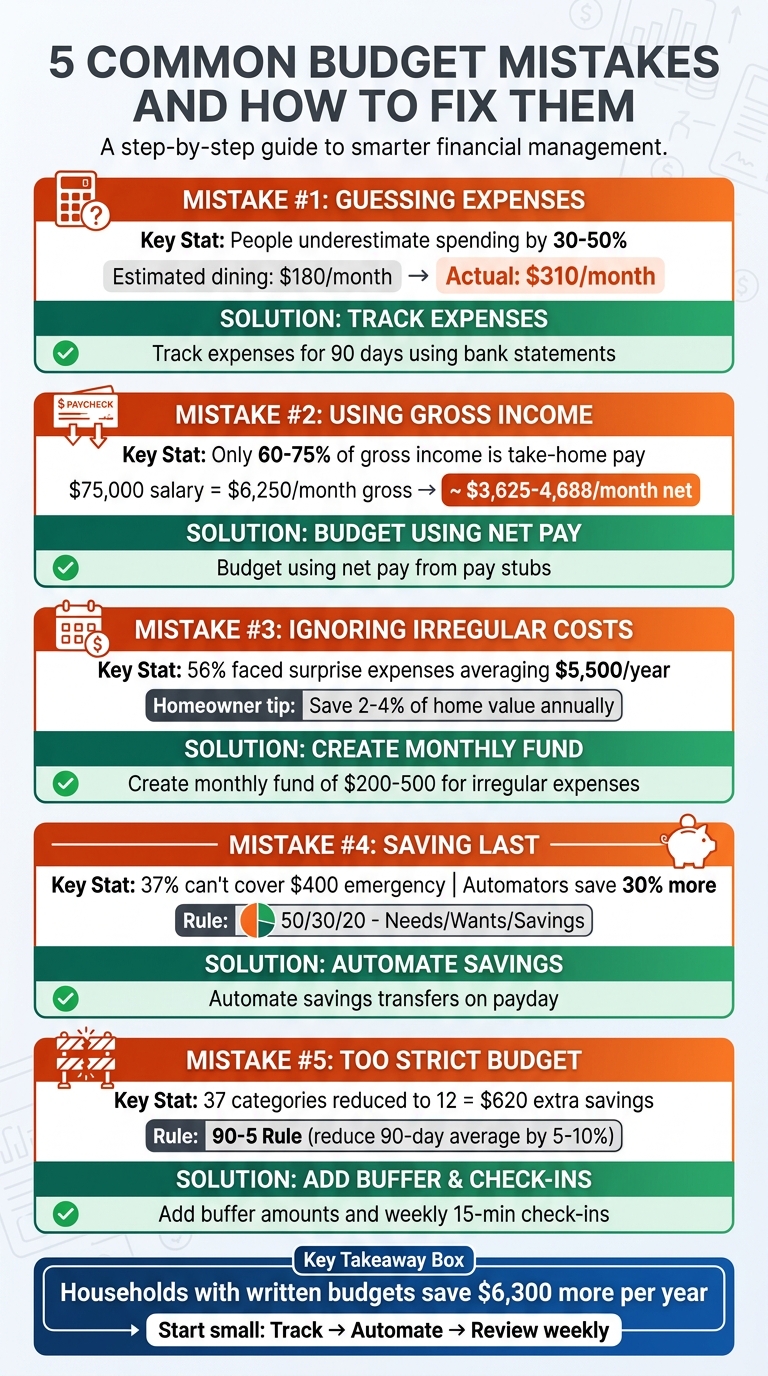
5 Common Budget Mistakes and How to Fix Them
START HERE: Why Your Budget Keeps Failing (And How to Finally Fix It)
sbb-itb-0a60575
Mistake #1: Guessing Your Expenses Instead of Tracking Real Spending
Many budgets fail because they rely on assumptions instead of actual spending data. Research indicates that people often underestimate their discretionary spending by 30% to 50%. For instance, a 2023 Duke University study found that participants estimated their dining-out expenses at $180 per month, but their bank records showed an average of $310. This discrepancy is often due to modern payment methods, which make it easy to overlook small, frequent purchases. A $5 coffee here and a $12 lunch there can quietly add up to $400–$600 a month.
The solution? Stop guessing and start tracking. Review your last three months of bank and credit card statements to uncover your actual spending patterns. This approach can help you spot those sneaky expenses that might otherwise go unnoticed.
"Tracking your spending reveals the gap between what you think you spend and what you actually spend, and that gap is usually larger than expected." – SenticMoney
How to Track Your Spending
To get a clear picture of where your money goes, try one of these straightforward tracking methods. You don’t need fancy tools – just a commitment to record every expense for at least 30 days before finalizing your budget. Here are a few effective ways to capture those overlooked costs:
- Phone Notes: Keep a running note on your phone (e.g., titled "April Spending") and log each purchase as it happens. Dedicate time at the end of each week to categorize your entries.
- Receipt Photos: For cash transactions, snap a quick photo of each receipt right after purchase. Then, organize and log these weekly.
- Spreadsheet Tracking: Set up a simple spreadsheet with columns for Date, Description, Category, and Amount. Download your bank transactions as a CSV file and import them. For purchases that include multiple categories – like a big-box store run – review the receipt and split the amounts accordingly.
Stick to 8–12 broad categories, such as Housing, Groceries, Dining Out, Transportation, Utilities, Entertainment, Healthcare, and Personal Care. You might also include a "Miscellaneous" category with a $25–$100 buffer for small, unpredictable expenses.
To stay on top of your finances, schedule a 15-minute weekly money check-in. This habit will help you catch spending leaks early and avoid surprises at the end of the month. Plus, households that follow a written budget save an average of $6,300 more per year compared to those that don’t.
Mistake #2: Using Gross Income Instead of Take-Home Pay
Many people fall into the trap of basing their budget on their gross income. Sure, a $75,000 salary sounds great on paper, but after taxes and other deductions, the reality can be quite different. By the time federal and state taxes, Social Security, Medicare, insurance premiums, and retirement contributions are taken out, you’re often left with only 60–75% of your gross income to actually spend.
"Using gross income for your budget is a recipe for failure. When you use gross income, you ‘double count’ your money, meaning you set yourself up to spend money that’s already going elsewhere." – Sarah C. Brady, Yahoo Personal Finance
Let’s break it down: a $75,000 salary translates to a gross monthly income of about $6,250. But once deductions kick in, the amount you have to work with is far less. This gap between expectation and reality can lead to overspending and frustration when your budget doesn’t align with your actual cash flow.
Calculating your take-home pay is like peeling back the curtain on your finances. It shows you exactly what’s available to spend and helps you avoid "double counting" money that’s already earmarked for taxes, retirement, or insurance. After deductions like federal taxes (10–37%), FICA (7.65%), and state taxes (3–10%), plus other withholdings, your net income is what you should use for budgeting. This figure reflects the money you have available for rent, groceries, savings, and other essentials.
How to Calculate Your Take-Home Pay
The simplest way to find your net income is by checking your most recent pay stub. Look for the "net pay" or "take-home" amount. If your income varies, here are some methods to calculate it:
- Biweekly paychecks: Multiply your average net paycheck by 26, then divide by 12. For instance, if your biweekly take-home pay is $1,673, your monthly net income is roughly $3,625.
- Weekly paychecks: Multiply your average net paycheck by 52, then divide by 12.
For freelancers or those with irregular income, reviewing tax returns from the past two to three years can help you estimate an average monthly net income. Alternatively, consider basing your budget on your lowest-earning month to ensure you can cover essential expenses.
One key tip: keep retirement savings separate from your everyday budget. While financial experts recommend setting aside 15% of your gross income for retirement, stick to your net income when planning your daily expenses. This keeps your budgeting process straightforward and ensures you’re only working with the money you actually have.
Mistake #3: Forgetting About Irregular and Unexpected Expenses
You’ve got your budget aligned with your take-home pay – rent, utilities, groceries, all accounted for. But what about those irregular costs that sneak up on you? Things like holiday gifts, car registration, or surprise home repairs can completely wreck a well-planned budget if you’re not prepared. These expenses aren’t unexpected – they’re just irregular, and they need to be part of your financial planning.
A 2024 PYMNTS report revealed that 56% of U.S. consumers faced at least one surprise expense in the past year, with an average cost of $5,500. That’s a serious blow to any budget. The real issue isn’t the expense itself – it’s treating these costs as one-off emergencies instead of anticipating them as part of your financial reality.
Annual expenses like subscription renewals, holiday celebrations, or even routine home maintenance can throw off your finances if you don’t plan ahead. For homeowners, the stakes are even higher. Foundation repairs average $5,000, and replacing a roof can cost anywhere from $15,159 to $27,580. Pet owners aren’t immune either – an emergency vet visit can wipe out a month’s budget in just one day.
"Save 2% to 4% of your home’s value just for annual maintenance costs." – Annie Cole, Founder, Money Essentials for Women
The key is to stop treating these expenses as surprises. Instead, spread them out over the year so they don’t catch you off guard. Think of them as fixed monthly costs that you plan for in advance.
Creating a Fund for Irregular Costs
Start by reviewing the past year’s bank and credit card statements. Identify all the non-monthly expenses you’ve had – things like car maintenance, insurance premiums, holiday spending, annual subscriptions, medical co-pays, birthday gifts, and back-to-school shopping. Total them up, then divide by 12 to calculate your monthly irregular expense reserve.
For most households, this reserve falls between $200 and $500 per month. If you’re a homeowner, you’ll need to add 2% to 4% of your home’s value annually for maintenance. For a $400,000 home, that means setting aside $667 to $1,333 per month just for repairs.
Once you’ve calculated your number, open a separate savings account dedicated to these costs. Set up an automatic transfer from your checking account every payday. This keeps the money out of sight and ensures it’s ready when you need it – whether it’s for new tires, a wedding gift, or a surprise medical bill. Treating these irregular expenses as fixed monthly costs can save you from financial stress down the road.
Mistake #4: Saving Whatever’s Left Over
If your plan is to save only what’s left at the end of the month, chances are you’ll save little – or nothing. After expenses, entertainment, and those "just this once" purchases, most people find there’s nothing left. The issue isn’t about willpower; it’s about having the wrong approach.
Money sitting in your checking account feels like it’s ready to be spent, and delaying savings transfers can make it feel like you’re losing money. Every payday, you’re faced with a choice: save some of your income or spend it. Here’s the reality: 37% of Americans can’t handle a $400 emergency expense as of 2025. On the flip side, people who automate their savings – treating it like a must-pay bill – save 30% more annually than those who rely on manual saving. It’s not about how much you earn; it’s about making savings a priority.
Like underestimating expenses or misjudging income, pushing savings to the back burner undermines your financial stability.
"Reverse budgeting flips traditional budgeting around by prioritizing savings first, rather than saving whatever might be left at month’s end." – Trent Porter, Certified Financial Planner, Priority Financial Partners
Treat savings like an essential monthly bill, on par with rent or utilities.
How to Prioritize Savings in Your Budget
To remove the temptation to spend extra cash, automate your savings as soon as you get paid.
Pay yourself first. Transfer money into savings immediately after your paycheck hits – before paying bills, buying groceries, or spending on extras. This isn’t about earning more; it’s about making savings automatic and unavoidable.
Set up automatic transfers on payday. Most banks let you schedule recurring transfers from your checking account to a savings account. Better yet, if your employer offers it, use direct deposit splitting to send part of your paycheck directly to a high-yield savings account. In 2026, high-yield savings accounts offer 4.0% to 5.0% APY, far outpacing the 0.01% to 0.10% rates at traditional banks.
Consider using the 50/30/20 rule to guide your budget:
- 50% of your take-home pay goes to needs (like rent, utilities, and groceries).
- 30% goes to wants (like dining out or entertainment).
- 20% goes to savings and debt repayment.
If 20% feels out of reach right now, start small – saving even $25 per paycheck builds the habit. Once you’re used to living on less, gradually increase your savings rate by 1% each month or whenever your income grows.
Keep your savings in a separate account at a different bank. This creates a small "friction barrier", making it harder to dip into your savings for everyday expenses while keeping it accessible for emergencies.
Building an emergency fund is a key first step. Start with a mini fund of $1,000 to $2,000 to handle smaller unexpected expenses without going into debt. After that, aim for a full emergency fund covering three to six months of expenses. The earlier you start, the better. For example, saving $300 a month starting at age 25 can grow to over $800,000 by age 65 (assuming a 7% return). Wait until age 35, and that total drops to about $370,000.
Mistake #5: Making Your Budget Too Strict
Overly rigid budgets are a recipe for frustration. When your budget doesn’t align with your actual spending habits, it can feel like you’re constantly failing. For example, imagine planning for a small treat like a coffee or lunch out, only to find you’ve already blown through your "Dining Out" category. It’s disheartening and often leads people to abandon their budgets entirely.
"Being aspirational on paper and human in real life creates constant budget guilt." – FIYR Blog
Take Jess, a high-income earner in 2026, who initially wrestled with a budget that had 37 categories and a strict $120 cap for fun spending. Unsurprisingly, that cap was gone by mid-month, leaving her stressed and discouraged. By simplifying her budget to just 12 main categories and basing her limits on her actual spending over the past 90 days, she uncovered an extra $620 in savings in just one month – without earning more. Her story highlights the power of a realistic, flexible approach.
The key isn’t to abandon budgeting altogether but to create a plan that reflects your real-life spending patterns. A budget that’s too tight will break under pressure, but one with built-in flexibility can adapt to life’s unexpected twists and turns.
How to Set Realistic Budget Amounts
Start with your actual spending data. Instead of guessing, review your expenses from the last 90 days to establish realistic baselines.
Use the 90-5 Rule: Take your 90-day average for a category and reduce it by just 5–10%. For instance, if you usually spend $400 on groceries, aim for a budget of $380–$400 rather than slashing it to an unrealistic number.
Add a buffer. If you anticipate spending $200 on a variable expense like groceries, budget slightly more – perhaps $250 – to give yourself some breathing room. Include a "Miscellaneous" category, setting aside $25–$100, and allocate a small amount for indulgences. This way, your budget remains practical and even enjoyable. A little cushion can prevent the entire plan from falling apart when things don’t go as expected.
"If your budget feels more like a punishment than a plan, there’s a good chance it’s not sustainable." – Trustway Accounting
To keep your budget on track, schedule a weekly 10–15 minute check-in. During this time, review your category balances and make adjustments as needed. For example, you can shift funds from categories with surpluses to those running tight. This habit ensures your budget evolves with your spending and stays effective. After all, a simple budget you stick with is far better than a perfect one you abandon.
Building flexibility into your budget, while staying grounded in your actual spending habits, is a practical step toward better money management.
How to Fix Your Budget
Once you’ve recognized common budgeting missteps – like overestimating your income or creating overly rigid categories – it’s time to adjust your plan using real spending data. Instead of scrapping everything and starting from scratch, focus on refining your budget. This approach helps align your financial goals with your actual habits.
Start by reviewing your last 90 days of expenses. This gives you a clear picture of your spending patterns and helps establish realistic baselines for categories like groceries, entertainment, and other day-to-day expenses. Using this data, you can close the gap between what you think you should spend and what you actually spend.
"Your budget is not broken. Your system is." – FIYR
Once you’ve calculated 90-day spending averages, simplify your budget into 8–12 main categories, such as Needs, Wants, and Goals. This broader approach reduces decision fatigue and makes your budget easier to stick with. Apply the 90-5 rule to your averages to set practical spending limits. For example, if you’ve been spending $320 a month on groceries, aim for a range of $304–$320 instead of slashing it to an unrealistic $200. These small but strategic adjustments help create a budget that reflects your current habits while staying flexible enough to adapt to future needs.
Steps to Adjust and Maintain Your Budget
- Clean Up Your Data: Remove transfers, refunds, and any duplicate entries from your spending records. This ensures you’re working with accurate numbers.
- Plan for Irregular Expenses: Create sinking funds for costs like annual insurance premiums, holiday gifts, or vacations. To do this, divide each annual expense by 12 and set aside that amount each month.
- Schedule Regular Check-Ins: Dedicate 15 minutes each week to organizing recent transactions and monitoring category balances. Then, set aside 30 minutes at the end of each month to review your overall progress, adjust spending limits, and evaluate your goals. Aim for a savings rate of 15%–25% of your take-home pay and keep spending variances within 5%–10%.
- Automate Where Possible: Set up automatic transfers for savings and sinking funds on payday. This ensures that money is allocated to your priorities before you have a chance to spend it elsewhere.
- Audit Subscriptions Monthly: Review recurring charges to ensure they don’t exceed 5% of your take-home pay. Cancel anything you no longer use or need.
A budget with a clear purpose – whether it’s building an emergency fund, saving for a home, or paying off debt – becomes much easier to maintain. By following these steps, you’ll create a system that works for your lifestyle and supports your long-term financial goals.
Conclusion
Your budget isn’t broken – it just needs a little fine-tuning. By addressing common pitfalls like guessing expenses, using gross income instead of net, ignoring those irregular costs, saving as an afterthought, or setting limits that are too strict, you can take control of your finances. These adjustments transform budgeting from a chore into a tool that works for your life.
The real challenge? Keeping your budget up to date. Many people don’t struggle with creating a budget but with keeping it relevant to their actual expenses. Regular weekly check-ins and monthly reviews can help you catch small issues before they grow into bigger problems.
"If you do not review your money, your money will review you." – FIYR
Think of your budget as a living document – something that changes as your life does. Whether it’s a raise, inflation, or those sneaky subscription fees, your budget should adapt to reflect these shifts. Flexibility is key to avoiding the mistakes we’ve covered.
Remember, the goal isn’t perfection – it’s progress. When you use real data to set spending limits, leave room for fun, and connect your daily choices to long-term goals, you create a system that reduces stress and helps you build wealth over time. Start with one small adjustment today, and let your budget start working for you.
Keep tweaking, and let your budget become the financial partner you can rely on.
FAQs
What if my income changes every month?
If your income changes from month to month, it’s important to tweak your budget to handle those ups and downs. Start by saving extra during high-income months so you have a financial cushion for the slower months. Make it a habit to track your income and expenses weekly – this keeps you nimble and ready to adjust as needed. Setting up a buffer fund for essentials is also key, ensuring you’re covered when times get tight. Instead of sticking to strict budget percentages, focus on categories where spending can be more flexible. These approaches can make managing irregular income far less stressful.
How do I plan for big, irregular expenses without stress?
To manage large, unexpected expenses without stress, consider creating a dedicated fund within your budget. Start by estimating the total annual cost of these irregular expenses – things like car repairs or medical bills – and divide that amount by 12. This gives you a manageable monthly savings goal.
Keeping your budget straightforward with around 8–12 categories and clearly labeling each expense can make tracking easier. By planning ahead, you’ll be ready when these costs pop up, helping you avoid financial surprises.
How can I budget without feeling deprived?
Budgeting doesn’t have to feel like a punishment. The key is to be realistic about your spending habits and allow some wiggle room in your plan. Start by tracking your actual expenses – this gives you a clear picture of where your money is really going. And don’t forget to include a category for discretionary or “fun” spending; life isn’t all about bills and savings.
Focus on your most important financial goals, but avoid setting rules that are too rigid. A balanced approach lets you stay on top of your finances and enjoy the things that matter to you.
Related Blog Posts
- Budget Calculator for Smarter Spending
- Debt Payoff Calculator to Break Free
- Emergency Fund Goal Calculator for Peace
- 7 Ways to Pay Off Credit Card Debt Faster

Karla Moss is a CPA and former startup Controller who spent 15 years managing finance at the executive level — including inside a company that grew to unicorn status. She founded Karla & Co. to bring real-world financial clarity to everyday money decisions. She’s based in Phoenix, AZ and writes from personal experience as much as professional expertise.