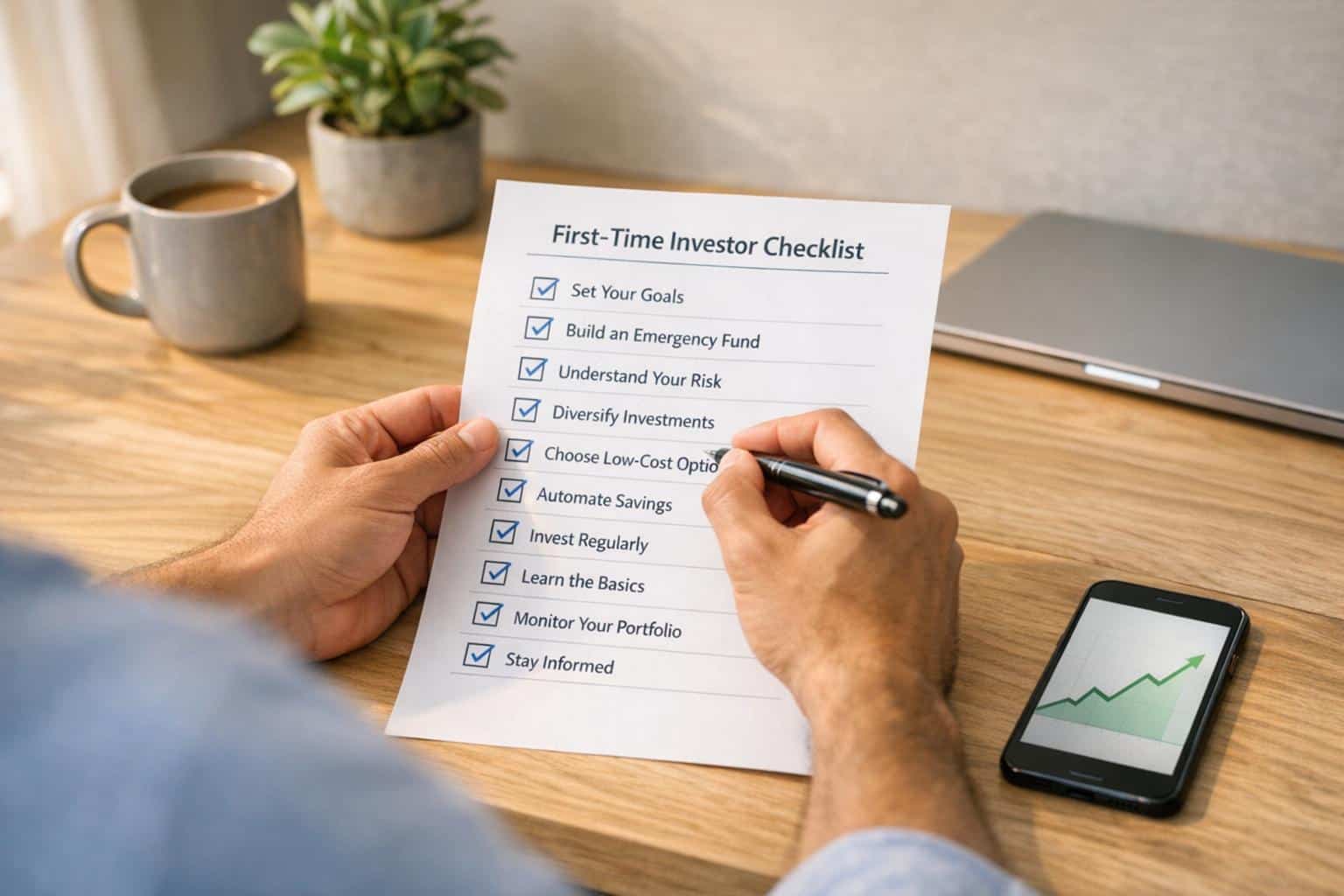
Investing for the first time can feel overwhelming, but it doesn’t have to be. Here’s a quick guide to help you build confidence and avoid common mistakes:
- Start with a solid financial foundation: Build an emergency fund (3-6 months of expenses) before investing.
- Set clear goals: Define specific short-term (less than 3 years) and long-term (5+ years) financial objectives.
- Learn the basics: Understand key concepts like stocks, bonds, ETFs, index funds, diversification, and compound interest.
- Know your risk tolerance: Assess how much risk you’re comfortable with based on your age, income, and goals.
- Diversify your portfolio: Spread investments across asset classes, industries, and regions to manage risk.
- Use beginner-friendly tools: Consider robo-advisors or low-cost index funds to simplify investing.
- Invest regularly: Start small, automate contributions, and use dollar-cost averaging to build wealth over time.
- Avoid emotional decisions: Stay disciplined, avoid panic-selling, and don’t chase trendy stocks.
- Watch for scams: Be cautious of promises of guaranteed returns or high-pressure sales tactics.
- Keep learning: Revisit your strategy as your life changes and stay informed about investment options.
The earlier you start, the more time your money has to grow. Even small, consistent contributions can lead to significant long-term gains thanks to compound interest. Stay patient, stay informed, and focus on your goals.
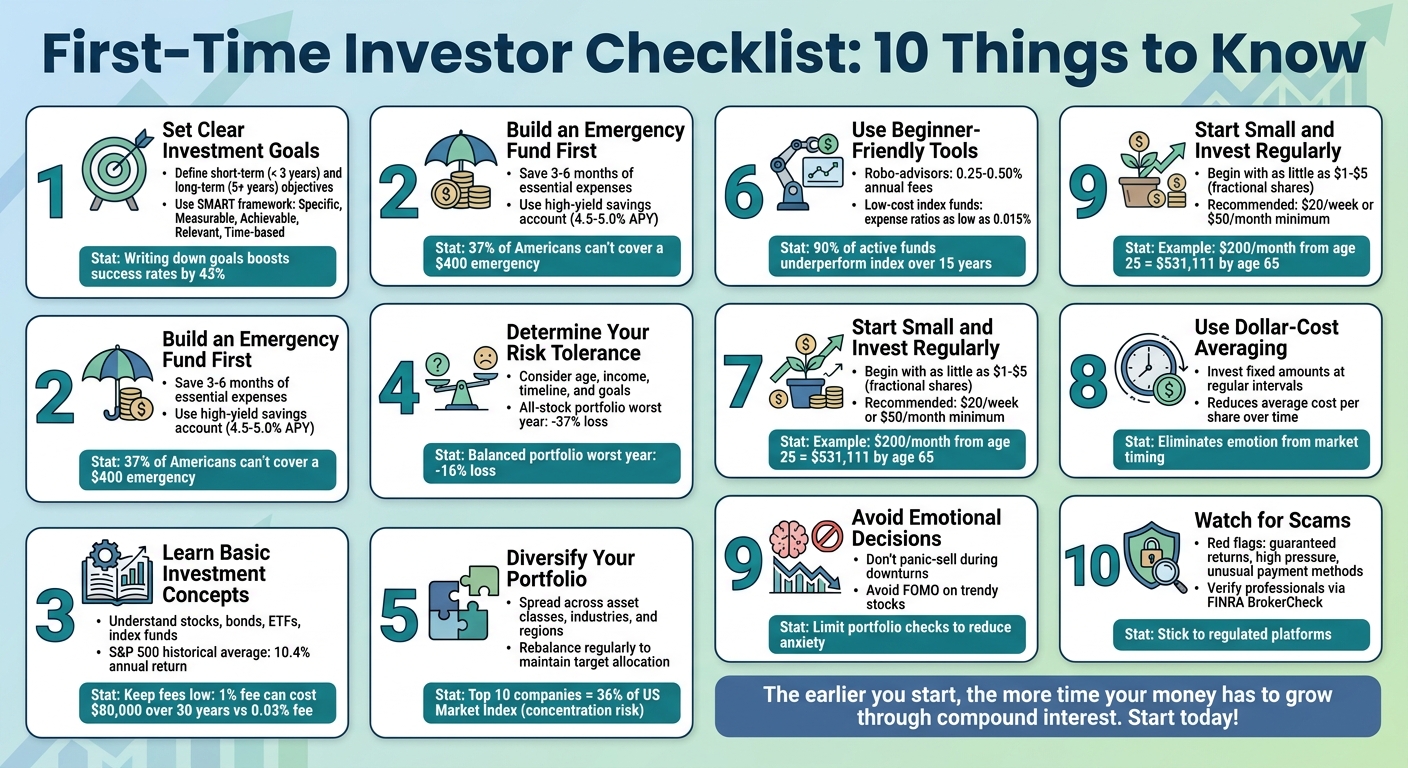
First-Time Investor Checklist: 10 Essential Steps to Start Investing
If I Started Investing In 2026, This Is What I Would Do (Full Beginner’s Guide)
1. Set Clear Investment Goals
Every successful investment strategy begins with clear objectives. Vague aspirations like "saving for the future" lack the direction needed to choose the right accounts or determine how much to invest each month. Without specific goals, it’s easy to lose focus or make poor financial decisions.
In fact, the way you define your goals can make or break your success. A 2015 study by Dr. Gail Matthews at the Dominican University of California revealed that writing down goals, creating action plans, and tracking progress boosted success rates by 43%. The study also found that 70% of participants who shared their goals with others achieved them, compared to just 35% who kept their goals private. This highlights the importance of clarity and accountability when setting financial objectives.
Short-Term vs. Long-Term Goals
Your timeline plays a critical role in shaping your investment strategy. Whether you’re saving for the short term or planning for the long haul, your approach will differ based on how soon you’ll need the money.
- Short-term goals (less than three years): These might include saving for a wedding, a vacation, or building an emergency fund. For short-term needs, the priority is keeping your money safe and accessible. Options like high-yield savings accounts, certificates of deposit (CDs), or money market funds are ideal for preserving capital while offering quick access.
- Long-term goals (five years or more): Goals like retirement, buying a home, or funding a child’s education require a different strategy. With more time, you can ride out market fluctuations and take advantage of compound growth. For instance, saving $80,000 for a home down payment in five years would mean setting aside approximately $1,333 each month, though this could vary depending on how flexible your timeline is.
Match Goals to Your Lifestyle
Your personal circumstances heavily influence how you should invest. Factors like your age, income, family situation, and career stage all play a role in shaping your financial goals.
For example, younger investors often have the flexibility to take on more risk, whereas individuals closer to retirement may need to prioritize stability. Fidelity offers a helpful guideline for retirement savings: 1x your annual income by age 30, 3x by age 40, 7x by age 55, and 10x by age 67. If you’re behind on these benchmarks, adjusting your contributions or investment strategy can help you catch up.
Additionally, life events such as marriage, starting a family, or a career change can impact your financial priorities and timelines. Using the SMART framework – Specific, Measurable, Achievable, Relevant, and Time-based – can help you create actionable goals with clear targets and deadlines. Tailoring your goals to your lifestyle ensures that your investment strategy aligns with what matters most to you.
2. Build an Emergency Fund First
Before diving into investments, make sure you have a financial safety net in place. An emergency fund acts as a buffer, protecting you from having to sell investments prematurely during unexpected setbacks. Without this cushion, surprises like medical bills, car repairs, or even job loss could force you to sell investments at the wrong time – turning what might have been a temporary market dip into a permanent financial loss.
The statistics are eye-opening: 37% of Americans can’t cover a $400 emergency expense with cash or its equivalent, and 44% would need to borrow money to handle a $1,000 emergency. Now, imagine being forced to sell $15,000 worth of investments during a market downturn of 30% – you’d lock in a $4,500 loss that could otherwise have been avoided. This is why having a cash reserve is crucial for staying on course with your long-term financial goals.
"Think of it as a shock absorber for the bumps of life, one that’ll keep you from adding to the load of debt you most likely already carry." – Investopedia
High-interest credit card debt, with rates hovering around 25% annually, could easily wipe out any investment gains. While holding $20,000 in cash instead of investing it might cost you about $1,280 per year in potential market returns, experts consider this a necessary "insurance premium" to avoid forced selling during a financial crunch. This safety net ensures you stay focused on your bigger financial picture.
How Much to Save
Once you’ve committed to building your emergency fund, the next step is figuring out how much to save. The general rule of thumb is to set aside three to six months of essential living expenses – not your total income. Focus on covering critical costs like rent or mortgage, utilities, groceries, insurance, transportation, and minimum debt payments. For context, the average U.S. household spends around $6,440 per month, which means a six-month fund would total approximately $38,640. Start small and work your way up.
Financial advisors often suggest a phased approach. Begin with a smaller goal, such as $1,000–$2,000, and gradually build toward covering three to six months of essential expenses. If you’re in a dual-income household with stable jobs, three months might suffice. However, single-income households or freelancers should aim for six to twelve months of expenses.
Keep your emergency fund in a high-yield savings account (HYSA) offering 4.5% to 5.0% APY, far better than the traditional bank average of 0.46%. For example, a $15,000 emergency fund in a high-yield account earning 5.0% APY would generate about $750 annually, compared to just $69 per year in a standard account. Ensure the account is FDIC-insured and that funds can be accessed within one to two business days. Avoid risky investments like stocks or crypto for your emergency fund – market volatility could shrink your safety net by 20% to 40% when you need it most.
To make saving easier, automate it. Set up recurring transfers on payday, treating your emergency fund as a non-negotiable expense. Windfalls like tax refunds, bonuses, or cash gifts can also speed up your progress. Even small, consistent contributions add up – saving $100 weekly, for instance, amounts to about $5,200 per year.
3. Learn Basic Investment Concepts
Understanding a few basic investment principles can set you up for smarter financial decisions. You don’t need to know everything to start investing – just enough to build confidence. Here’s a quick rundown:
- Stocks represent ownership in a company and offer the potential for higher returns, though they come with greater risk.
- Bonds are essentially loans to governments or corporations, providing steady interest payments.
- Mutual funds and ETFs group together multiple stocks or bonds, making diversification easy.
- Index funds, a popular choice for beginners, track market benchmarks like the S&P 500. Over the last century, the S&P 500 has averaged an annual return of 10.4%.
Diversification and Asset Allocation
Two essential strategies for managing risk are diversification and asset allocation. Diversification involves spreading your investments across different companies, industries, or even countries to minimize the impact of a single poor performer. Asset allocation, on the other hand, is about deciding how to divide your money among stocks, bonds, and cash based on your goals and risk tolerance. For example:
- Younger investors often lean heavily into stocks for growth potential.
- Retirees or those close to retirement might aim for a balanced mix of stocks and bonds for stability.
Keeping costs low is another crucial factor. High fees can eat away at your returns over time. For instance, a 1% annual fee on a $100,000 portfolio earning 10% could cost you about $80,000 over 30 years compared to a fund with a 0.03% expense ratio. Even small fee differences can significantly impact long-term growth.
"Think of stock-picking the same way you would think about a game of chance: Only play with what you can afford to lose. For most people, investing isn’t about finding the next high-flying stock – it’s having a solid strategy and sticking to it."
– Nicholas Ryan, Senior Financial Advisor & Planner, Empower
Key Terms to Know
| Term | What It Means |
|---|---|
| Stocks (Equities) | Shares of ownership in a company with potential for high returns (and higher risk). |
| Bonds (Fixed-Income) | Loans to governments or corporations that pay regular interest. |
| Mutual Funds | Pooled investments bundling various stocks or bonds for built-in diversification. |
| ETFs | Investment funds that trade like stocks throughout the day, similar to mutual funds. |
| Index Funds | Funds designed to mirror a market index, such as the S&P 500. |
| Diversification | Spreading investments across different asset classes to reduce risk. |
| Asset Allocation | Dividing your portfolio among stocks, bonds, and cash based on your goals and risk tolerance. |
| Expense Ratio | The annual fee charged by a fund, expressed as a percentage of the assets under management. |
How Compound Interest Works
Compound interest is what transforms small savings into significant wealth over time. It’s the process of earning returns not just on your initial investment but also on the accumulated interest – essentially, interest on interest.
Here’s an example: A $10,000 investment earning an average annual return of 10% could grow to about $174,000 in 30 years without adding a single extra dollar. That’s the magic of compounding.
Starting early is key. Consider this comparison:
- Henry invests $10,000 at a 6% interest rate and leaves it untouched for 20 years, ending up with roughly $32,100.
- Helen waits 10 years before investing $2,000 annually for 10 years (totaling $20,000) at the same rate. She ends up with about $28,000.
Even though Helen invested more, her late start cost her. The lesson? Start as early as possible, even with smaller amounts.
You can also use the Rule of 72 to estimate how long it will take for your money to double. Simply divide 72 by your expected annual return. For example, with a 7% return, your investment would double in approximately 10.3 years.
Automating reinvestment of dividends and capital gains helps keep the compounding effect rolling. For instance, investing $200 monthly for 10 years at a 6% average annual return could grow to over $32,000 – with nearly $9,000 (around 30%) coming from gains alone.
"The first rule of compounding: Never interrupt it unnecessarily."
– Charlie Munger
4. Determine Your Risk Tolerance
Risk tolerance is about understanding both your comfort level with market ups and downs and your financial ability to handle potential losses in pursuit of higher returns. It’s a mix of your emotional response to risk and your financial situation. The U.S. Securities and Exchange Commission explains that risk tolerance requires balancing these two factors: your willingness to take risks and your ability to absorb losses based on your circumstances.
A variety of personal factors shape your risk tolerance. For example, age plays a big role – younger investors typically have more time to recover from market dips, while those closer to retirement may need to be more cautious. Other considerations include income stability, job security, family obligations, upcoming major expenses (like buying a home), and your overall financial situation. It’s worth noting that your risk tolerance can shift over time as your income, expenses, and life stage evolve.
Your investment timeline also matters. Short-term goals (less than five years) often require more conservative strategies to protect your funds, while those with long-term goals (10 years or more) can generally afford to take on more risk and ride out market fluctuations. For perspective, historical data shows that while an all-stock portfolio might experience a steep decline of up to 37% in its worst year, a balanced portfolio typically limits losses to around 16%.
"People tend to focus only on their comfort level with risk. But your ability to take risks based on your financial situation is just as important."
– Nevenka Vrdoljak, Senior Quantitative Investment Analyst, Merrill and Bank of America Private Bank
Use Risk Assessment Tools
If you’re unsure about your risk tolerance, online tools can help. Many investment platforms offer free questionnaires that simulate scenarios – like how you’d react to a sudden 14% market drop – and assess your emotional and financial capacity to handle such changes. These tools can provide valuable insights into your risk profile.
Having a clear understanding of your risk tolerance now will guide your investment decisions as you diversify and choose the right strategies.
5. Diversify Your Portfolio
Once you’ve gauged your risk tolerance, the next step is to reduce the overall risk in your portfolio by diversifying your investments. Diversification is all about spreading your money across different types of investments, so if one takes a hit, others can help soften the blow. Different assets react differently to economic shifts. For example, when stocks dip, bonds often rise, creating a natural balance. To truly diversify, you need to spread your investments not only across asset classes but also within them – covering various industries, company sizes, and regions. Here’s an eye-opener: historically, large company stocks have lost money about one out of every three years on average.
In 2026, diversification is even more critical because of market concentration risks. The 10 largest companies in the Morningstar US Market Index now make up 36% of the index weight, compared to 23% just five years ago. This increase has been largely driven by stocks tied to artificial intelligence.
"Investors don’t have to think there’s an AI bubble to be concerned about the concentration risk that AI has wrought." – Dan Lefkovitz, Strategist at Morningstar Indexes
What Diversification Looks Like
A well-diversified portfolio typically includes a mix of stocks (for growth), bonds (for stability and income), and cash (for safety). Each plays a unique role in balancing risk and reward. Within your stock investments, it’s smart to spread your money across different industries, company sizes (like large-cap and small-cap), and geographic regions to avoid overloading in one area.
International diversification is also key. While the U.S. accounts for just 25% of the global economy, it holds a whopping 63% of the global stock market value. Adding international stocks to your portfolio can help reduce home-market bias and give you exposure to economies that may perform differently from the U.S. economy. Regular rebalancing is equally important. For instance, a portfolio that started with 60% in stocks and 40% in bonds could shift to over 80% in stocks over a decade if left unchecked.
For beginners, there are simple tools to help you diversify without the headache of managing individual investments.
Easy Diversification Tools for Beginners
Mutual funds and Exchange-Traded Funds (ETFs) make diversification a breeze. These funds bundle hundreds – or even thousands – of securities into one investment. A total stock market index fund, for example, gives you exposure to thousands of companies in a single purchase. This approach removes the need to pick individual stocks and keeps costs low.
Target-date funds, also known as lifecycle funds, are another great option. These funds automatically adjust your investment mix to become more conservative as you get closer to a specific date, like your retirement. If you’d rather build your own portfolio, lazy portfolios are a simple alternative. They offer broad diversification with just two to five index funds.
The good news? Most major U.S. brokers now offer $0 commissions on online stock and ETF trades. Plus, fractional shares let you invest in high-priced stocks with as little as $1. This makes it easier than ever to diversify, even if you’re starting small.
6. Use Beginner-Friendly Investment Tools
Navigating the stock market can feel daunting, especially for beginners. Thankfully, modern tools have simplified the process, making it easier to start investing. Two standout options are robo-advisors and low-cost index funds. These tools take much of the complexity out of investing, allowing you to focus on your long-term financial goals instead of worrying about daily market fluctuations. They also build on key principles like diversification and risk management, helping you put theory into action.
Robo-Advisors
Once you’ve set your investment goals and assessed your risk tolerance, robo-advisors can be an excellent next step. These platforms use algorithms to create and manage a portfolio tailored to your needs. They handle tasks like asset allocation, rebalancing, and even tax-loss harvesting. The process typically starts with a short questionnaire that asks about your age, income, goals, and risk preferences. Based on your answers, the platform suggests a diversified portfolio of low-cost ETFs, which may include stocks, bonds, and even real estate.
By 2025, robo-advisors were managing over $1 trillion in assets. Their fees are generally much lower than traditional financial advisors, ranging from 0.25% to 0.50% annually. For example, Fidelity Go charges no advisory fees for accounts under $25,000, while Schwab Intelligent Portfolios has no management fees but does require a $5,000 minimum investment. Platforms like Wealthfront and Betterment have also earned top ratings for features such as goal-based planning, tax optimization, and socially responsible investment options.
One of the major advantages of robo-advisors is their ability to eliminate emotional decision-making. Research shows that 94% of portfolio returns are determined by the overall investment strategy, not by attempts to time the market. For those who want a mix of automated tools and human guidance, hybrid options like Vanguard Personal Advisor or Betterment Premium offer access to financial advisors for more complex questions.
Low-Cost Index Funds
Index funds are another beginner-friendly option, offering broad diversification by tracking market indices. Because they are passively managed, these funds come with much lower fees compared to actively managed ones. For instance, the Vanguard Total Stock Market ETF (VTI) has an expense ratio of just 0.03%, while the Fidelity Total Market Index Fund (FSKAX) charges only 0.015%.
Over the long term, index funds have proven their worth. Roughly 90% of actively managed funds fail to outperform their benchmark index over a 15-year period. Meanwhile, the S&P 500 has delivered an average annual return of about 10.3% from 1926 through 2023. Many brokers now offer $0 commissions on ETF trades and allow you to invest in fractional shares for as little as $1. This means you don’t need a large sum to get started. By starting small, automating your contributions, and letting compound interest do its job, you can steadily build your portfolio over time.
7. Start Small and Invest Regularly
Getting started with investing doesn’t require a fortune. Many major brokerages now allow you to open accounts with no minimum balance and offer fractional share investing. This means you can buy a piece of a stock or ETF for as little as $1 to $5. While starting with $1 is technically possible, financial experts often recommend aiming for about $20 per week or $50 per month. This helps establish a consistent habit and lets you take advantage of the long-term benefits of compound growth.
The earlier you begin, the better. Compound growth works its magic over time, and delaying your investments can be costly. For example, investing $200 per month starting at age 25 could grow to around $531,111 by the time you’re 65. However, waiting just 10 years to start could cost you over $335,000 in potential wealth (assuming a 10% average annual return).
To make things easier, consider setting up automatic transfers on payday and enabling a dividend reinvestment plan (DRIP). These small steps ensure you stay consistent and allow your money to grow faster through reinvested earnings.
Dollar-Cost Averaging Explained
Dollar-cost averaging (DCA) is a strategy where you invest a fixed amount of money at regular intervals, no matter how the market is performing. When prices drop, your set amount buys more shares; when prices rise, it buys fewer. Over time, this approach reduces your average cost per share and takes the pressure off trying to time the market.
"One of the key benefits of dollar-cost averaging is that it makes investing a regular part of your financial life."
- Kirsten Cabacungan, Investment Strategist, Merrill and Bank of America Private Bank
For beginners, DCA is particularly helpful because it removes emotions from the equation. By sticking to a schedule, you’re less likely to panic during market downturns or get overly excited during rallies. While a 2023 Vanguard study revealed that lump-sum investing outperformed 12-month DCA in 68% of cases, DCA remains an excellent way to avoid the risks of trying to time the market.
8. Avoid Common Mistakes
Most investment pitfalls can be sidestepped once you know what to look out for.
Don’t Let Emotions Drive Decisions
Letting emotions take the wheel can derail your investment journey. For example, selling in a panic during a market downturn often locks in losses and prevents you from benefiting from eventual recoveries. On the flip side, FOMO (fear of missing out) can tempt you into buying trendy stocks at their peak, which often leads to overpaying.
Constantly checking your portfolio is another trap. It can heighten anxiety and lead to impulsive, news-driven decisions that stray from your strategy. David A. Schneider, a Certified Financial Planner at Schneider Wealth Strategies, explains it perfectly:
"Checking your portfolio constantly is like looking at a plant every five minutes to see if it has grown. It just creates anxiety and distracts you from your long-term plan".
To counteract emotional reactions, consider these steps:
- Take 24–48 hours to think before acting on market tips.
- Automate your contributions to reduce the temptation to time the market.
- Limit portfolio reviews to a few times per year if you’re in it for the long haul.
Once you’ve mastered emotional control, the next challenge is steering clear of fraudulent schemes.
Watch Out for Investment Scams
Scammers often target new investors who are still learning the ropes. Be wary of classic red flags like promises of guaranteed high returns with little to no risk, high-pressure tactics designed to make you act fast, or requests for unusual payment methods like gift cards or overseas wire transfers. Fraudsters may also exploit FOMO by hyping trendy sectors such as cryptocurrency or artificial intelligence.
Some scammers build trust through unsolicited messages before pitching fraudulent opportunities. As Investor.gov wisely cautions:
"If an investment opportunity sounds too good to be true, it probably is".
Protect yourself by:
- Verifying investment professionals through tools like Investor.gov or FINRA‘s BrokerCheck to ensure they are licensed and registered.
- Never sharing sensitive information, like your Social Security number or bank account details, with anyone who contacts you out of the blue.
- Sticking to regulated platforms and well-established exchanges like the New York Stock Exchange (NYSE). Avoid over-the-counter (OTC) markets, where penny stocks (typically priced under $5 per share) trade with minimal oversight and a higher risk of fraud.
True wealth comes from investing in solid, reliable companies – not gambling on speculative ventures. By avoiding emotional decisions and staying vigilant against scams, you can keep your focus where it belongs: building lasting financial security.
Conclusion
Starting your investment journey doesn’t have to feel overwhelming. This checklist provides you with clear, actionable steps to invest with confidence and steer clear of common mistakes. It breaks down the essentials of smart investing into 10 practical steps. Along the way, you’ve learned to set clear financial goals, establish a strong foundation with an emergency fund, and grasp fundamental concepts like compound interest. You’ve also evaluated your risk tolerance, embraced diversification, and explored beginner-friendly tools to simplify the process.
Consistent, steady investing beats sporadic efforts every time. Even starting small with automated contributions through dollar-cost averaging can help you grow wealth over time – without the stress of trying to time the market. The data backs it up: historically, U.S. stock market returns have been strong, and over any 15-year period, a diversified portfolio has never resulted in a loss.
Warren Buffett’s timeless advice sums it up perfectly:
"The stock market is a device for transferring money from the impatient to the patient".
Your biggest advantage is time in the market – not chasing the "perfect" stock. The longer you wait to get started, the more you risk missing out on significant long-term gains.
As life unfolds – whether through career changes, family events, or shifting priorities – make it a habit to revisit this checklist at least once a year. Your investment strategy should evolve with your circumstances to ensure your portfolio remains aligned with your goals and risk tolerance.
With these 10 steps in hand, you’re ready to take that first step toward building a strong financial future. Stay informed, stay grounded, and let this checklist guide you toward making smart, confident investment decisions. Your journey starts now.
FAQs
Which account should I invest in first (401(k), IRA, or brokerage)?
When deciding where to begin, it’s all about your financial goals. If your employer offers a 401(k) with matching contributions, that’s a great starting point – you’re essentially getting "free money" along with tax benefits. Once you’ve maximized that, an IRA can be a solid next step, offering more control over your investments and potential tax perks.
For those looking beyond retirement-specific accounts, a brokerage account is a good option. While it doesn’t come with tax breaks, it offers flexibility for non-retirement investments. If you’re eligible for a 401(k), prioritize that first, then explore an IRA or brokerage account based on your needs.
How do I choose a simple stock/bond mix that fits my risk tolerance?
To begin, take a close look at your investment goals, the time frame for achieving them, and how much risk you’re comfortable taking. A common strategy is to choose a diversified, low-cost fund that fits your risk preference. For instance, if you’re okay with more risk, you might lean toward a portfolio with more stocks. On the other hand, if you’d rather play it safer, bonds could take up a larger share.
A balanced example? A portfolio with 60% stocks and 40% bonds might work well for someone with a moderate risk tolerance. The key is to make sure your investments are in sync with both your financial objectives and your timeline.
How much should I invest each month to reach my goal?
The amount you should set aside each month depends on factors like your financial goal, the time you have to achieve it, and the returns you anticipate. For instance, if you invest $100 monthly and earn an average annual return of 7%, that could grow to more than $120,000 over 20 years. To figure out your ideal monthly contribution, start by defining your target amount. Then, use financial calculators or planning tools to estimate how much you’ll need to invest regularly to stay on course.
Related Blog Posts
- Budget Calculator for Smarter Spending
- Emergency Fund Goal Calculator for Peace
- Budget Not Working? 5 Common Mistakes to Fix Now
- How Much Should You Save for Retirement by Age?

Karla Moss is a CPA and former startup Controller who spent 15 years managing finance at the executive level — including inside a company that grew to unicorn status. She founded Karla & Co. to bring real-world financial clarity to everyday money decisions. She’s based in Phoenix, AZ and writes from personal experience as much as professional expertise.