Building an emergency fund might seem daunting, but it’s simpler than you think. Whether you’re starting from zero or looking to grow your savings, these six steps can help you create a financial safety net:
- Determine Your Goal: Save 3–6 months of essential expenses. Start smaller if needed, like $1,000, and work your way up.
- Choose the Right Account: Use a high-yield savings account for safety, accessibility, and better interest rates.
- Start Small, Stay Consistent: Begin with manageable contributions, like $20–$50 per paycheck, and automate your savings.
- Cut Unnecessary Spending: Identify and eliminate wasteful expenses, then redirect those savings into your fund.
- Automate Transfers: Schedule automatic deposits or split your paycheck to make saving effortless.
- Boost Savings with Extra Income: Use windfalls, bonuses, or tax refunds to accelerate your progress.
Even small, regular contributions add up over time. By following these steps, you can prepare for unexpected expenses and reduce financial stress.
Emergency Funds: How Much You Need & How to Get Started
sbb-itb-0a60575
Step 1: Figure Out How Much to Save
Emergency Fund Savings Targets by Household Situation
The general rule of thumb is to save three to six months’ worth of essential expenses. This doesn’t mean your full income – it’s only the bare necessities you’d need to cover in case of a sudden loss of income. Think of it as a survival fund, not a way to maintain your current lifestyle.
List Your Basic Monthly Expenses
Your emergency fund should focus on essential expenses – the bills and costs you’d still need to manage if your income disappeared tomorrow. These typically include:
- Housing (rent, mortgage, property insurance)
- Utilities (electricity, water, gas)
- Groceries
- Transportation (car payments, gas, insurance)
- Communications (cell phone, internet)
- Insurance premiums
- Minimum debt payments
Skip non-essential spending like dining out, streaming services, entertainment, or new clothes. On average, essential costs like housing, transportation, and food make up about 62.8% of household income.
Another factor to consider is insurance deductibles. For example, in 2023, the average deductible for employer-sponsored health insurance was $1,735.
"Most insurance policies include a deductible – and this can be surprisingly high… Without an emergency fund, one unexpected medical event could plunge you deep into credit card debt." – Curran Clark, Co-founder, ContractorNerd
Once you’ve outlined your essential costs, you’ll have a clearer picture of how much you need to save.
Set a Target You Can Reach
With your monthly essentials calculated, it’s time to set a realistic savings goal. Multiply your essential monthly expenses by three to six months to determine your target. For many, this number can seem intimidating – especially when nearly 44% of Americans can’t handle a $1,000 emergency without borrowing.
If the full amount feels out of reach, consider the 1-3-6 framework. Start small by saving one month’s worth of expenses, then build up to three months, and eventually aim for six months.
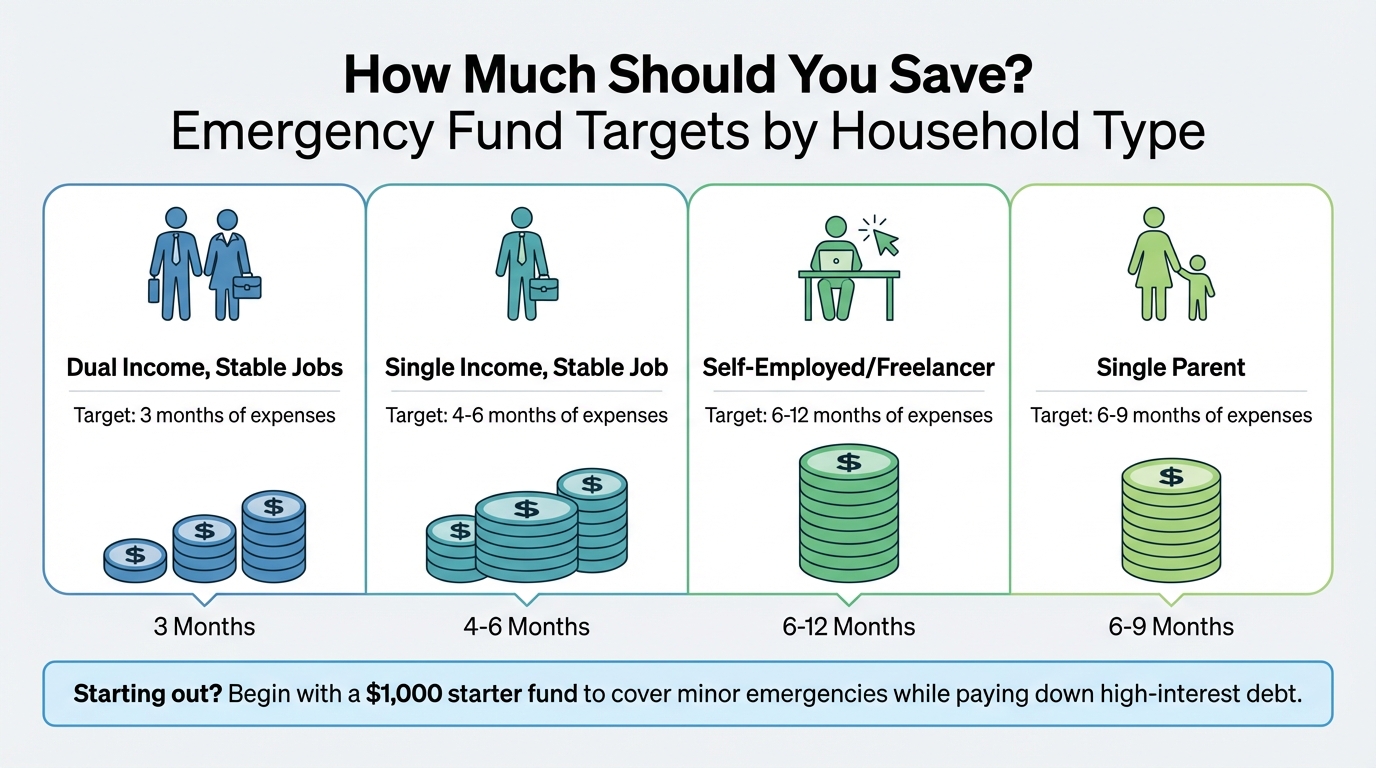
Your specific savings target depends on your financial situation:
- Dual-income households with stable jobs can aim for three months of expenses.
- Single-income households should save four to six months.
- Self-employed individuals or freelancers may need six to twelve months to account for irregular income.
- Single parents should aim for six to nine months.
Here’s a quick breakdown:
| Household Situation | Recommended Target |
|---|---|
| Dual income, stable jobs | 3 months of expenses |
| Single income, stable job | 4–6 months of expenses |
| Self-employed / Freelancer | 6–12 months of expenses |
| Single parent | 6–9 months of expenses |
For those dealing with high-interest debt, starting with a $1,000 "starter fund" is a smart move. This small cushion can handle minor emergencies, helping you avoid taking on more debt while you focus on paying down existing balances. Interestingly, research from Vanguard found that even $2,000 in emergency savings can provide a sense of financial security comparable to having $1 million in assets.
Step 2: Pick the Right Savings Account
Once you’ve figured out how much to save, the next step is deciding where to keep that money. Your emergency fund should be safe, easy to access, and earning interest – not sitting in a low-interest checking account. This way, your money stays protected and ready for unexpected situations. Here’s what to look for in the perfect account.
Consider High-Yield Savings Accounts
A high-yield savings account (HYSA) is one of the top choices for storing emergency funds. As of April 2026, the best HYSAs offer interest rates as high as 5.55% APY, compared to the national average of just 0.45%. Major banks like Chase or Bank of America often pay much less, with rates ranging between 0.01% and 0.04%. For example, a $5,000 deposit in a leading HYSA could earn about $136 over six months, while the same deposit at the average rate would yield only $11. Online-only banks such as SoFi, Chime, and Varo typically offer better rates since they save on overhead costs.
Make sure the account you choose is FDIC-insured (for banks) or NCUA-insured (for credit unions), which guarantees deposits up to $250,000 per depositor. Also, avoid accounts with monthly fees or minimum balance requirements, as these can chip away at your savings.
"Think of it as a financial safety net that helps you handle surprise costs without needing to turn to credit cards or dipping into your long-term investments." – Investopedia
Keep It Separate
Your emergency fund should live in its own dedicated account, separate from your regular checking account. This separation reduces the temptation to use the money for routine expenses. For added discipline, consider opening the account at a different bank than your primary checking account. This small barrier can discourage impulsive transfers while still allowing access within one or two business days when a real emergency arises. Some banks also offer digital tools, like savings vaults, to help you keep your emergency fund distinct from other savings.
"You may want to keep your emergency fund in a separate savings account so that you aren’t tempted to spend it on non-emergencies." – SoFi
If you ever need to dip into your emergency fund, make replenishing it a priority – treat it like a must-pay bill until it’s back to full strength.
Step 3: Start Small and Stay Consistent
Building an emergency fund doesn’t require massive deposits upfront. In fact, nearly 30% of people don’t have any emergency savings at all, often because they feel overwhelmed by the idea of saving large amounts. But here’s the truth: small, consistent contributions add up over time. Regular deposits not only grow your balance but also help you develop the habit of saving – a critical step toward hitting your financial goals.
Aim for $1,000 First
Instead of focusing on saving three to six months’ worth of expenses right away, start with a more manageable goal: $1,000. Why $1,000? Because common emergencies like car repairs, medical bills, or appliance fixes typically cost between $200 and $900. A $1,000 cushion can cover these unexpected expenses without the need to rely on credit cards.
To make this goal less intimidating, break it into smaller chunks. For example:
- Save ten $100 contributions
- Or four $250 contributions
- Or even twenty $50 contributions
Each mini-goal you achieve gives you a sense of accomplishment, keeping you motivated to continue.
"An emergency fund of a few thousand dollars is an amazing start. That alone can cover unexpected car or home repairs, medical bills, or emergency travel." – Jeremy Zuke, Financial Planner, Abundo Wealth
Reaching that first $1,000 often shifts your mindset. You stop seeing yourself as someone who’s “trying to save” and start seeing yourself as someone who saves. That mental shift can provide the momentum needed to tackle larger financial targets.
Save a Little Each Paycheck
The amount you save per paycheck doesn’t need to be huge – what matters is consistency. Whether it’s $20, $50, or $100, saving even a small amount regularly can make a big difference. For example, saving just $25 a week adds up to $1,300 in a year.
The easiest way to stick to this habit? Automate your savings. Treat it like any other bill you have to pay. Research shows that people who automate their savings typically save two to three times more than those who transfer money manually.
"Even $50 is enough to kick off an emergency fund – consistency matters more than the amount." – Jeremy Zuke, Financial Planner, Abundo Wealth
If you’re paid bi-weekly, saving $50 per paycheck results in $1,300 by year’s end. Prefer weekly contributions? Setting aside $25 each week achieves the same result. The exact amount isn’t as important as building a regular saving routine. Once that habit is in place, you can always increase your contributions over time.
Step 4: Set Up Automatic Savings
Building on the idea of consistent savings, automating your transfers is a smart move to protect your growing emergency fund. The biggest hurdle isn’t usually about how much you earn – it’s about avoiding the temptation to spend money that’s meant to be saved. When cash sits in your checking account, it’s far too easy to spend it. Automation takes the decision-making out of the equation, making saving effortless.
"I strongly recommend automating your monthly contribution because when you never see the money, it’s easier to avoid accidentally spending it." – Jeremy Zuke, Financial Planner, Abundo Wealth
Schedule Automatic Transfers
Most banks offer the option to set up recurring transfers from your checking account to your savings account. The best time to schedule these transfers is right after your paycheck hits your account. This approach ensures the funds are available while minimizing the risk of overdraft fees.
Decide on a fixed amount that works for your budget – whether it’s $50, $100, or another amount – and choose how often the transfer should happen (weekly, bi-weekly, or monthly). Once set, these transfers happen automatically, helping you save without even thinking about it.
If this method doesn’t feel foolproof enough, you can take it a step further by splitting your direct deposit.
Split Your Direct Deposit
Splitting your direct deposit is an even more effective way to save. This involves directing a portion of your paycheck straight into your savings account before it even touches your checking account. To set this up, reach out to your employer’s HR or payroll department and request a direct deposit authorization form. You’ll need to provide the routing and account numbers for both your checking and savings accounts, along with the specific amount or percentage you want to allocate to savings.
Interestingly, a survey of 2,000 workers found that while 82% used direct deposit, only 24% chose to split their deposits across multiple accounts. Of those who did, 83% used the feature to build an emergency fund. Splitting your deposit is highly effective because the money bypasses your checking account entirely, removing the temptation to spend it.
Many employers using platforms like ADP or Workday allow you to update your direct deposit settings quickly and paperlessly. Some companies even offer Emergency Savings Accounts (ESAs) with matching contributions, much like a 401(k). This approach not only secures your savings but also keeps you steadily progressing toward your financial goals.
Step 5: Reduce Unnecessary Spending
With your automated savings already working, the next step is to cut back on unnecessary spending. Believe it or not, many people unknowingly waste $100–$300 every month on things they don’t really need. The good news? You don’t need a bigger paycheck to save more – you just need to find where your money is slipping through the cracks.
"The real secret? Spending less. You don’t need a bigger paycheck. You need to stop leaking money where you don’t even notice it."
– Theis Paul, Fintech Content Strategist
Review Where Your Money Goes
Start by tracking every single expense for 14 days. This includes everything – your morning coffee, a snack from the gas station, or an app subscription. Studies show that this simple habit can help you save up to 23% more. After two weeks, take a closer look at your bank and credit card statements from the past 30 to 90 days. You’ll likely spot patterns of unnecessary spending.
For example, the average household has 4.7 unused subscriptions. Think about streaming services you barely watch, gym memberships you haven’t used in months, or premium tiers you don’t need. These alone can cost you $50–$75 per month. Canceling them and putting that money toward your emergency fund is a quick win.
Focus on the big leaks rather than obsessing over every small expense. For instance:
- Switching from an $85 cable package to a $45 streaming bundle saves $40 a month.
- Opting for a $30 unlimited phone plan instead of a $50 plan saves $20 monthly.
- Choosing generic medications over brand-name ones can cut costs from over $50 to as little as $4–$10.
Another smart move? Perform quarterly bill audits to catch hidden fees or unexpected price increases. This effort can save the average household about $137.50 per month. Once you’ve identified these unnecessary expenses, make sure the money you save goes straight to your emergency fund.
Move Saved Money to Your Fund
Cutting expenses is only half the battle – you need to put those savings to work immediately. Each time you cancel a subscription or negotiate a lower bill, set up an automatic transfer for the exact amount into your emergency fund. For example:
- Canceling a $50 subscription? Transfer $50 to your fund.
- Saving $30 by negotiating your internet bill? Move that $30 right away.
- Cutting back on dining out by $75? Schedule a $75 transfer.
This approach ensures that every dollar you save is actively helping you build your financial safety net. By locking in these savings, you’re not just cutting costs – you’re creating a more secure future.
Step 6: Add Extra Money When You Can
Beyond your regular automated contributions, look for opportunities to give your emergency fund a little extra boost. This doesn’t mean taking on a second job – it’s about making smart choices with unexpected income to strengthen your financial safety net.
Deposit Windfalls and Bonuses
When unexpected cash comes your way – like a tax refund (typically $2,000–$3,000 for many Americans), work bonuses, performance incentives, birthday or holiday gifts, or even proceeds from selling items you no longer need – aim to deposit at least 50% of it into your emergency fund. Similarly, if you get a raise, try to maintain your current spending habits and save the additional income. Another smart move: when you finish paying off a car loan or personal loan, continue setting aside that same amount, but direct it into your savings instead. These strategies help you avoid lifestyle inflation while giving your emergency fund a faster boost.
Use Round-Up Programs
Round-up programs are an easy, low-effort way to save small amounts consistently. Apps like Acorns allow you to link your spending cards and automatically round each purchase up to the nearest dollar, saving the difference into your fund. Over time, these small amounts add up. Combined with interest earnings, this passive approach can help grow your savings without requiring much thought or effort.
Earn Interest on Your Savings
Choose an account for your emergency fund that earns compound interest while keeping your money easily accessible. Compound interest allows your savings to grow without any additional work. For example, with a 5% interest rate, every $1,000 saved could earn you about $50 annually.
"An emergency fund is intended to be used at a moment’s notice… it’s best to keep your fund relatively liquid."
– Brian Walsh, CFP® and Head of Advice & Planning, SoFi
Steer clear of risky investments like stocks or cryptocurrency for your emergency fund. These can lose significant value – up to 30–50% – just when you might need the money most. Keeping your fund in a safe, interest-earning account ensures it’s there when you need it.
Conclusion
By following these six steps – setting your target, selecting the right account, starting small, automating your savings, trimming unnecessary expenses, and increasing contributions when you can – you’re doing more than just saving money. You’re securing your financial future.
With 37% of Americans unable to handle an unexpected $400 expense, even saving $5 a day – adding up to $1,825 a year – can make a huge difference. The secret isn’t starting with a large amount; it’s starting today and sticking with it. Small, consistent efforts lead to steady progress.
Building an emergency fund takes time, but the effort pays off by providing a cushion against life’s surprises. Whether you’re working toward your first $1,000 or aiming for six months of expenses, every dollar saved reduces the risk of relying on high-interest credit cards during tough times.
Start now with what you have, and let automation make the process easy. When the unexpected happens, your future self will be grateful you took action.
FAQs
When should I use my emergency fund?
Your emergency fund is there to handle unexpected costs that fall outside your usual monthly budget. Think medical bills, urgent car or home repairs, or even bridging essential expenses if you lose your income. It’s designed for true emergencies – not planned purchases or non-essential spending. Keep it for situations that could disrupt your financial security or demand immediate action.
Should I save or pay off debt first?
Deciding whether to focus on saving or paying off debt often depends on your individual financial circumstances. A good rule of thumb is to tackle high-interest debt first – like credit card balances – since the interest can quickly add up and cost you more in the long run. Simultaneously, aim to set aside a small emergency fund, typically between $500 and $1,000, to handle unexpected expenses.
Once you’ve managed to get high-interest debt under control, shift your attention to expanding your emergency fund. Ideally, this fund should cover 3 to 6 months of living expenses, providing a safety net for long-term financial stability.
How do I rebuild my emergency fund after using it?
To get your emergency fund back on track, start with a realistic savings target – perhaps $500 or $1,000 to start – and work toward covering 3–6 months of expenses. Set up automatic transfers to a separate savings account to make saving effortless and consistent. Make it a priority in your budget, even if the contributions are small. Over time, these steady efforts will rebuild your financial cushion.

Karla Moss is a CPA and former startup Controller who spent 15 years managing finance at the executive level — including inside a company that grew to unicorn status. She founded Karla & Co. to bring real-world financial clarity to everyday money decisions. She’s based in Phoenix, AZ and writes from personal experience as much as professional expertise.