
Paying off collections can help your credit score – but only under certain conditions. Newer credit scoring models like FICO 9, FICO 10, and VantageScore 3.0/4.0 disregard paid collections, potentially boosting your score. However, older models like FICO 8, still widely used, treat paid and unpaid collections the same, meaning no immediate score improvement.
Key points to consider:
- Newer models: Paid collections are ignored, improving your score.
- Older models: Paid collections remain a negative mark.
- Time matters: Collections stay on your report for 7 years, but their impact lessens as they age.
- Medical debts: Paid medical collections under $500 no longer appear on reports.
- Practical benefits: Paying collections can help with loan approvals, avoid lawsuits, and show responsibility to lenders.
Best strategies include negotiating pay-for-delete agreements, disputing errors, or requesting goodwill deletions. Always verify debts before paying to avoid resetting the statute of limitations. While paying collections doesn’t always guarantee a score boost, it can clear the way for future financial opportunities.
How Collection Accounts Affect Your Credit Score
What Is a Collection Account?
A collection account is created when a debt goes unpaid and is handed over to either the lender’s internal collections team or an outside agency. This usually happens after 120–180 days of missed payments, though the exact timing depends on the lender and type of debt. Once sent to collections, the debt shows up on your credit report as a separate negative entry. Often, the original account will also appear, marked as "closed" or "transferred", meaning one debt can show up twice and hurt your credit even more.
Collection efforts can be handled in two ways: first-party collections, managed directly by the original creditor, and third-party collections, handled by outside agencies or debt buyers. Some newer credit scoring models treat paid third-party collections more leniently. Now, let’s look at why these accounts can damage your credit.
Why Collection Accounts Lower Credit Scores
The reason collection accounts hurt your credit so much lies in how credit scores are calculated. Payment history is the largest factor, making up 35% of a FICO Score, 40% of VantageScore 3.0, and 41% of VantageScore 4.0.
"A collection account is a blemish on your credit report that remains for seven years and can harm your credit scores until it expires." – Jim Akin, Experian
When a debt is sent to collections, it sends a clear signal to lenders that you’ve defaulted on a financial obligation. This increases your perceived risk as a borrower. Beyond lowering your credit scores, collection accounts can also make it harder to rent an apartment or pass certain employment background checks.
How Long Do Collections Stay on Your Credit Report?
The length of time a collection account stays on your credit report plays a big role in its impact. Typically, collections remain on your report for seven years from the original delinquency date – the first missed payment that led to the account being sent to collections.
"The original delinquency date is the date of the first missed payment on the credit account that was sold to collections, or the date the account first became delinquent and was never brought current." – Experian
While the impact of a collection account lessens over time, a recent collection can significantly lower your score. For example, a six-year-old collection will have much less influence than one from six months ago. However, there are exceptions: in New York, paid collection accounts are removed after five years instead of seven.
Medical debt is treated differently. Paid medical collections, debts under $500, or medical bills less than a year old cannot legally appear on your credit report. If you find such entries on your report, you may be able to dispute them.
sbb-itb-0a60575
Does Paying A Collection Actually Help Your Credit?
When Paying Collections Can Help Your Credit Score
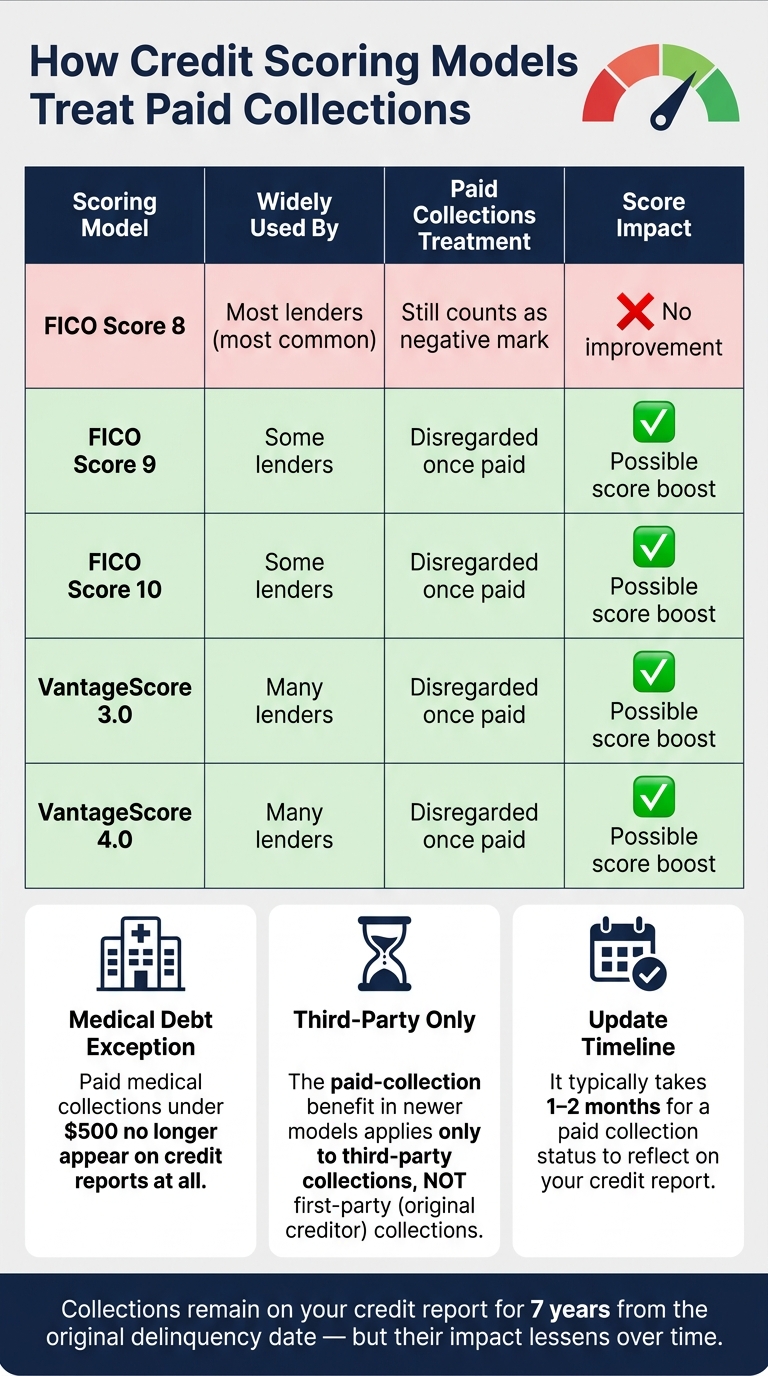
How Credit Scoring Models Treat Paid Collections
Paying off a collection might not give your credit score an instant lift, but under certain scoring models, it can make a difference. Whether or not it helps depends largely on the specific credit scoring model a lender uses. Let’s dive into how newer scoring models handle paid collections.
How Newer Credit Scoring Models Handle Paid Collections
Recent credit scoring models have shifted in how they treat paid collections. For instance, FICO® Score 9, FICO® Score 10, VantageScore® 3.0, and VantageScore® 4.0 no longer penalize you for collection accounts that have been fully paid. Once your balance hits zero, these models stop counting that collection against your score.
"Collections reported as paid in full are disregarded by FICO® Score 9 and the FICO® Score 10 suite." – myFICO
This rule also applies to settled accounts. If you negotiate with the collector to pay less than the full amount owed, these models treat the zero balance just like a fully paid account and disregard it. However, this benefit only applies to third-party collections. Collections from the original creditor (first-party collections) remain a negative mark on your credit report.
It typically takes one to two months for your credit report to reflect a paid collection status. Once updated, newer scoring models may show a positive change in your score fairly quickly.
| Scoring Model | Treatment of Paid Collections |
|---|---|
| FICO Score 8 | Still counts against you (no score improvement) |
| FICO Score 9 | Disregarded once paid (possible score boost) |
| FICO Score 10 | Disregarded once paid (possible score boost) |
| VantageScore 3.0 | Disregarded once paid (possible score boost) |
| VantageScore 4.0 | Disregarded once paid (possible score boost) |
Paying off collections isn’t just about your score – it also affects how lenders perceive you overall.
How Paying Collections Affects Future Lending Decisions
Even if your score doesn’t improve immediately, paying off collections can send a strong signal of financial responsibility. Lenders see unpaid collections as unresolved debts, but paid ones show that you’ve taken steps to address your obligations. This can enhance how lenders view your creditworthiness.
For example, many mortgage lenders require all collection accounts to be resolved before they approve a loan – regardless of your credit score. Beyond lending, unpaid collections can lead to legal trouble. Creditors might sue for the debt, which could result in wage garnishment or even a lien on your property. Paying off the collection eliminates that risk entirely.
"Paying off collection accounts can be a smart financial decision." – Capital One
If you’re preparing to apply for a mortgage or another large loan, it’s a good idea to ask the lender which scoring model they use. Your score under FICO® Score 9 or 10 could be higher than under FICO® Score 8, especially if you’ve recently paid off a collection.
When Paying Collections May Not Help Your Credit Score
Paying off a collection account might not always improve your credit score. In fact, there are situations where it has little to no effect. Understanding these scenarios can help you make smarter financial decisions and avoid unnecessary frustration.
Why Older Credit Scoring Models Treat Paid and Unpaid Collections the Same
The FICO® Score 8, one of the most widely used credit scoring models, doesn’t differentiate between paid and unpaid collections if the original debt was over $100. This means that even if you settle the account, it remains a negative mark on your credit report.
"The FICO® Score 8, however, the most widely used FICO® Score version, does not ignore paid collections if the original debt was over $100." – Experian
This scoring model keeps collections on your report for seven years, regardless of whether they’re paid. So, before deciding to pay off a collection solely to improve your score, it’s worth checking which scoring model your lender uses. If they rely on FICO® Score 8, paying the collection might not result in any immediate improvement.
Why Older Collection Accounts May Already Have Little Impact
As collection accounts age, their impact on your credit score naturally diminishes – even if they remain unpaid. This is because older negative marks carry less weight over time.
"As with any derogatory information, when reported, its impact on a FICO Score will gradually lessen over time as they age off the credit report." – myFICO
Collections typically fall off your credit report seven years from the original delinquency date. If a collection is already 5 or 6 years old, it likely has minimal influence on your score. Paying it off won’t remove it any sooner or significantly change your score. Instead, focus on actions that directly impact your credit, like reducing credit utilization or consistently making on-time payments on current accounts. These strategies address the factors that carry the most weight in your credit score calculation.
Ways to Handle a Collection Account
Once you know how collections impact your credit score, it’s time to decide on the best course of action. There are five main strategies to consider, and the right choice depends on your specific circumstances. Let’s break them down, starting with paying the debt in full.
Paying the Debt in Full
Clearing the entire balance eliminates the debt completely. This approach ends the risk of lawsuits, stops collection calls, and satisfies most lenders’ requirements. However, under FICO® Score 8, even a paid collection still counts as a negative mark. As one credit repair firm explains:
"Payment resolved the debt. That matters legally and sometimes practically for specific loan types and landlords. But payment did not touch the credit score because under FICO 8… the classification that damaged your score did not change." – ASAP Credit Repair USA
Settling the Debt for Less Than You Owe
Debt settlement involves negotiating with the collector to pay less than the full amount owed. Since third-party collectors often buy debts for just 4 to 14 cents on the dollar, they’re usually open to negotiation. A good starting offer is 20% to 30% of the balance, with many settlements landing between 40% and 50%.
Keep in mind, if the forgiven portion of the debt exceeds $600, the collector may issue a 1099-C form, and the IRS will treat that amount as taxable income. Additionally, your credit report will show the account as "settled for less than full balance," which some lenders may see as less favorable compared to a full payoff.
Negotiating a Pay-for-Delete Agreement
This strategy involves negotiating with the collector to completely remove the account from your credit report in exchange for payment. Unlike just paying the debt, a successful pay-for-delete agreement can make the collection disappear entirely, which may improve how lenders view your credit.
"With pay-for-delete, you negotiate not just a reduced payment – you negotiate the complete removal of the account from your credit reports. No ‘settled’ notation. No negative mark. The account disappears as if it never existed." – Ashley Rivera, Credit Repair Specialist, Crowned Credit
A Q2 2025 study found that pay-for-delete agreements had a 55% success rate. Always get the agreement in writing before sending any payment. To protect your financial details, use a money order or cashier’s check instead of providing your bank account information.
Disputing Inaccurate Collection Accounts
If a collection account contains errors – such as an incorrect balance, wrong date, or a debt that isn’t yours – you have the right to dispute it. Start by obtaining your free credit reports from AnnualCreditReport.com and carefully review them for mistakes like duplicated entries, incorrect balances, or re-aged accounts.
To dispute, file a formal complaint with each credit bureau reporting the error, and send a separate dispute letter directly to the collection agency. Credit bureaus are required to investigate disputes within 30 days, and if they can’t verify the information, the account must be removed. In early 2026, disputing paid collections resulted in a 38% removal rate. This process is free and can help clean up your report while improving your credit profile.
Requesting a Goodwill Deletion
If you’ve already paid the collection but it’s still on your credit report, you can try requesting a goodwill deletion. Write a letter explaining the circumstances, such as a job loss or medical emergency, and ask the creditor to remove the negative mark. This approach works best if the collection was a one-time issue and your payment history has been solid since then. While there’s no guarantee it will work, it costs nothing to try and could help improve your credit report.
How to Choose the Right Approach for Your Situation
Choosing the best strategy for handling collections depends on several factors, including the debt’s validity, its age, the scoring model used by your lender, and your financial objectives. Making the right choice can help minimize credit damage and guide you toward resolving the issue effectively. Federal law allows you to request written verification of the debt within 30 days of the collector’s first contact. If the collector can’t verify it, you should dispute the debt immediately – many older or resold debts can’t be verified.
Collections typically drop off your credit report after seven years. If your debt is nearing that seven-year mark, paying it off – or negotiating a pay-for-delete – might not offer much benefit compared to waiting for it to age off naturally. On the other hand, newer collections (within the last two or three years) are more likely to harm your credit score and may require quicker action. Your financial goals also play a big role in deciding the best approach.
For example, if you’re planning to apply for a mortgage, keep in mind that older FICO models (such as FICO 2, 4, and 5) still penalize paid collections. In this case, a pay-for-delete agreement could be more beneficial. However, if you’re targeting newer credit products, paying off the collection might be enough, as scoring models like FICO 9 and VantageScore 3.0/4.0 generally ignore paid collections.
Here’s a quick breakdown of strategies based on different situations:
| Your Situation | Best Approach |
|---|---|
| Debt has errors or can’t be verified | Dispute with the credit bureaus |
| Account is near the seven-year reporting mark | Let it age off naturally |
| Applying for a mortgage soon | Pay-for-delete or pay in full |
| Focusing on newer credit models | Pay in full |
| Can’t afford the full balance | Settle for less than owed |
| Already paid but account still appears | Request a goodwill deletion |
One important caution: avoid making payments before verifying the debt. Even a partial payment can restart the statute of limitations, which could make the debt legally collectible again. Always get any agreements – especially pay-for-delete deals – in writing before making a payment.
How to Rebuild Your Credit After Paying Collections
Paying off a collection is a great start, but rebuilding your credit requires consistent, responsible habits moving forward.
"Improving your credit scores requires responsible credit use over time."
Building a Positive Payment History
Your payment history plays a major role in your credit score – accounting for 35% of your FICO score and up to 41% of your VantageScore 4.0. Every on-time payment you make from now on helps boost your credit.
To stay on track, consider setting up autopay for at least the minimum payment on all your accounts. You can also speed things up with tools like Experian Boost. This free service lets you add on-time payments for utilities, phone bills, and rent to your Experian credit file.
Keeping Your Credit Utilization Low
When it comes to credit cards, aim to keep balances below 30% of your credit limits. This sends a positive signal to lenders and is especially important when you’re in the process of rebuilding. Keep in mind that only first-party collections impact your utilization rate.
Protect your progress by staying diligent and avoiding any new delinquencies.
Preventing New Negative Marks on Your Credit Report
New delinquencies can undo your hard work, so it’s crucial to avoid them. If you miss a payment, contact your creditor immediately. Accounts generally aren’t sent to collections until they’re significantly overdue, so acting quickly can prevent further issues.
Make it a habit to review your credit reports regularly using AnnualCreditReport.com. Look out for errors, such as incorrect dates that extend the reporting period for collections. Also, avoid applying for new credit too soon – wait at least 60 to 90 days after paying off a collection before pursuing major credit applications. This helps minimize hard inquiries, which can temporarily lower your score.
Conclusion: What You Need to Know About Paying Collections and Credit Scores
Whether paying off a collection improves your credit score isn’t a straightforward yes or no – it all depends on the scoring model a lender uses, the age of the debt, and the overall details in your credit report. For instance, newer scoring models ignore paid collections, while older ones like FICO 8 treat them similarly to unpaid debts. Under the right circumstances, paying off a collection could lead to a noticeable improvement in your score.
That said, paying collections isn’t a waste of effort. Even if your score doesn’t immediately jump, resolving a collection could clear the way for major financial steps like getting approved for a mortgage, car loan, or rental. Many lenders require collections to be resolved before they’ll approve applications, no matter what your credit score says. This practical benefit is widely emphasized by financial experts.
"Taking the time to weigh these approaches and your other options can make the difference between simply closing an account and actually moving your finances forward." – CBS News
Experts also highlight that older collections impact your credit less, and medical collections under $500 no longer appear on credit reports. Additionally, collections drop off your credit report entirely seven years after the original missed payment date.
FAQs
How can I find out which credit score model a lender will use?
To determine which credit score model a lender uses, start by checking if your bank or lender offers a free credit report or score. These often indicate both the model and the credit bureau they rely on. Another option is to reach out to the lender directly and ask. Generally, lenders pull a single report from one credit bureau for each application. If your application is denied, the model used might also be listed in the adverse action notice you receive.
Will paying a collection restart the statute of limitations in my state?
Paying off a collection debt could reset the statute of limitations, which might allow collectors additional time to take legal action against you. However, this varies based on the laws in your state. It’s important to review your state’s regulations to see how making a payment might affect your circumstances.
What should I ask for in a pay-for-delete agreement before paying?
Before making any payment, make sure to get a written settlement agreement that clearly outlines the following:
- The exact amount you’ll be paying.
- Confirmation that the account will be marked as either "paid in full" or "settled in full" – not "settled for less."
- A statement that the collector will request the account’s deletion from credit bureaus, if permissible.
- The timeline for when this deletion will reflect on your credit report.
Only proceed with payment once you have this agreement in writing.
Related Blog Posts
- Credit Score Estimator to Boost Your Rating
- What Credit Score Do You Need to Buy a House?
- Paying Off Debt: Short-Term Credit Score Changes
- How to Monitor Business Credit with Experian, Equifax, and D&B

Karla Moss is a CPA and former startup Controller who spent 15 years managing finance at the executive level — including inside a company that grew to unicorn status. She founded Karla & Co. to bring real-world financial clarity to everyday money decisions. She’s based in Phoenix, AZ and writes from personal experience as much as professional expertise.