
When you plan a move, it’s easy to focus on obvious expenses like hiring movers or renting a truck. But hidden costs – like fuel surcharges, utility deposits, cleaning fees, and even lost wages – can quickly inflate your budget. In 2026, a local move averages $933, while long-distance moves can exceed $6,000, and that’s before surprise fees.
Here’s what to watch for:
- Moving Company Fees: Fuel surcharges, stair fees, and extra costs for long-carry distances or furniture assembly.
- Packing Supplies: Last-minute purchases can cost 30–40% more. Specialty items like wardrobe boxes add up fast.
- Insurance: Basic coverage often falls short. Upgrading to Full Value Protection costs 1–2% of your shipment’s value.
- Cleaning and Repairs: Move-out cleaning ranges from $280–$500, with additional costs for repairs or carpet cleaning.
- Utility Setup: Deposits and connection fees can cost $300–$1,500, depending on services and credit history.
- Temporary Housing or Storage: Storage fees range from $150–$500 per month, while short-term lodging costs $100–$250 per night.
- Lost Income: Taking time off work can cost hundreds, especially for self-employed individuals.
- Cost of Living Changes: Relocation often reshapes expenses, from higher insurance rates to unexpected purchases for your new home.
To avoid surprises, create a detailed budget, account for these hidden costs, and plan ahead. Start early, get binding estimates, and prioritize expenses to keep your move stress-free and within budget.
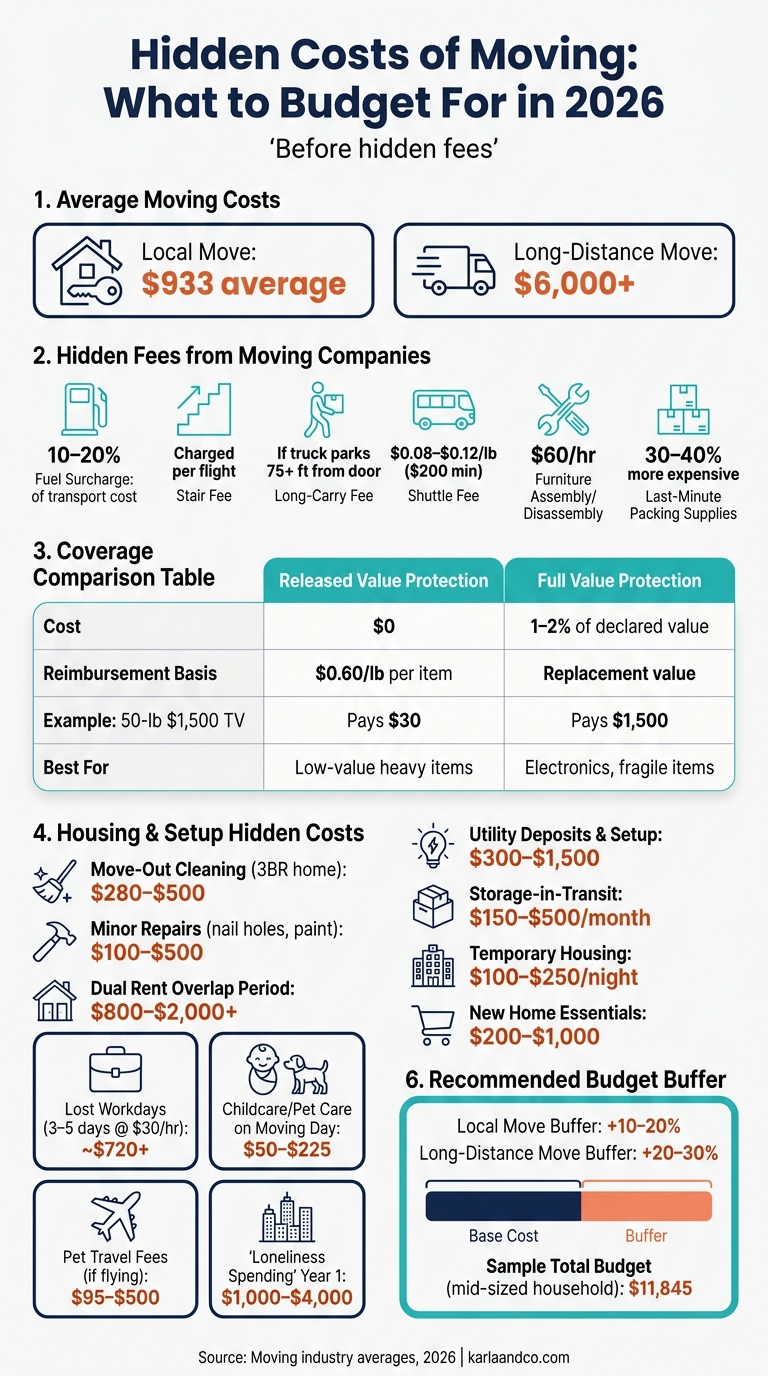
Hidden Costs of Moving: Complete Budget Breakdown 2026
Direct Moving Costs You Might Miss
Surprise Fees from Moving Companies
The initial quote from a moving company often doesn’t reflect the final bill. Why? Because there are extra charges that tend to sneak in – and they can add up quickly.
Common unexpected fees include fuel surcharges (typically 10%–20% of your transportation cost), stair fees (charged per flight), and long-carry fees if the truck has to park more than 75 feet from your door. If your street can’t accommodate a full-size truck, you’ll likely face a shuttle fee, which is usually $0.08 to $0.12 per pound with a $200 minimum. Need furniture disassembled and reassembled? That’s another $60 per hour.
The type of estimate you choose plays a big role in your final costs. A non-binding estimate is just a rough guess, and under the Federal 110% Rule, movers can charge up to 110% of that estimate at delivery and bill the rest later. A binding estimate locks in the price, but the most reliable option for many is a binding not-to-exceed estimate. This ensures you won’t pay more than the quoted amount, and you might even pay less if the shipment weighs less than expected.
"A lower quote loses its value quickly if the final invoice is full of surprises." – Great White Moving Company
To sidestep unexpected fees, send photos or videos of staircases, narrow driveways, and parking spaces to your mover before the big day. Finalize your item list early, as adding items on moving day could void a binding estimate. Also, ask when the company’s travel fee starts – does the clock begin when they leave their office or when they arrive at your home?.
Now, let’s talk about how packing materials can quietly inflate your moving bill.
Packing Materials Cost More Than You Think
Packing supplies are another sneaky expense that can catch you off guard. If you don’t plan ahead, you could end up paying 30%–40% more for supplies bought at the last minute. For a three-bedroom home, you’ll likely need 80–100 boxes, and specialty items like wardrobe boxes ($15–$25 each) and mattress bags ($10–$20 each) can quickly strain your budget.
"When you’re frantically packing at 11 PM the night before the move, you don’t shop for deals – you pay whatever the 24-hour store charges." – Long Distance USA Movers
Instead of overspending, consider sourcing free or low-cost boxes from Facebook Marketplace, Craigslist, or local "Buy Nothing" groups. To save on bubble wrap, use towels, blankets, or sweaters to cushion fragile items. If you’re hiring professional packers, opt for partial packing – let them handle tricky areas like the kitchen and glassware, while you pack books and linens. This compromise can save you $300–$700 compared to full-service packing.
Moving Insurance and Liability Coverage
Beyond service fees and packing costs, liability coverage is another area where expenses can catch you off guard. Here’s a little-known fact: what movers call "coverage" is actually valuation, not insurance. It’s a federally regulated liability standard, not a true insurance policy.
The default option, Released Value Protection, only reimburses $0.60 per pound per item. For instance, if a 50-pound TV worth $1,500 gets damaged, you’d only receive $30. For better protection, consider Full Value Protection (FVP), where movers are responsible for the actual replacement value of lost or damaged items. This option costs 1%–2% of your shipment’s declared value, with deductibles ranging from $250 to $500.
| Coverage Type | Cost | Basis | Ideal for |
|---|---|---|---|
| Released Value Protection | $0 | $0.60/lb per item | Low-value, heavy items |
| Full Value Protection | 1%–2% of declared value | Replacement value | Electronics, fragile items, valuables |
Before moving, take photos of every room and document high-value items. If you own anything worth more than $100 per pound – like fine art, antiques, or jewelry – list it on a high-value inventory form to ensure it’s covered under FVP. Also, review your homeowners’ or renters’ insurance policy, as some policies include coverage for goods in transit, which could save you from spending extra on additional protection.
Hidden Moving Costs You Might Forget | Avoid These Common Moving Expenses
Housing Costs When You Move Out and Move In
Moving to a new home often brings extra housing costs, beyond the obvious moving fees and packing expenses.
Cleaning and Repair Costs
Once you’ve moved out, your old place will likely need a thorough cleaning and some minor repairs. Move-out cleaning goes beyond everyday tidying – it tackles hidden grime behind appliances, inside cabinets, on baseboards, and even in vents. For a 3-bedroom home, hiring professionals typically costs $280–$500, with carpet cleaning adding another $100–$300 to your bill.
Timing plays a big role here. Booking cleaners at the last minute or at the end of the month can cost 20–30% more. If your home has significant grease buildup, pet hair, or mold, expect the labor – and the cost – to increase.
"A cleaner quoting you without asking about condition is a sign they may revise the price once they arrive, which puts you in a tough spot on move-out day." – AlphaLux Cleaning
Minor repairs, like filling nail holes or touching up paint, can cost between $100–$500. To save money, do a walkthrough of your old home about three weeks before moving out. A $20 investment in spackle and touch-up paint could save you hundreds in deductions from your security deposit.
Security Deposits and Overlapping Rent
The timing of leases can quickly add up to extra costs. Most leases begin on the 1st of the month, but cleaning and repairs may take several days, leaving you paying rent on two places simultaneously. This dual rent period can cost anywhere from $800 to $2,000+, depending on market rates in 2026.
Staying past your lease’s end date without an agreement can be even more expensive. Many landlords charge 150%–200% of your daily rent as a holdover penalty. On the flip side, leaving early without a formal agreement means you’re still responsible for rent until the lease officially ends.
"Losing a thousand-dollar deposit over holes you could have patched yourself for fifteen bucks – that’s one of the most painful hidden costs of the entire move." – Cross Country Movers
To manage these costs, ask your current landlord for a pro-rated move-out date to minimize overlap, and see if your new landlord offers early key access for a flat fee. Both options are often cheaper than paying for an extra day’s rent. Also, avoid relying on an immediate refund of your security deposit – it can take weeks to process.
Necessary Purchases for Your New Home
Once you’ve moved in, there are always immediate purchases to make. Essentials like curtains, rugs, cleaning supplies, light bulbs, and basic hardware are often needed right away. Depending on your new home’s condition, these items can cost between $200 and $1,000.
Start with safety items: replace locks, check smoke/CO detector batteries, and install a fresh HVAC filter. Day-one essentials – like toilet paper, trash bags, dish soap, and bedding – should come next. Other items, such as decorative touches or furniture, can wait. Creating a prioritized list before moving day can help keep impulse buys in check and prevent overspending.
| Category | Essential Items | Estimated Cost |
|---|---|---|
| Safety | New locks, smoke/CO detector batteries, HVAC filter | $100–$250 |
| Bathroom | Toilet paper, shower curtain, towels, hand soap | $50–$150 |
| Kitchen | Trash bags, dish soap, coffee maker, basic utensils | $100–$300 |
| Comfort | Curtains/blinds, floor rugs, fresh bedding | $200–$500+ |
If you’re on a tight budget, platforms like Facebook Marketplace or Nextdoor can be lifesavers. You can often find furniture and home essentials for 10–20% of retail prices. Planning for these costs ahead of time can help you stick to a realistic moving budget, making the transition smoother and less stressful.
Utility, Storage, and Temporary Housing Costs
Utility Deposits and Setup Fees
Setting up utilities at your new home can cost anywhere from $300 to $1,500, depending on your credit history and the provider. Security deposits for individual utilities typically range between $50 and $300. If you have limited or poor credit, these deposits are more likely. However, you might be able to avoid them by providing a letter of credit from your previous utility provider – definitely worth checking before you pay.
Here’s a breakdown of typical utility costs:
| Utility Service | Connection Fee | Potential Deposit | Total Estimated Cost |
|---|---|---|---|
| Electricity | $30–$100 | $100–$300 | $30–$400 |
| Water & Sewer | $25–$75 | $50–$200 | $75–$275 |
| Natural Gas | $30–$70 | $50–$150 | $80–$220 |
| Internet & Cable | $50–$200 | N/A | $50–$500 |
| Trash & Recycling | $10–$50 | N/A | $10–$100 |
The time it takes to activate utilities can vary. Electricity and water are usually ready within 3–5 business days, while internet setup can take 7–14 business days. If you’re moving into new construction, expect delays of up to 2–4 weeks.
"Internet is the utility with the longest and most variable lead time, and the one that causes the most post-move disruption." – First Home Start Guide
To avoid unnecessary stress or costs, take these steps:
- Photograph meters at both your old and new homes on moving day to prevent billing disputes.
- Schedule disconnections at your old address for the day after you move out. This ensures you’ll still have power and water for last-minute cleaning.
- If your new home is part of an HOA, confirm whether services like water, trash, or basic cable are already included before arranging separate accounts.
If your move involves temporary housing or storage, additional expenses can quickly pile up.
Storage Units and Temporary Housing
When your move-out and move-in dates don’t align, you may need to budget for temporary lodging and storage. Temporary housing costs range from $100 to $250 per night, while storage adds another layer of expense.
For short-term gaps – such as a delay in closing – Storage-in-Transit (SIT) is often the most practical solution. SIT allows your moving company to store your belongings in a secure warehouse near your destination for 7 to 90 days, typically costing $150 to $500 per month. The advantage? Your items are only loaded and unloaded once. In contrast, self-storage often requires two separate moves – one to the storage unit and another to your new home.
"With self-storage on an interstate move, you’re not paying for one move, you’re paying for two." – Moving Hub Editorial Team
For example, a family moving from Miami to Charlotte experienced a three-week delay in closing. Their 5,200-pound shipment was placed in SIT, costing $280 in handling fees plus $390 for 28 days of storage. Because their initial quote was binding and included redelivery, they avoided an extra $450 charge.
Here’s a comparison of storage options:
| Storage Type | Best For | Typical Monthly Cost |
|---|---|---|
| Storage-in-Transit | Short gaps (7–90 days) on long-distance moves | $150–$500 |
| Warehouse/Vaulted | Long-term transitions or renovations | $100–$400 |
| Portable Containers | DIY moves or gradual loading | $100–$450 |
| Self-Storage | Local moves with frequent access needs | $50–$400+ |
One often-overlooked cost is redelivery fees. When your belongings come out of storage and are delivered to your new home, this leg of the journey can cost an additional $150 to $400 if it’s not included in your original estimate. Always confirm whether redelivery is part of the deal – and get it in writing.
sbb-itb-0a60575
Work and Life Costs During a Move
Moving isn’t just about paying for trucks and movers – it often comes with hidden expenses tied to disruptions in your personal and professional life.
Lost Income and Downtime
Taking time off work for a move can add up fast. Most people need three to five workdays to handle the packing, moving, and settling in. If you earn $30 per hour, each missed workday costs about $240. Over three days, that’s $720 gone. These expenses often sneak past initial budget planning.
For freelancers or self-employed individuals, the impact can be even greater. Declining a client project to focus on moving isn’t just inconvenient – it’s lost revenue. Before deciding to handle the move yourself, weigh your daily earnings against the cost of hiring professional movers. Surprisingly, sticking to your regular work schedule and paying for help might save you money.
If you’re flexible, consider scheduling your move mid-week. It could reduce truck and labor costs by up to 20%.
Childcare and Pet Care on Moving Day
Keeping kids and pets safe and out of the way during a move can be another expense. Hiring a sitter on moving day typically costs $50 to $150, while boarding your pet may run $30 to $75 per day.
Since movers won’t transport live animals, you’ll need to plan separate travel for your pets. If flying, expect airline pet fees ranging from $95 to $500, plus a vet visit costing $50 to $200.
Changes in Cost of Living After a Move
Relocating often reshapes your monthly expenses, and not always for the better. For instance, moving from a rural area to a city could increase your auto insurance by $300 to $800 annually. Property taxes can also eat into savings. A household earning $100,000 might save $6,500 in state income tax by moving from California to Texas, but end up paying an extra $3,600 in property taxes on a $400,000 home.
Adjusting to a new city can also bring unexpected costs. During the first year, "loneliness spending" – extra dining out, travel, and entertainment – can add $1,000 to $4,000 to your budget. While these expenses often stabilize over time, it’s smart to treat your first few months’ budget as a flexible guideline rather than a rigid plan.
To avoid unnecessary charges, cancel location-specific subscriptions – like gym memberships, parking passes, or meal delivery services – at least 30 days before you move.
Factoring in these often-overlooked expenses can help you create a more realistic and stress-free moving budget.
How to Budget for Hidden Moving Costs
Building a Moving Budget
Creating a moving budget isn’t just about tallying up obvious costs; it’s also about preparing for the unexpected. Start by taking a thorough inventory of your belongings – don’t skip closets, attics, or outdoor items. This detailed list helps ensure that your moving estimates are accurate, reducing the risk of surprise charges later.
Next, break your expenses into categories: professional moving services, packing supplies, travel and temporary housing, and administrative fees. For example, updating your vehicle registration in a new state can cost $100–$300, while a driver’s license update might run $25–$50. Don’t forget to budget for moving day gratuities, which typically range from $20–$50 per mover for local moves and $50–$100 for long-distance moves.
After estimating costs, add a contingency buffer – 10–20% is recommended for local moves, while long-distance moves might require 20–30%. As Capitol Moving & Storage aptly puts it:
"A moving budget is more than a spreadsheet. It is a planning tool that shapes every decision that follows."
Here’s a sample budget for a mid-sized household, factoring in a 15% buffer:
| Category | Estimated Cost |
|---|---|
| Moving Company (Base) | $4,500 |
| Travel (Gas, Hotels, Meals) | $900 |
| Temporary Stay/Housing | $1,200 |
| Deposits & Setup Fees | $2,000 |
| Packing Supplies | $400 |
| Insurance/Valuation Upgrade | $300 |
| New Home Purchases | $1,000 |
| 15% Contingency Buffer | $1,545 |
| Total Budget Target | $11,845 |
Use this framework to track your actual expenses against estimates. A simple spreadsheet can help you monitor costs, allowing you to catch and address any overruns before moving day arrives.
To make managing these costs easier, consider using sinking funds to align savings with key payment milestones.
Using Sinking Funds and Payment Timelines
A sinking fund is a great way to save for your move gradually. Start setting money aside 6–8 weeks before your move date. Booking services early not only helps you manage cash flow but also locks in better rates.
Coordinate your savings with critical payment deadlines. For instance:
- Buy packing supplies 6–8 weeks before your move.
- Pay utility deposits about two weeks ahead of time.
- Cover cleaning or repair costs a week before moving out.
This approach keeps you from relying on high-interest credit cards for last-minute expenses.
Since 84% of Americans admit to exceeding their monthly budgets, having a dedicated moving fund is a smart move. One practical tip is to audit your bank statements 30 days before your move. Look for subscriptions tied to your current location – like gym memberships, parking apps, or meal delivery services – that require a 30-day cancellation notice. Canceling these in advance can save you from unnecessary charges.
Conclusion: Plan Ahead to Avoid Budget Surprises
Moving can quickly become more expensive than expected. Beyond the obvious truck rentals and base fees, there are often overlooked costs – like utility deposits, overlapping rent, packing supplies, cleaning fees, and even lost workdays – that can add up if you’re not prepared.
The silver lining? Most of these expenses are predictable if you know where to look. Start early. Simple steps like requesting binding estimates, contacting utility companies at least two weeks in advance, and canceling or transferring subscriptions before moving day can save you significant money with just a little effort.
As Peter Klein of Tress Homes wisely points out:
"Moving isn’t just a transaction – it’s a transition. And like any major life change, it comes with costs people don’t always see coming. The more prepared you are, the smoother the journey will be."
His insight highlights the importance of realistic planning. Many people fall into the trap of underestimating how much time packing and organizing will take. Combat this by creating a detailed room-by-room checklist, setting aside a contingency budget, and sticking to a clear timeline.
For straightforward, CPA-backed advice on budgeting and saving, check out Karla & Co..
FAQs
How do I avoid surprise mover fees?
To steer clear of surprise fees, ask for a binding estimate to secure your moving costs – this ensures pricing won’t change unless your inventory does. Be as detailed as possible when describing your home and belongings. Mention specifics like the number of stairs, elevator usage, or the distance from parking to your home. Additionally, request that movers break down any potential extra charges, such as fuel costs or fees for handling specialty items, and make sure all agreements are documented in writing. Lastly, stick to your original packing plan and schedule, as last-minute changes can often result in unexpected costs.
Do I need Full Value Protection?
Whether you should opt for Full Value Protection (FVP) comes down to how much your belongings are worth and how much financial risk you’re comfortable taking. By law, moving companies must provide two coverage options: Released Value Protection (free but capped at $0.60 per pound per item) and FVP, which comes at an additional cost. FVP is often a smart choice if the total value of your items exceeds $5,000 or if you’re moving expensive items like electronics, antiques, or large furniture.
How much extra should I budget for hidden costs?
Experts suggest including a 10% to 20% cushion in your moving budget to account for hidden costs. These might include utility setup fees, cleaning services, temporary storage, or extra charges for stairs, elevators, or long-distance carries. For a $5,000 move, this means reserving an additional $500 to $1,000. Preparing in advance can help you sidestep surprise expenses and reduce financial strain when the final bill is higher than expected.
Related Blog Posts
- Budget Not Working? 5 Common Mistakes to Fix Now
- Why Budgets Fail: Common Mistakes Explained
- How to Budget for Big-Ticket Items
- 10 Benefits to Negotiate Beyond Salary

Karla Moss is a CPA and former startup Controller who spent 15 years managing finance at the executive level — including inside a company that grew to unicorn status. She founded Karla & Co. to bring real-world financial clarity to everyday money decisions. She’s based in Phoenix, AZ and writes from personal experience as much as professional expertise.