
Salary negotiations aren’t just about numbers – they’re shaped by different communication styles, values, and workplace norms. These unspoken factors can greatly influence outcomes, especially in global or diverse workplaces. Here are the seven key aspects to consider:
- Individualism vs. Collectivism: U.S. negotiations focus on individual value, while group-oriented cultures, like Japan, prioritize harmony and relationships.
- Power Distance: Low power distance cultures (e.g., U.S.) encourage open dialogue, whereas hierarchical ones (e.g., India) expect deference to authority.
- Direct vs. Indirect Communication: Americans prefer clear, upfront discussions, while indirect cultures rely on subtle cues and non-verbal signals.
- Attitudes Toward Money: Pay discussions are open in the U.S., but in "face" or "honor" cultures, they may feel intrusive or trust-dependent.
- Gender, Race, and Bias: Women and minorities often face challenges in being perceived as assertive negotiators, impacting outcomes.
- Time Orientation and Risk: Americans value quick results, while others, like Japan, focus on long-term relationships and cautious decision-making.
- Industry Norms: Startups, corporations, and nonprofits differ in flexibility, with startups offering equity and titles, while large firms focus on structured pay.
Key takeaway: Understanding these factors can help you negotiate effectively, align your approach with workplace norms, and secure better financial outcomes.
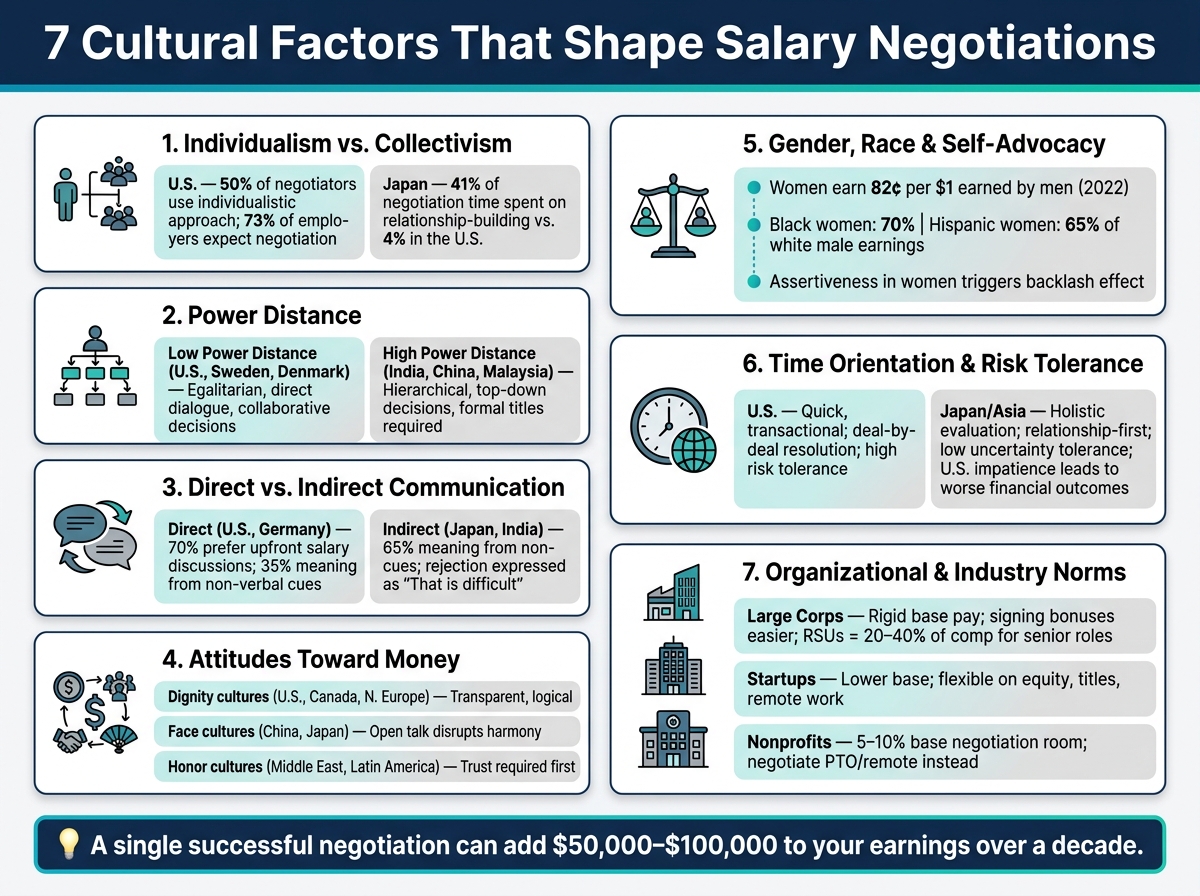
7 Cultural Factors That Shape Salary Negotiations
How to Deal with Cultural Differences in Negotiation | Ask a Negotiator with Bob Bordone
sbb-itb-0a60575
1. Individualism vs. Collectivism
Salary negotiations often hinge on a fundamental question: Is the focus on the individual or the group?
In the U.S., the process tends to be highly personal. About 50% of negotiators adopt an individualistic approach, coming to the table armed with detailed performance metrics, competing offers, and clear expectations. Interestingly, 73% of U.S. employers anticipate candidates will negotiate and even build flexibility into their initial offers.
However, in collectivist cultures – common in East Asia and Latin America – the focus shifts toward maintaining group harmony. For instance, in Japan, negotiators dedicate about 41% of their time to relationship-building, compared to just 4% for their American counterparts. Diving straight into salary discussions can seem abrupt or even disrespectful in these settings, where trust and "saving face" are often valued over immediate outcomes.
These cultural differences shape how negotiations unfold:
"In individualistic cultures like the United States, negotiation is often approached from a competitive standpoint, with an emphasis on individual goals, autonomy, and personal achievement." – J. Wittwer, Success Across Cultures
If you’re from a collectivist background negotiating in a U.S. workplace, highlighting your individual market value becomes crucial. On the flip side, when dealing with someone from a collectivist culture, it’s wise to focus on building relationships and emphasizing long-term benefits. Adapting to these cultural nuances can make a significant difference – whether the setting prioritizes individual success or group cohesion. Framing your request in a way that aligns with these values can lead to a more favorable outcome.
2. Power Distance and Respect for Authority
Power distance refers to how a culture views and accepts unequal power distribution within organizations and society. In countries like the U.S., Sweden, and Denmark – where power distance is low – employees feel at ease questioning authority, engaging in direct discussions, and negotiating openly with their managers. Negotiations in these cultures are often seen as a logical exchange between equals. On the other hand, in high power distance cultures, such as India, Malaysia, China, and the Middle East, employees are expected to show deference to senior leaders. Even a polite challenge to a superior’s proposal can be perceived as disrespectful.
"In high-power-distance cultures like Malaysia, negotiators respect hierarchical protocols, while low-power-distance cultures like Denmark favor egalitarian approaches." – iResearchNet
These cultural differences significantly influence negotiation styles. In high power distance environments, formal titles, status, and adherence to hierarchy are critical. Skipping these protocols can derail negotiations. In contrast, negotiations in the U.S. tend to be quicker, with direct questions and a mutual expectation of open communication.
Here’s a quick comparison of how these approaches differ:
| Feature | Low Power Distance (e.g., U.S.) | High Power Distance (e.g., India, China) |
|---|---|---|
| Authority Relation | Egalitarian; authority can be questioned | Hierarchical; seniority is respected |
| Communication Style | Direct and assertive | Indirect; avoids confrontation |
| Decision Making | Collaborative; input from all levels is valued | Top-down; decisions rest with senior leaders |
| Trust Baseline | Often begins with a level of assumed trust | Trust is built gradually over time |
Adapting negotiation strategies to match these cultural norms is key. For high power distance settings, it’s essential to involve senior leaders early in the process. Use formal titles, follow established protocols, and focus on building relationships before jumping into numbers or specifics. As Ric Lewis, Chief Executive of Tristan Capital Partners, explains:
"In different countries, winning is defined differently, and how you win, and how you win gracefully… If you haven’t built a cultural and social setting, it’s not polite to enter into a hard negotiation."
Meanwhile, for those accustomed to high power distance norms, U.S.-style negotiations may require a shift toward greater assertiveness and direct communication.
Recognizing how power distance shapes interactions helps negotiators navigate both direct and indirect communication styles effectively.
3. Direct vs. Indirect Communication
Negotiation styles often reflect how directly or indirectly people express their needs, which ties closely to cultural communication norms.
In salary negotiations, how you say something can be just as important as the message itself. In the U.S., direct communication dominates. American negotiators typically state their expectations upfront, support them with data, and anticipate a clear response. In fact, about 70% of U.S. professionals prefer a straightforward approach when discussing salary, openly sharing their needs and reasoning right from the start.
On the other hand, indirect communication styles, common in countries like Japan, China, and India, rely heavily on non-verbal cues. While U.S. negotiators derive approximately 35% of meaning from non-verbal signals, Japanese negotiators lean on them for as much as 65% of the message. This reliance on subtlety reflects deeper cultural values and can lead to misunderstandings when these styles intersect.
One common challenge arises with interpreting rejection. In indirect cultures, a flat "no" is rarely spoken. As Jeswald Salacuse from Harvard Law School’s Program on Negotiation points out:
"If in response to one of your proposals your Japanese supplier says, ‘That’s difficult,’ you might erroneously assume that the door is still open… In fact, your supplier… may have been giving a flat no."
A direct communicator might misread this as a signal to continue pushing, not realizing they’ve already hit a wall.
Confidence also manifests differently across these styles. In the U.S., presenting a specific number backed by research conveys professionalism and preparation. Hedging or being vague can weaken your position. Talaera explains:
"The difference between ‘I want a higher salary’ and ‘Based on my research and the value I bring, I’d like to discuss the compensation’ isn’t politeness alone. That second version signals professionalism, preparation, and collaborative intent."
Stating a precise, data-supported figure demonstrates readiness and a collaborative mindset. Here’s a quick comparison of how direct and indirect styles play out:
| Feature | Direct (e.g., U.S., Germany) | Indirect (e.g., Japan, India) |
|---|---|---|
| Primary Goal | Clarity and efficiency | Harmony and saving face |
| Disagreement | Open and explicit | Subtle, nuanced, or avoided |
| "No" Response | Clearly stated as "No" | Phrases like "That is difficult" |
| Contracts | Detailed and binding | Flexible frameworks based on trust |
When negotiating across these styles, small adjustments can make a big difference. Start with enthusiasm, then pivot to numbers anchored in market data rather than personal needs. If you’re working with someone who communicates indirectly, pay close attention to pauses, hesitations, and vague language – these often reveal the true message.
Grasping these communication differences lays the groundwork for exploring how attitudes toward money shape salary negotiations.
4. Attitudes toward Money and Discussing Pay
Cultural attitudes toward money play a big role in shaping salary discussions. How comfortable someone feels talking about pay often depends on their cultural background, and this comfort level can significantly influence how salary negotiations unfold.
In the U.S., conversations about pay are relatively common. Psychologist Michele Gelfand describes the U.S. as a "loose" culture, where a wide range of social behaviors, including openly discussing money, are generally accepted. This openness is reflected in workplace norms: 73% of U.S. employers expect candidates to negotiate salaries, with many setting aside 10–20% above the initial offer for this purpose. However, even in the U.S., not everyone feels at ease – 43% of Americans are uncomfortable discussing salary with coworkers, and only 30% feel okay talking about personal finances.
Researchers often divide negotiation cultures into three main categories:
| Culture Type | Examples | Attitude Toward Pay Discussions |
|---|---|---|
| Dignity | U.S., Canada, Northern Europe | Salary is seen as a transparent, logical topic |
| Face | China, Japan | Open money talk can disrupt social harmony |
| Honor | Middle East, North Africa, Latin America | Money is linked to reputation; trust is a prerequisite |
Source:
These categories highlight how cultural norms influence salary discussions. In "face" cultures, directly asking about pay can feel intrusive, so negotiators may rely on subtle cues or reactions rather than explicitly stating expectations. Similarly, in "honor" cultures, financial details are often left unspoken until a personal relationship has been built – jumping into specifics too quickly can be perceived as distrustful.
Even within Western cultures, there are differences. For instance, while the U.S. tends to favor directness, the U.K. leans toward a softer, more reserved tone. In such settings, framing a counteroffer with objective data, like market rates, rather than personal needs, helps avoid appearing overly assertive.
"Directness is valued in the US and Western Europe – discuss numbers, rationale, and benchmarks head-on."
- Elias Oconnor, Content Writer, Huru.ai
A practical tip: base your salary discussions on market data. Tools like Levels.fyi for U.S. tech roles or AmbitionBox for India can help shift the focus from personal desires to industry standards. This approach tends to resonate across different cultural contexts.
5. Gender, Race, and Self-Advocacy Norms
Negotiation strategies are shaped by more than just communication styles; gender and race play a major role in influencing outcomes. Consider this: in 2022, women in the U.S. earned only 82 cents for every dollar earned by men. The gap widens further when race is factored in – Black women earned just 70% of what white men earned, while Hispanic women earned only 65%. These disparities add another layer of complexity to the challenges negotiators already face.
Interestingly, recent data reveals that women now initiate salary negotiations as often as men. The issue lies in how their requests are received. Assertiveness in negotiation is often seen as a norm for men, but when women display similar behavior, it can lead to what researchers call the "backlash effect".
"When women negotiate for higher salaries, they must behave contrary to deeply ingrained societal gender roles of women as passive, helpful, and accommodating. As a result, their requests often face a backlash." – Hannah Riley Bowles, Senior Lecturer, Harvard Kennedy School
This fear of backlash often forces women to lower their requests compared to men. However, the gap becomes less pronounced when women negotiate on behalf of others rather than for themselves.
The challenges don’t stop there. Racial bias magnifies these issues. A 2019 study led by Morela Hernandez from the University of Virginia revealed that even when Black and white candidates negotiated at the same rate, evaluators with strong racial biases mistakenly believed Black candidates negotiated more aggressively. This perception led to fewer salary concessions for Black candidates, despite no difference in actual behavior.
So, how can negotiators navigate these biases? One effective approach is to ground requests in market data rather than personal needs, steering the conversation toward objective benchmarks. Another strategy is to frame requests around the value brought to the organization, focusing on contributions instead of personal gains. On the employer side, publishing pay ranges and implementing structured interviews with clear scoring criteria can help create a more equitable playing field.
6. Time Orientation and Risk Tolerance
The way you perceive time can have a big impact on how you approach negotiations. In the U.S., the focus is often on quick, transactional results – close the deal, finalize the numbers, and move on to the next task. However, in many other parts of the world, negotiation is seen as the start of a deeper, long-term relationship.
For example, U.S. negotiators often tackle issues one at a time, aiming for quick resolutions on each point. On the other hand, negotiators from Japan or other Asian cultures typically prefer to evaluate the entire deal as a whole before making decisions. What might feel like unnecessary delays to an American negotiator could simply reflect a different, more holistic decision-making process.
"In America, basis points matter. And in Europe, relationships matter." – Ric Lewis, Chief Executive, Tristan Capital Partners
Risk tolerance also plays a key role in shaping negotiation styles. Cultures with high uncertainty avoidance – such as those in parts of the Arab world, Mexico, and Greece – often lean toward formal rules and structured, cautious approaches. In contrast, cultures that are more comfortable with ambiguity, like the U.S. and Scandinavian countries, tend to take bolder risks, make ambitious requests, and are more open to flexible outcomes. Interestingly, research shows that the impatience of U.S. negotiators often leads to worse financial results.
If you’re negotiating with someone from a culture that values relationships or has a low tolerance for risk, it’s important to slow down. Pushing for a quick outcome before building trust can end up costing you more in concessions.
"When Americans adapt to the slower pace of counterparts from tighter cultures, they are likely to make fewer concessions, while also building stronger relationships with their counterparts." – Michele Gelfand, Psychologist, University of Maryland
These differences in timing and risk tolerance naturally tie into how norms within organizations and industries further influence salary negotiations.
7. Organizational and Industry Norms
The type of organization and industry you’re negotiating with can have a big impact on what’s up for discussion. Whether you’re dealing with a small startup, a Fortune 100 company, or a nonprofit, the environment sets the tone for what’s negotiable. These norms can vary widely depending on the type of employer.
Large corporations often have rigid salary structures, with HR acting as a go-between for you and the hiring manager. While base salaries might have little wiggle room, there’s typically more flexibility with perks like signing bonuses. Since signing bonuses are one-time expenses from a separate budget, they’re often easier for managers to approve. For senior-level roles in public companies, restricted stock units (RSUs) can make up 20%–40% of total compensation, offering a key area to negotiate when base pay is non-negotiable.
In startups, compensation packages can be all over the map. For instance, a Senior Product Manager at a 50-person Series B startup in Austin might make $80,000 less than someone in the same role at a Fortune 100 company in New York. While base salaries are usually lower, startups often offer more flexibility in areas like equity, job titles, and remote work. If a startup can’t meet your salary expectations, negotiating for a higher title – like Director instead of Senior Manager – doesn’t cost them extra but can significantly boost your future earning potential.
Nonprofits, on the other hand, typically allow only about 5%–10% room to negotiate on base pay. That said, they may offer other benefits like additional PTO, remote work options, or expedited performance reviews to make up for limited salary flexibility.
Pay transparency laws are also changing the game. By 2025, 16 U.S. states, including California, New York, and Washington, will require employers to post salary ranges. Your goal? Position yourself in the top third of the range. Understanding these norms – whether they’re tied to your industry or the specific type of employer – can help you navigate negotiations more effectively and turn cultural insight into tangible financial gains.
"Compensation is no longer a black box – it’s a conversation." – Tom McMullen, Senior Client Partner, Korn Ferry
Conclusion
Salary negotiations go beyond just discussing numbers – they are deeply shaped by cultural factors that influence how you communicate, view authority, and feel about advocating for yourself. From the balance between individualism and collectivism to workplace norms around pay transparency, the seven factors outlined earlier all come into play when you’re at the negotiating table.
Your personal background – whether shaped by societal taboos about money or a tendency to prioritize group harmony – can significantly affect your negotiation style. Recognizing these influences allows you to refine your approach and negotiate more effectively.
When done right, a single successful negotiation can add $50,000–$100,000 to your earnings over a decade.
"Your salary is not just a number – it’s the foundation for every financial goal you have." – GroYourWealth
Each dollar you negotiate today strengthens your financial future, from your monthly budget to your emergency fund, retirement savings, and long-term security. For straightforward advice on budgeting, managing debt, and confidently advocating for your worth, check out Karla & Co..
FAQs
How do I adjust my negotiation style for a different culture?
When navigating negotiations across cultures, it’s crucial to focus on research and adaptability, steering clear of assumptions or stereotypes. Start by observing how people communicate – are they more direct or subtle? Pay attention to how decisions are made and the emotional tone they use during discussions. These clues can help you better understand their approach.
Tailor your level of directness to suit the situation. In some cultures, being assertive is respected, while in others, indirect communication helps maintain harmony and avoids conflict. Trust and rapport are often the foundation of successful negotiations, so take the time to build genuine connections before diving into business discussions.
What are polite ways to counteroffer in indirect communication cultures?
In societies that lean toward indirect communication, it’s essential to steer clear of outright demands. Instead, use more nuanced approaches that emphasize cooperation and mutual problem-solving. By framing your requests in a way that fosters collaboration, you can maintain harmonious relationships.
Taking the time to understand local customs and communication styles shows respect and helps establish trust. Patience is key – focus on finding common ground and addressing issues tactfully. This approach helps you avoid coming across as confrontational, which could potentially be interpreted as dismissive or rejecting.
What can I negotiate if the base salary is fixed?
If your base salary is non-negotiable, shift your attention to total compensation. This can include perks like a one-time signing bonus, more paid time off (PTO), equity or stock options, or the option to work remotely or in a hybrid setup. Other possibilities? You might ask for a professional development budget, a higher job title, or an earlier performance review – say, in six months instead of the usual twelve – to revisit your salary sooner.
Related Blog Posts
- Credit Score Estimator to Boost Your Rating
- Budget Not Working? 5 Common Mistakes to Fix Now
- How Much Should You Save for Retirement by Age?
- Why Budgets Fail: Common Mistakes Explained

Karla Moss is a CPA and former startup Controller who spent 15 years managing finance at the executive level — including inside a company that grew to unicorn status. She founded Karla & Co. to bring real-world financial clarity to everyday money decisions. She’s based in Phoenix, AZ and writes from personal experience as much as professional expertise.