
A beneficiary form can beat your will. If that form is blank, old, or wrong, your retirement money can go through probate, go to the wrong person, or get tied up for months.
Here’s the short version: I’d check for five problems right away – no beneficiary listed, old forms after life changes, no contingent beneficiary, wrong or vague personal details, and forms that don’t match the estate plan. One old form in the article led to about $750,000 going to an ex because the account owner never changed it.
- No beneficiary: the account may go to your estate and face probate
- No update after marriage, divorce, birth, or death: old choices can still control
- No backup beneficiary: if the first person can’t inherit, the account may fall into the estate
- Wrong names or ID details: even small errors can delay payout
- No match with your will or trust: the beneficiary form usually wins
Quick comparison
| Mistake | What can happen | What I’d do |
|---|---|---|
| No beneficiary named | Probate, delays, estate costs | Add primary and contingent beneficiaries |
| Form not updated | Money may go to an ex or other old choice | Review after each major life event |
| No contingent beneficiary | No backup if primary dies first | Name at least one backup |
| Wrong or old details | Payment delays or disputes | Use full legal names and current info |
| No match with estate plan | Form may override will | Review forms with will or trust |
If I wanted one simple rule, it would be this: review every retirement account once a year and after any big life change.
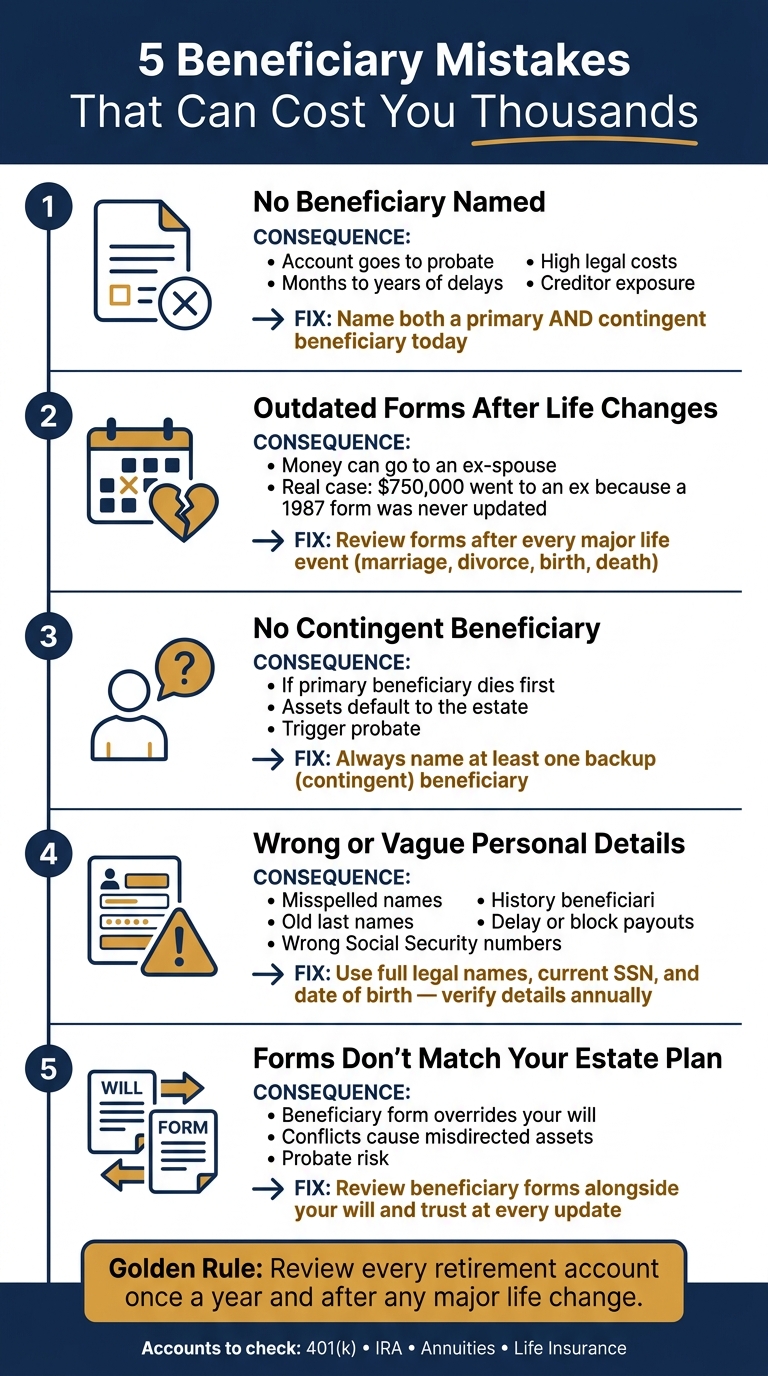
5 Beneficiary Mistakes That Can Cost You Thousands
6 Beneficiary Mistakes That Could Cost Your Family Everything | YBFY May Week 2
sbb-itb-0a60575
1. Not Naming Any Beneficiary At All
If you leave the beneficiary line blank, the account will usually go to your estate or follow the plan’s default rules. That can push the money into probate, which is public, slow, and often expensive.
The tax side can get worse too. When you name an individual beneficiary, that person may be able to take withdrawals over time. An estate usually doesn’t get that same option. As a result, distributions can happen faster, which may lead to a bigger tax bill for heirs. And if the assets pass through your estate, that money may be tapped first to cover debts, medical bills, and court judgments.
The fix is simple: log in to your retirement account portal or contact your plan administrator today. Use full legal names. Name both a primary beneficiary and a contingent beneficiary. Then double-check the spelling. That first move only helps if the form stays up to date.
2. Forgetting To Update After Major Life Changes
You can fill out a beneficiary form the right way and still run into trouble later. Why? Because life moves, but those forms don’t move with it.
Marriage, divorce, remarriage, the birth or adoption of a child, or a beneficiary’s death can all make an old form wrong. The problem isn’t the life change itself. The problem is leaving the old form sitting there after everything else has changed.
That can cost a lot of money. Jeffrey Rolison named his then-girlfriend as his 401(k) beneficiary in 1987. They broke up in 1989, but he never updated the form. When he died in 2015, she received about $750,000 because the old form still controlled.
If a named beneficiary dies and you don’t update the form, the account may end up going to your estate.
The fix: Update your beneficiary forms after any major life event, save the confirmation, and review them once a year.
3. Not Naming Contingent Beneficiaries
Naming a primary beneficiary is a good start. But by itself, it may not be enough.
If that person dies before you or can’t inherit for some other reason, you need a backup plan. That’s where a contingent beneficiary comes in.
A contingent beneficiary inherits only if your primary beneficiary dies before you or can’t be found. Without one, there’s no fallback.
If the primary beneficiary can’t inherit, a contingent beneficiary helps keep the account out of your estate. Without one, the account may default to your estate.
| Scenario | With a Contingent Beneficiary | Without a Contingent Beneficiary |
|---|---|---|
| Primary beneficiary dies first | Assets pass directly to the contingent beneficiary. | Assets typically default to the estate. |
| Speed of transfer | Relatively fast distribution. | Significant delays due to administrative requirements. |
| Costs | Minimal administrative overhead. | Potential for higher costs to heirs. |
Add at least one contingent beneficiary now.
4. Using Vague, Outdated, Or Incorrect Information
Naming a beneficiary isn’t always enough. If the details on the form are wrong, the form can still break down when it matters most. A misspelled name, the wrong Social Security number, or an old last name can hold up payment or even send money to the wrong person if the plan administrator can’t confirm who you meant.
These aren’t harmless typos. Small mistakes can slow the verification process and delay payment to heirs. If the beneficiary can’t be verified, the account may end up passing to your estate instead, which can trigger probate and push distribution back even more.
And the problem doesn’t need to be dramatic. Even a minor mismatch in a name or number can lead to disputes or drag out settlement for months.
The good news? The fix is simple. Log in to each retirement plan or brokerage account and check that every form shows the beneficiary’s full legal name and current identifying details. It usually takes only a few minutes per account. Getting those details right helps keep the payout on track and cuts the odds of a dispute.
5. Not Coordinating Beneficiaries With Your Overall Estate Plan
The last mistake is treating beneficiary forms like they live in a separate lane from the rest of your estate plan.
A lot of people fill out those forms once, then never look at them again. That sounds harmless. It isn’t. Those forms can override your will.
Beneficiary forms on retirement accounts override your will. When beneficiary forms and estate documents conflict, it creates confusion for heirs. If the form and estate plan conflict, the payout can be delayed, misdirected, or forced into probate.
Tax results can also differ by beneficiary and account type.
That’s why it makes sense to review beneficiary forms at the same time you review your will or trust.
The table below shows what each mistake can cost.
Comparison Tables: What Is At Stake With Each Mistake
Beneficiary mistakes can look minor on paper. In practice, they can tie up money, slow payouts, and send assets somewhere you never meant them to go. The tables below make that tradeoff easy to see.
Mistake 1: No beneficiary vs. properly named beneficiary
| Feature | No Beneficiary Named | Beneficiary Properly Named |
|---|---|---|
| Probate or direct transfer | Goes through probate court | Bypasses probate; transfers by contract |
| Timeline | Months to years of delays | Usually distributed within weeks |
| Tax impact | May face faster required withdrawals and less tax flexibility | Spouses can defer; other beneficiaries generally have a 10-year withdrawal window |
| Costs | High probate fees and legal costs | Lower administrative costs |
| Creditor exposure | Assets can be used to pay estate debts | Generally protected from estate creditors |
This is the big one. If no beneficiary is listed, the account often ends up in probate. That means more time, more cost, and more risk that estate debts eat into what loved ones receive.
Mistake 2: Primary only vs. primary plus contingent
| Scenario | Primary Only | Primary + Contingent |
|---|---|---|
| If primary predeceases you | Assets default to the estate; probate is triggered | Assets pass directly to the contingent beneficiary |
| If the primary beneficiary cannot be verified | Distribution is delayed; may require court intervention | Assets pass directly to the contingent beneficiary |
| What one failure can do | One death can undo your entire plan | Provides a reliable safety net regardless of timing |
A contingent beneficiary acts like a backup key. If the first person can’t inherit for any reason, the account still has somewhere to go without falling into the estate.
Mistake 3: Vague or incorrect information vs. clear and complete details
| Information Quality | Vague or Incorrect | Clear and Complete |
|---|---|---|
| Identification | Nicknames or outdated last names cause confusion | Full legal names and current details allow immediate processing |
| Verification | Requires back-and-forth with plan administrators | Efficient, straightforward distribution |
| Conflict risk | Opens the door to family disputes or legal challenges | Minimal risk of confusion or challenge |
This is where small clerical issues turn into delays. A nickname, an old surname, or partial identifying info can force extra review and spark disputes that were easy to avoid.
Mistake 4: Outdated beneficiary details vs. current and accurate details
| Detail | Outdated or Missing | Current and Accurate |
|---|---|---|
| Name on file | Old last name or nickname delays verification | Full legal name matches ID; processed without delay |
| Identifying information | Wrong Social Security number blocks confirmation | Correct details allow immediate payout |
| Result | Account may default to the estate; probate triggered | Assets transfer directly to the intended person |
Even if you filled out the form years ago, life moves on. Marriage, divorce, and name changes can turn a once-correct form into a problem. If the data on file doesn’t line up with current records, payouts can stall fast.
Mistake 5: Beneficiary forms not coordinated with the estate plan vs. fully aligned
| Factor | Not Coordinated | Fully Aligned |
|---|---|---|
| Will vs. form conflict | Beneficiary form overrides the will; assets go to the wrong person | Form and will point to the same outcome |
| Probate risk | Conflicts can force assets into probate | Direct transfer; probate avoided |
| Tax outcome | Mismatched planning may increase tax burden on heirs | Coordinated strategy can reduce tax exposure |
| Review frequency | Forms go years without review; life changes go unrecorded | Forms reviewed alongside the will or trust at each update |
This mistake catches people off guard all the time. They assume the will controls everything, but beneficiary forms often override it. If those documents don’t match, your plan can split in two.
Next, use the checklist below to review your forms after marriage, divorce, a child’s birth, a death, or any account update.
Beneficiary Review Checklist After Major Life Changes
Review your beneficiary forms after marriage, divorce, a birth or adoption, a death, or a new job. That simple habit can help you catch stale forms before they turn into the kinds of problems mentioned above.
Here’s a quick checklist for the life events that tend to trigger updates:
| Life Event | What To Do |
|---|---|
| Marriage | Add your new spouse and update your legal name on all accounts if it changed |
| Divorce | Remove your ex-spouse; don’t assume a divorce decree or state law updates it automatically, and check whether ERISA applies to the account |
| Birth or Adoption | For a minor child, use a trust or custodial arrangement instead of naming the child directly |
| Death of a beneficiary | Replace them immediately to prevent assets from defaulting to your estate |
| New job | Add beneficiaries to your new 401(k) and review any old employer plans |
| Legal name change | Update all forms so names match your current legal identification |
It also makes sense to review beneficiary forms at least once a year, even if nothing major has changed. These accounts tend to pile up over time: IRAs, 401(k)s, annuities, and life insurance policies. And once you have a few of them, it’s easy to lose track of what’s on file and where.
One part people often miss is confirming the update was actually processed. Sending in a form doesn’t prove the provider recorded it. After you make any change, get written confirmation and keep it with your estate documents. Then make sure those beneficiary forms match the rest of your estate plan.
How To Keep Beneficiary Forms Aligned With Your Estate Plan
Any time you make a change, check that each beneficiary form still lines up with your estate plan. Your beneficiary forms need to match your will and trust. If the will and beneficiary form say different things, the beneficiary form usually controls.
That can create a big problem. An old form can still send a 401(k) to an ex-spouse, even if your will says something else. After a divorce or remarriage, update every retirement account form so it reflects what you want now.
If a trust is part of your plan, make sure it’s named the right way and set up to meet IRS rules. That helps retirement assets pass the way your estate plan intends.
It helps to review beneficiary forms at the same time as your will and trust so every document points in the same direction. If your forms and estate documents don’t match, ask a tax advisor or estate planning attorney to look them over, especially if your situation involves minor children, a blended family, or a trust-based plan.
Conclusion
Beneficiary forms can determine where your retirement money ends up. That’s why it makes sense to check them on a regular basis. The fix isn’t hard: review every account now and update the forms before a life event does it for you.
Look at every account, including current and old employer plans, IRAs, and annuities. Make sure each account lists both a primary and contingent beneficiary. Then verify that full legal names, Social Security numbers, and dates of birth are correct.
After a marriage, divorce, birth, adoption, or death, update the forms right away. And don’t stop there – save proof that the change was processed.
It also helps to review your beneficiary forms alongside your will and trust so each document says the same thing.
A smart move is to add beneficiary review to your annual financial checklist. A once-a-year check can keep your forms in line with your wishes.
FAQs
Do beneficiary forms override a will?
Yes. Beneficiary forms usually override a will because they’re tied to a contract with a bank, insurer, or plan provider.
For assets like retirement accounts and life insurance policies, the named beneficiary will usually get the money, even if the will says something different.
Who should I name as a contingent beneficiary?
Name at least one contingent beneficiary as a backup in case your primary beneficiary dies before you or can’t be located.
That extra step helps your assets pass smoothly and according to your wishes.
Can I name a trust or minor child as beneficiary?
Yes. You can name a trust as the beneficiary to manage assets for a minor child, since minors usually can’t legally receive or control retirement assets on their own.
A trust or custodial setup can also help you avoid court-appointed guardianship.
Related Blog Posts
- 10 SMART Financial Goal Examples
- Durable vs. Non-Durable POA: Which Do You Need?
- 10 Common Tax Filing Mistakes To Avoid
- 10 Factors to Consider When Choosing a Guardian

Karla Moss is a CPA and former startup Controller who spent 15 years managing finance at the executive level — including inside a company that grew to unicorn status. She founded Karla & Co. to bring real-world financial clarity to everyday money decisions. She’s based in Phoenix, AZ and writes from personal experience as much as professional expertise.